
Walther von der Vogelweide
Walther von der Vogelweide was a German minstrel singer (c. 1170 – c. 1230). Born 1170, in Austria. Died 1230, in Würzburg. Known for Palästinalied, Unter der Linden and Lieder.
Facts
16 facts · 0 confirmed by two sources · 6 cited · 10 from one source
Where this comes from
Papalocal keeps its own record. It started from these sources; what each one said is kept here as it was copied, so a change on their side never changes this page by itself. Tap one to read its version.
What Wikidata says · copied November 16, 2026 · revision 2568987648
- Described as
- German minstrel singer (c. 1170 – c. 1230)
- Born
- 1170 · 10 references
- Died
- 1230 · 12 references
- Born in
- Austria
- Died in
- Würzburg
- Buried in
- Würzburg · 1 reference
- Citizen of
- Holy Roman Empire
- Occupation
- composer · 1 reference; poet · 2 references; Minnesänger · 1 reference; singer · 1 reference; playwright · 1 reference; writer · 1 reference
- Known for
- Palästinalied; Unter der Linden; Lieder; Sprüche
- Wikipedias with a page
- 62
Wikidata item Q44385 (wikidata.org/wiki/Q44385), public domain (CC0). Copied November 16, 2026.
What Wikipedia says · copied November 16, 2026 · revision 1374230907
Walther von der Vogelweide (Modern German pronunciation: [ˈvaltɐ fɔn deːɐ̯ ˈfoːɡl̩vaɪdə]; c. 1170 – c. 1230) was a Minnesänger who composed and performed love-songs and political songs (Sprüche) in Middle High German. Walther has been described as the greatest German lyrical poet before Goethe; his hundred or so love-songs are widely regarded as the pinnacle of Minnesang, the medieval German courtly love song tradition, and his innovations breathed new life into this genre. He was also the first political poet to write in German, with a considerable body of encomium, satire, invective, and moralising.
Little is known about Walther's life. He was a travelling singer who performed for patrons at various princely courts in the states of the Holy Roman Empire. He is particularly associated with the Babenberg court in Vienna. Later in life he was given a small fief by the future Holy Roman Emperor, Frederick II.
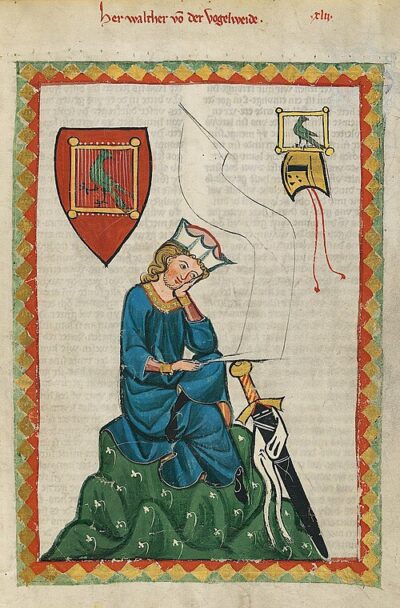
His work was widely celebrated in his time and in succeeding generations—for the Meistersingers he was a songwriter to emulate—and this is reflected in the exceptional preservation of his work in 32 manuscripts from all parts of the High German area. The largest single collection is found in the Codex Manesse, which includes around 90% of his known songs. However, most Minnesang manuscripts preserve only the texts, and only a handful of Walther's melodies survive.
Notable songs include the love-song "Under der linden", the contemplative "Elegy", and the religious "Palästinalied", for which the melody has survived.
From the Wikipedia article “Walther von der Vogelweide” (en.wikipedia.org/wiki/Walther_von_der_Vogelweide), by its contributors, under CC BY-SA 4.0 (creativecommons.org/licenses/by-sa/4.0/). Copied November 16, 2026; not changed.
Confirmed Two sources agree. Cited One source, and it names where it got it. One source One source, without a reference of its own. Sources disagree The sources disagree. We show the best-supported value and keep theirs below.
