
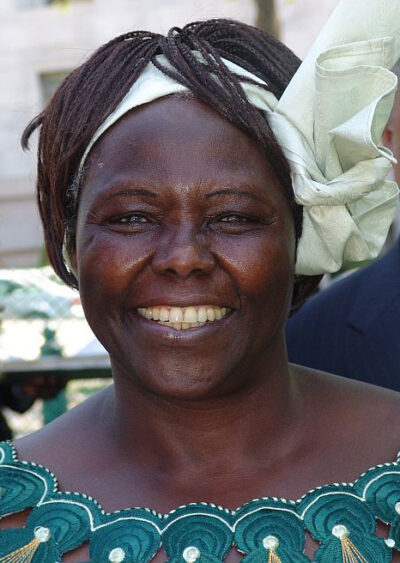
Wangari Muta Maathai
Wangari Muta Maathai was a Kenyan environmentalist and politician who won the Nobel Peace Prize in 2004. Born April 1, 1940, in Nyeri. Died September 25, 2011, in Nairobi. Positions held include Minister of Environment of Kenya (2003–2005) and Member of the National Assembly (2002–2007). Known for Unbowed and The Challenge for Africa. Educated at LMU Munich and University of Nairobi. Awards include Nobel Peace Prize, Knight of the Legion of Honour and Jawaharlal Nehru Award for International Understanding.
Facts
47 facts · 2 confirmed by two sources · 19 cited · 26 from one source
Where this comes from
Papalocal keeps its own record. It started from these sources; what each one said is kept here as it was copied, so a change on their side never changes this page by itself. Tap one to read its version.
What Wikidata says · copied November 16, 2026 · revision 2569517190
- Described as
- Kenyan environmentalist and politician who won the Nobel Peace Prize in 2004 (1940–2011)
- Other names
- Wangari Maathaï, Maathai, WangariMaathai, Wangari Maathai
- Born
- April 1, 1940 · 6 references
- Died
- September 25, 2011 · 6 references
- Born in
- Nyeri · 2 references
- Died in
- Nairobi · 3 references
- Cause of death
- ovarian cancer · 1 reference
- Name at birth
- Wangarĩ Muta
- Citizen of
- Kenya Colony; Kenya
- Occupation
- teacher; politician · 1 reference; philanthropist · 1 reference; biologist · 1 reference; environmentalist
- Positions held
- Minister of Environment of Kenya (2003–2005); Member of the National Assembly (2002–2007)
- Political party
- Mazingira Green Party of Kenya
- Worked for
- Yale University
- Education
- LMU Munich; University of Nairobi (–1971); University of Giessen; University of Pittsburgh (–1966); Benedictine College; Loreto High School, Limuru
- Member of
- Alpha Kappa Alpha; Nobel Women's Initiative · 1 reference
- Known for
- Unbowed; The Challenge for Africa
- Awards
- Nobel Peace Prize (2004) · 2 references; Knight of the Legion of Honour; Jawaharlal Nehru Award for International Understanding (2005) · 1 reference; Right Livelihood Award (1984) · 1 reference; Petra-Kelly-Preis (2004) · 1 reference; Sophie Prize (2004) · 1 reference; Goldman Environmental Prize (1991) · 1 reference; Indira Gandhi Peace Prize (2006) · 1 reference; The Nichols-Chancellor's Medal · 1 reference; NAACP Image Award – Chairman's Award · 1 reference; World Citizenship Award (2007) · 1 reference; Elizabeth Blackwell Award (2008) · 1 reference; Dorothy McCluskey Visiting Fellowship in Conservation (2000) · 1 reference; honorary doctor of Waseda University (2006); Grand Cordon of the Order of the Rising Sun (2009) · 1 reference
- Spouse
- Mwangi Maathai (–1978)
- Children
- Wanjira Mathai; 123
- Religion
- Catholic Church
- Lived in
- Nairobi
- Wikipedias with a page
- 130
Wikidata item Q46795 (wikidata.org/wiki/Q46795), public domain (CC0). Copied November 16, 2026.
What Wikipedia says · copied November 16, 2026 · revision 1385091206
Wangarĩ Maathai (; 1 April 1940 – 25 September 2011) was a Kenyan social, environmental, and political activist who founded the Green Belt Movement, an environmental non-governmental organization focused on planting trees, environmental conservation, and women's rights. In 2004, she became the first African woman to win the Nobel Peace Prize.
As a beneficiary of the Kennedy Airlift, she studied in the United States, earning a bachelor's degree from Mount St. Scholastica College in Atchison, Kansas, and a masters degree from the University of Pittsburgh in Pittsburgh. She then became the first woman in East and Central Africa to become a Doctor of Philosophy, receiving her Ph.D. from the University of Nairobi in Nairobi, Kenya. In 1984, she received the Right Livelihood Award for "converting the Kenyan ecological debate into mass action for reforestation."
Wangari Maathai was an elected member of the parliament of Kenya, and served as the assistant minister for environment and natural resources in the government of President Mwai Kibaki between January 2003 and November 2005. She was an Honorary Councillor in the World Future Council. As an academic and the author of several books, Maathai was not only an activist but also an intellectual who made significant contributions to thinking about ecology, development and gender in addition to African cultures and religions. She died of complications from ovarian cancer on 25 September, 2011.
- Born, in its opening lines
- April 1, 1940
- Died, in its opening lines
- September 25, 2011
From the Wikipedia article “Wangarĩ Maathai” (en.wikipedia.org/wiki/Wangarĩ_Maathai), by its contributors, under CC BY-SA 4.0 (creativecommons.org/licenses/by-sa/4.0/). Copied November 16, 2026; not changed.
Confirmed Two sources agree. Cited One source, and it names where it got it. One source One source, without a reference of its own. Sources disagree The sources disagree. We show the best-supported value and keep theirs below.
