
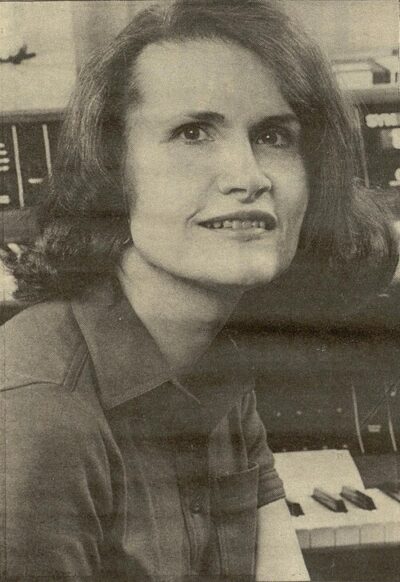
Wendy Carlos
Wendy Carlos is an American composer and electronic musician. Born November 14, 1939, in Pawtucket. Known for Switched-On Bach. Educated at Brown University and Columbia University. Awards include Grammy Awards and SEAMUS Lifetime Achievement Award.
Facts
19 facts · 1 confirmed by two sources · 5 cited · 13 from one source
Where this comes from
Papalocal keeps its own record. It started from these sources; what each one said is kept here as it was copied, so a change on their side never changes this page by itself. Tap one to read its version.
What Wikidata says · copied November 15, 2026 · revision 2563745546
- Described as
- American composer and electronic musician (born 1939)
- Other names
- Walter Carlos
- Born
- November 14, 1939 · 4 references
- Born in
- Pawtucket · 2 references
- Name at birth
- Walter Carlos
- Citizen of
- United States
- Occupation
- composer · 4 references; record producer; film score composer; music arranger · 1 reference; musician · 1 reference
- Worked for
- Computer Music Center · 1 reference
- Education
- Brown University; Columbia University
- Genre
- electronic music
- Instrument
- synthesizer
- Record label
- Columbia Masterworks
- Known for
- Switched-On Bach · 1 reference
- Awards
- Grammy Awards · 1 reference; SEAMUS Lifetime Achievement Award (2005) · 2 references
- Website
- https://www.wendycarlos.com/
- Wikipedias with a page
- 38
Wikidata item Q44641 (wikidata.org/wiki/Q44641), public domain (CC0). Copied November 15, 2026.
What Wikipedia says · copied November 15, 2026 · revision 1383791016
Wendy Carlos (born Walter Carlos, November 14, 1939) is an American musician and composer known for electronic music and film scores.
Born and raised in Rhode Island, Carlos studied physics and music at Brown University before moving to New York City in 1962 to study music composition at Columbia University. Studying and working with various electronic musicians and technicians at the city's Columbia-Princeton Electronic Music Center, she helped in the development of the Moog synthesizer, Robert Moog's first commercially available keyboard instrument.
Carlos came to prominence with Switched-On Bach (1968), an album of music by Johann Sebastian Bach performed on a Moog synthesizer, which helped popularize its use in the 1970s and won her three Grammy Awards. Its commercial success led to several more albums, including further synthesized classical music adaptations, and experimental and ambient music. She composed the score to two Stanley Kubrick films, A Clockwork Orange (1971) and The Shining (1980), and for Tron (1982) for Walt Disney Productions.
In 1979, Carlos raised public awareness of transgender issues by disclosing she had been living as a woman since at least 1968, and in 1972 had undergone gender-affirming surgery.
- Born, in its opening lines
- November 14, 1939
From the Wikipedia article “Wendy Carlos” (en.wikipedia.org/wiki/Wendy_Carlos), by its contributors, under CC BY-SA 4.0 (creativecommons.org/licenses/by-sa/4.0/). Copied November 15, 2026; not changed.
Confirmed Two sources agree. Cited One source, and it names where it got it. One source One source, without a reference of its own. Sources disagree The sources disagree. We show the best-supported value and keep theirs below.
