
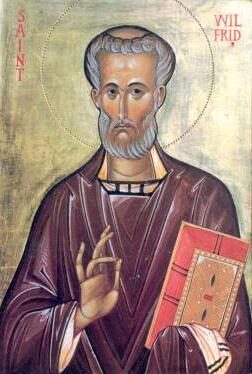
Wilfrid
Wilfrid was a Christian saint, Bishop of York from 664 to 678. Born 634, in Kingdom of Northumbria. Died 709, in Oundle. Positions held include abbot, bishop of York (2 times) (669–) and diocesan bishop (692–).
Facts
13 facts · 1 confirmed by two sources · 3 cited · 8 from one source · 1 where the sources disagree
What’s different
- Born: we show 634 (Sources disagree). Wikipedia says 633
Where this comes from
Papalocal keeps its own record. It started from these sources; what each one said is kept here as it was copied, so a change on their side never changes this page by itself. Tap one to read its version.
What Wikidata says · copied November 17, 2026 · revision 2562790931
- Described as
- Christian saint, Bishop of York from 664 to 678
- Other names
- St. Wilfrid, St Wilfred, Saint Wilfred
- Born
- 634 · 4 references
- Died
- 709
- Born in
- Kingdom of Northumbria
- Died in
- Oundle
- Occupation
- Latin Catholic priest; Catholic bishop · 1 reference
- Positions held
- abbot; bishop of York (2 times) (669–) · 2 references; diocesan bishop (692–) · 2 references; Roman Catholic Bishop of Hexham (705–) · 2 references; bishop · 1 reference
- Field
- Christianity · 1 reference
- Religion
- Catholic Church · 1 reference
- Wikipedias with a page
- 24
Wikidata item Q719721 (wikidata.org/wiki/Q719721), public domain (CC0). Copied November 17, 2026.
What Wikipedia says · copied November 17, 2026 · revision 1383905579
Wilfrid (c. 633 – 709 or 710) was an English bishop and saint. Born a Northumbrian noble, he entered religious life as a teenager and studied at Lindisfarne, at Canterbury, in Francia, and in Rome; he returned to Northumbria in about 660, and became the abbot of a newly founded monastery at Ripon. In 664, Wilfrid acted as spokesman for the Roman position at the Synod of Whitby, and became famous for his speech advocating that the Roman method for calculating the date of Easter should be adopted. His success prompted the king's son, Alhfrith, to appoint him Bishop of Northumbria. Wilfrid chose to be consecrated in Gaul because of the lack of what he considered to be validly consecrated bishops in England at that time. During Wilfrid's absence, Alhfrith seems to have led an unsuccessful revolt against his father, Oswiu, leaving a question mark over Wilfrid's appointment as bishop. Before Wilfrid's return, Oswiu had appointed Ceadda in his place, resulting in Wilfrid's retirement to Ripon for a few years following his arrival back in Northumbria.
After becoming Archbishop of Canterbury in 668, Theodore of Tarsus resolved the situation by deposing Ceadda and restoring Wilfrid as the Bishop of Northumbria. For the next nine years, Wilfrid discharged his episcopal duties, founded monasteries, built churches, and improved the liturgy. However, his diocese was very large, and Theodore wished to reform the English Church, a process which included breaking up some of the larger dioceses into smaller ones. When Wilfrid quarrelled with Ecgfrith, the Northumbrian king, Theodore took the opportunity to implement his reforms despite Wilfrid's objections. After Ecgfrith expelled him from York, Wilfrid travelled to Rome to appeal to the papacy. Pope Agatho ruled in Wilfrid's favour, but Ecgfrith refused to honour the papal decree and instead imprisoned Wilfrid on his return to Northumbria before exiling him.
Wilfrid spent the next few years in Selsey, now in West Sussex, where he founded an episcopal see and converted the pagan inhabitants of the Kingdom of Sussex to Christianity. Theodore and Wilfrid settled their differences, and Theodore urged the new Northumbrian king, Aldfrith, to allow Wilfrid's return. Aldfrith agreed to do so, but in 691, he expelled Wilfrid again. Wilfrid went to Mercia, where he helped missionaries and acted as bishop for the Mercian king. Wilfrid appealed to the papacy about his expulsion in 700, and the pope ordered that an English council should be held to decide the issue. This council, held at Austerfield in South Yorkshire in 702, attempted to confiscate all of Wilfrid's possessions, and so Wilfrid travelled to Rome to appeal against the decision. His opponents in Northumbria excommunicated him, but the papacy upheld Wilfrid's side, and he regained possession of Ripon and Hexham, his Northumbrian monasteries. Wilfrid died in 709 or 710. After his death, he was venerated as a saint.
Historians then and now have been divided over Wilfrid. His followers commissioned Stephen of Ripon to write a Vita Sancti Wilfrithi (or Life of Saint Wilfrid) shortly after his death, and the medieval historian Bede also wrote extensively about him. Wilfrid lived ostentatiously and travelled with a large retinue. He ruled a large number of monasteries, and claimed to be the first Englishman to introduce the Rule of Saint Benedict into English monasteries. Some modern historians see him mainly as a champion of Roman customs against the customs of the British and Irish churches, others as an advocate for monasticism.
- Born, in its opening lines
- 633
- Died, in its opening lines
- 709
From the Wikipedia article “Wilfrid” (en.wikipedia.org/wiki/Wilfrid), by its contributors, under CC BY-SA 4.0 (creativecommons.org/licenses/by-sa/4.0/). Copied November 17, 2026; not changed.
Confirmed Two sources agree. Cited One source, and it names where it got it. One source One source, without a reference of its own. Sources disagree The sources disagree. We show the best-supported value and keep theirs below.
