
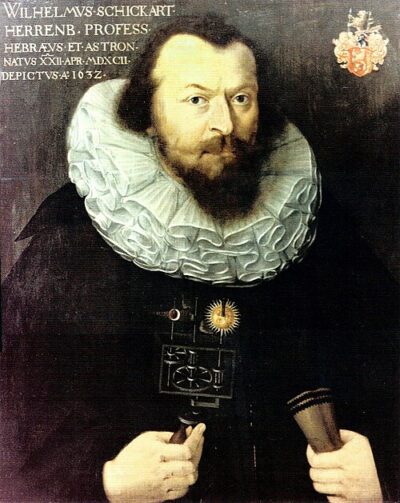
Wilhelm Schickard
Wilhelm Schickard was a German astronomer, mathematician. Born April 22, 1592, in Herrenberg. Died October 23, 1635, in Tübingen. Educated at University of Tübingen and Bebenhausen Abbey.
Facts
24 facts · 1 confirmed by two sources · 16 cited · 6 from one source · 1 where the sources disagree
What’s different
- Died: we show October 23, 1635 (Sources disagree). Wikipedia says October 24, 1635
Where this comes from
Papalocal keeps its own record. It started from these sources; what each one said is kept here as it was copied, so a change on their side never changes this page by itself. Tap one to read its version.
What Wikidata says · copied November 16, 2026 · revision 2568919948
- Described as
- German astronomer, mathematician
- Born
- April 22, 1592 · 8 references
- Died
- October 23, 1635 · 4 references
- Born in
- Herrenberg · 3 references
- Died in
- Tübingen · 3 references
- Cause of death
- plague
- Citizen of
- Duchy of Württemberg · 1 reference
- Occupation
- mathematician · 2 references; astronomer · 2 references; orientalist · 2 references; computer scientist; university teacher · 2 references; theologian · 2 references; geographer · 2 references; cartographer · 2 references
- Worked for
- University of Tübingen (1619–1635) · 1 reference
- Education
- University of Tübingen (1606–1613) · 1 reference; Bebenhausen Abbey (1603–1606) · 1 reference
- Field
- mathematics; oriental studies
- Spouse
- Sabina Schickard · 1 reference
- Children
- Ursula Margaretha Schickard · 1 reference
- Father
- Lucas Schickhardt · 1 reference
- Siblings
- Lucas Schickhardt
- Religion
- Lutheranism
- Wikipedias with a page
- 36
Wikidata item Q57403 (wikidata.org/wiki/Q57403), public domain (CC0). Copied November 16, 2026.
What Wikipedia says · copied November 16, 2026 · revision 1352580866
Wilhelm Schickard (22 April 1592 – 24 October 1635) was a German professor of Hebrew and astronomy who became famous in the second part of the 20th century after Franz Hammer, a biographer (along with Max Caspar) of Johannes Kepler, claimed that the drawings of a calculating clock, predating the public release of Pascal's calculator by twenty years, had been discovered in two unknown letters written by Schickard to Johannes Kepler in 1623 and 1624.
Hammer asserted that because these letters had been lost for three hundred years, Blaise Pascal had been called and celebrated as the inventor of the mechanical calculator in error during all this time.
After careful examination it was found that Schickard's drawings had been published at least once per century starting from 1718, that his machine was not complete and required additional wheels and springs and that it was designed around a single tooth carry mechanism that didn't work properly when used in calculating clocks.
Schickard's machine was the first of several designs of direct entry calculating machines in the 17th century (including the designs of Blaise Pascal, Tito Burattini, Samuel Morland and René Grillet). The Schickard machine was particularly notable for its integration of an ingenious system of rotated Napier's bones for multiplication with a first known design for an adding machine, operated by rotating knobs for input, and with a register of rotated numbers showing in windows for output. Taton has argued that Schickard's work had no impact on the development of mechanical calculators. However, whilst there can be debate about what constitutes a "mechanical calculator" later devices, such as Moreland's multiplying and adding instruments when used together, Caspar Schott's Cistula, René Grillet's machine arithmétique, and Claude Perrault's rhabdologique at the end of the century, and later, the Bamberger Omega developed in the early 20th century, certainly followed the same path pioneered by Schickard with his ground breaking combination of a form of Napier's bones and adding machine designed to assist multiplication.
Schickard has been called "the father of the computer age".
- Born, in its opening lines
- April 22, 1592
- Died, in its opening lines
- October 24, 1635
From the Wikipedia article “Wilhelm Schickard” (en.wikipedia.org/wiki/Wilhelm_Schickard), by its contributors, under CC BY-SA 4.0 (creativecommons.org/licenses/by-sa/4.0/). Copied November 16, 2026; not changed.
Confirmed Two sources agree. Cited One source, and it names where it got it. One source One source, without a reference of its own. Sources disagree The sources disagree. We show the best-supported value and keep theirs below.
