
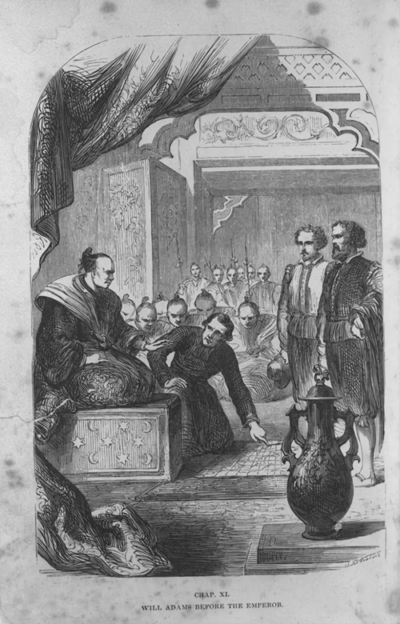
William Adams
William Adams was an English navigator who travelled to Japan. Born September 24, 1564, in Gillingham. Died May 16, 1620, in Hirado Island.
Facts
16 facts · 2 confirmed by two sources · 2 cited · 11 from one source · 1 where the sources disagree
What’s different
- Buried in: we show Anjinzuka (Sources disagree). Wikidata also lists Sakikata Park
Where this comes from
Papalocal keeps its own record. It started from these sources; what each one said is kept here as it was copied, so a change on their side never changes this page by itself. Tap one to read its version.
What Wikidata says · copied November 16, 2026 · revision 2558281734
- Described as
- English navigator who travelled to Japan
- Other names
- Anjin-sama, Anjin Miura, William Adams (1564-1620), Wiliam Adams (1564-1620), Wiliam Adams, Will Adams
- Born
- September 24, 1564 · 1 reference
- Died
- May 16, 1620 · 6 references
- Born in
- Gillingham
- Died in
- Hirado Island · 1 reference
- Buried in
- Anjinzuka; Sakikata Park
- Citizen of
- Kingdom of England
- Occupation
- explorer; sailor; navigator; castaway; government advisor; seafarer · 1 reference
- Children
- Joseph Adams
- Religion
- Anglicanism
- Military branch
- Royal Navy
- Lived in
- Nihonbashi-Muromachi
- Wikipedias with a page
- 37
Wikidata item Q313866 (wikidata.org/wiki/Q313866), public domain (CC0). Copied November 16, 2026.
What Wikipedia says · copied November 16, 2026 · revision 1385143117
William Adams (24 September 1564 – 16 May 1620), better known in Japan as Miura Anjin (三浦按針; 'the pilot of Miura'), was an English navigator who, in 1600, became the first Englishman to reach Japan. He was later granted hatamoto status, and was recognised as one of the most influential foreigners in Japan during the early 17th century.
He arrived in Japan as one of the few survivors of the ship Liefde under the leadership of Jacob Quaeckernaeck. It was the only vessel to reach Japan from a five-ship expedition launched by a company of Rotterdam merchants (a voorcompagnie, or predecessor, of the Dutch East India Company). Soon after his arrival in Japan, Adams and his second mate Jan Joosten became advisors to shōgun Tokugawa Ieyasu.
Among Adams's legacies was his promotion of a policy of religious intolerance aimed particularly at Catholics, which later developed into a centuries-long policy of religious persecution directed primarily against Europeans and Christians of all denominations, eventually extending to Japanese converts as well. He also influenced the development of Japan's isolationist sakoku policy, under which interactions with other countries were severely restricted, almost all foreign nationals were barred from entering Japan, and Japanese commoners were prohibited from leaving the country.
For more than a decade, the Tokugawa authorities did not allow Adams and Joosten to leave Japan. Although he was eventually granted permission to return to England, Adams chose to remain in Japan, where he died at the age of 55. His Japan-born children, Joseph and Susanna, were likely expelled to Batavia in 1635, when Tokugawa Iemitsu closed Japan to foreign trade; after that, they disappear from the historical record.
- Born, in its opening lines
- September 24, 1564
- Died, in its opening lines
- May 16, 1620
From the Wikipedia article “William Adams (samurai)” (en.wikipedia.org/wiki/William_Adams_(samurai)), by its contributors, under CC BY-SA 4.0 (creativecommons.org/licenses/by-sa/4.0/). Copied November 16, 2026; not changed.
Confirmed Two sources agree. Cited One source, and it names where it got it. One source One source, without a reference of its own. Sources disagree The sources disagree. We show the best-supported value and keep theirs below.
