
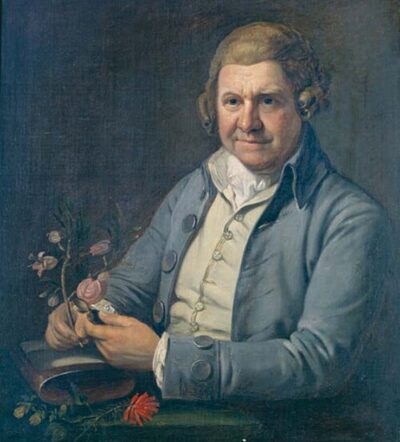
William Aiton
William Aiton was a British botanist. Born 1731, in Hamilton. Died February 2, 1793, in Richmond.
Facts
12 facts · 2 confirmed by two sources · 3 cited · 7 from one source
Where this comes from
Papalocal keeps its own record. It started from these sources; what each one said is kept here as it was copied, so a change on their side never changes this page by itself. Tap one to read its version.
What Wikidata says · copied November 16, 2026 · revision 2563095261
- Described as
- British botanist (1731-1793)
- Other names
- Wm. Aiton, Aiton, Ait.
- Born
- 1731 · 14 references
- Died
- February 2, 1793 · 3 references
- Born in
- Hamilton
- Died in
- Richmond
- Buried in
- St Anne's Church, Kew
- Citizen of
- Kingdom of Great Britain
- Occupation
- horticulturist; botanist · 1 reference; pteridologist
- Worked for
- Kew Gardens · 1 reference
- Field
- botany · 1 reference
- Children
- William Townsend Aiton · 1 reference
- Wikipedias with a page
- 34
Wikidata item Q465898 (wikidata.org/wiki/Q465898), public domain (CC0). Copied November 16, 2026.
What Wikipedia says · copied November 16, 2026 · revision 1368872292
William Aiton (1731 – 2 February 1793) was a Scottish botanist.
Aiton was born near Hamilton. Having been regularly trained to the profession of a gardener, he travelled to London in 1754, and became assistant to Philip Miller, then superintendent of the Chelsea Physic Garden. In 1759 he was appointed director of the newly established botanical garden at Kew, where he remained until his death. He effected many improvements at the gardens, and in 1789 he published Hortus Kewensis, a catalogue of the plants cultivated there. He is buried at nearby St. Anne's Church, Kew.
A second and enlarged edition of the Hortus was brought out in 1810–1813 by his eldest son, William Townsend Aiton.
Aiton is commemorated in the specific epithet aitonis.
In 1789, he classified the Sampaguita plant to the Jasminum genus and also named it as Arabian Jasmine because it was believed that the plant originated from The Arabian Peninsula although the plant didn't originate from Arabia.
- Born, in its opening lines
- 1731
- Died, in its opening lines
- February 2, 1793
From the Wikipedia article “William Aiton” (en.wikipedia.org/wiki/William_Aiton), by its contributors, under CC BY-SA 4.0 (creativecommons.org/licenses/by-sa/4.0/). Copied November 16, 2026; not changed.
Confirmed Two sources agree. Cited One source, and it names where it got it. One source One source, without a reference of its own. Sources disagree The sources disagree. We show the best-supported value and keep theirs below.
