
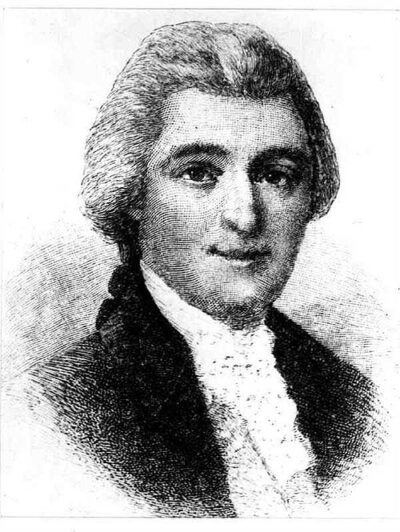
William Blount
William Blount was an American statesman and land speculator who signed the United States Constitution. Born March 26, 1749, in Windsor. Died March 21, 1800, in Knoxville. Positions held include Speaker of the Tennessee Senate, member of the State Senate of Tennessee and United States senator (1796–1797).
Facts
17 facts · 1 confirmed by two sources · 3 cited · 12 from one source · 1 where the sources disagree
What’s different
- Born: we show March 26, 1749 (Sources disagree). Wikipedia says April 6, 1749
Where this comes from
Papalocal keeps its own record. It started from these sources; what each one said is kept here as it was copied, so a change on their side never changes this page by itself. Tap one to read its version.
What Wikidata says · copied November 16, 2026 · revision 2553890865
- Described as
- American statesman and land speculator who signed the United States Constitution (1749-1800)
- Born
- March 26, 1749 · 4 references
- Died
- March 21, 1800 · 5 references
- Born in
- Windsor
- Died in
- Knoxville
- Buried in
- Tennessee
- Citizen of
- United States
- Occupation
- politician
- Positions held
- Speaker of the Tennessee Senate; member of the State Senate of Tennessee; United States senator (1796–1797) · 1 reference; member of the North Carolina Senate; Delegate to the United States Constitutional Convention (1787) · 1 reference; Speaker of the North Carolina House of Commons; member of the North Carolina House of Commons
- Political party
- Democratic-Republican Party
- Children
- William Grainger Blount
- Father
- Jacob Blount · 1 reference
- Wikipedias with a page
- 20
Wikidata item Q767446 (wikidata.org/wiki/Q767446), public domain (CC0). Copied November 16, 2026.
What Wikipedia says · copied November 16, 2026 · revision 1382264856
William Blount ( BLUNT; April 6, 1749 – March 21, 1800) was an American politician, landowner and Founding Father who was one of the signers of the Constitution of the United States. He was a member of the North Carolina delegation at the Constitutional Convention of 1787 and led the efforts for North Carolina to ratify the Constitution in 1789 at the Fayetteville Convention. He then served as the only governor of the Southwest Territory and played a leading role in helping the territory gain admission to the union as the state of Tennessee. He was selected as one of Tennessee's initial United States Senators in 1796, serving until he was expelled for treason in 1797.
Born to a prominent North Carolina family, Blount served as a paymaster during the American Revolutionary War. He was elected to the North Carolina legislature in 1781, where he remained in one role or another for most of the decade, except for two terms in the Continental Congress in 1782 and 1786. Blount pushed efforts in the legislature to open the lands west of the Appalachians to settlement. As governor of the Southwest Territory, he negotiated the Treaty of Holston in 1791, bringing thousands of acres of Indian lands under U.S. control.
An aggressive land speculator, Blount gradually acquired millions of acres in Tennessee and the Trans-Appalachian West. His risky land investments left him in debt, and in the 1790s, he conspired of his own accord to have Great Britain take over Spanish-controlled Louisiana and Florida in the hope of boosting local land prices. When the conspiracy was uncovered in 1797, he was expelled from the Senate and became the first federal official to face impeachment. However, Blount remained popular in Tennessee and served in the state senate during the last years of his life.
- Born, in its opening lines
- April 6, 1749
- Died, in its opening lines
- March 21, 1800
From the Wikipedia article “William Blount” (en.wikipedia.org/wiki/William_Blount), by its contributors, under CC BY-SA 4.0 (creativecommons.org/licenses/by-sa/4.0/). Copied November 16, 2026; not changed.
Confirmed Two sources agree. Cited One source, and it names where it got it. One source One source, without a reference of its own. Sources disagree The sources disagree. We show the best-supported value and keep theirs below.
