
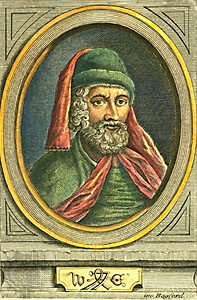
William Caxton
William Caxton was an English merchant and printer (c. 1422–c. 1491). Born 1422, in Hadlow. Died March 1492, in London. Known for The Game and Playe of the Chesse, Recuyell of the Historyes of Troye and The history of Jason.
Facts
23 facts · 0 confirmed by two sources · 7 cited · 16 from one source
Where this comes from
Papalocal keeps its own record. It started from these sources; what each one said is kept here as it was copied, so a change on their side never changes this page by itself. Tap one to read its version.
What Wikidata says · copied November 16, 2026 · revision 2569114124
- Described as
- English merchant and printer (c. 1422–c. 1491)
- Born
- 1422 · 11 references
- Died
- March 1492 · 1 reference
- Born in
- Hadlow
- Died in
- London
- Buried in
- St Margaret's Church, Westminster
- Citizen of
- Kingdom of England
- Occupation
- linguist; translator · 1 reference; writer · 2 references; publisher · 2 references; diplomat · 1 reference; printer; book printer · 1 reference
- Known for
- The Game and Playe of the Chesse; Recuyell of the Historyes of Troye; The history of Jason; Esope; Eneydos; Paris and Vienne; The lyff of the olde auncyent holy faders hermytes; The craft for to die for the health of man's soule; The four sons of Aymon; The boke of the fayt of armes and of chyvalrye
- Wikipedias with a page
- 50
Wikidata item Q94608 (wikidata.org/wiki/Q94608), public domain (CC0). Copied November 16, 2026.
What Wikipedia says · copied November 16, 2026 · revision 1381111290
William Caxton (c. 1422 – c. 1491) was an English merchant, diplomat and writer. He is thought to be the first person to introduce a printing press into England in 1476, and as a printer to be the first English retailer of printed books.
His parentage and date of birth are not known for certain, but he may have been born between 1415 and 1424, perhaps in the Weald or wood land of Kent, perhaps in Hadlow or Tenterden. In 1438 he was apprenticed to Robert Large, a wealthy London silk mercer.
Shortly after Large's death, Caxton moved to Bruges, Flanders, a wealthy cultured city in which he was settled by 1450. Successful in business, he became governor of the Company of Merchant Adventurers of London; on his business travels, he observed the new printing industry in Cologne, which led him to start a printing press in Bruges in collaboration with Colard Mansion. When Margaret of York, sister of Edward IV, married the Duke of Burgundy, they moved to Bruges and befriended Caxton. Margaret encouraged Caxton to complete his translation of the Recuyell of the Historyes of Troye, a collection of stories associated with Homer's Iliad, which he did in 1471.
On his return to England, heavy demand for his translation prompted Caxton to set up a press at Westminster in 1476. Although the first book that he is known to have produced was an edition of Chaucer's The Canterbury Tales, he went on to publish chivalric romances, classical works and English and Roman histories and to edit many others. He was the first to translate Aesop's Fables in 1484. Caxton was not an adequate translator, and under pressure to publish as much as possible as quickly as possible, he sometimes simply transferred French words into English; but because of the success of his translations, he is credited with helping to promote Chancery Standard (a London dialect of Middle English) that he used to the status of standard dialect throughout England.
In 2002, Caxton was named among the 100 Greatest Britons in a BBC poll.
From the Wikipedia article “William Caxton” (en.wikipedia.org/wiki/William_Caxton), by its contributors, under CC BY-SA 4.0 (creativecommons.org/licenses/by-sa/4.0/). Copied November 16, 2026; not changed.
Confirmed Two sources agree. Cited One source, and it names where it got it. One source One source, without a reference of its own. Sources disagree The sources disagree. We show the best-supported value and keep theirs below.
