
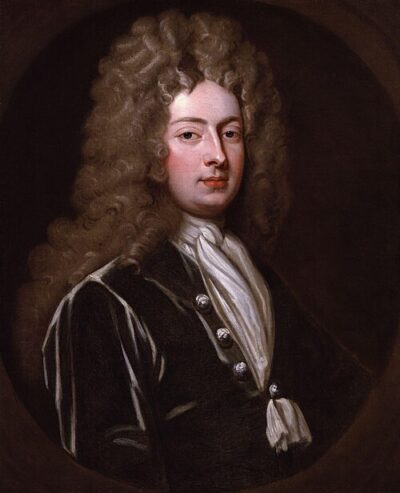
William Congreve
William Congreve was a British writer. Born January 24, 1670, in Leeds. Died January 19, 1729, in London. Educated at Kilkenny College.
Facts
14 facts · 2 confirmed by two sources · 5 cited · 7 from one source
Where this comes from
Papalocal keeps its own record. It started from these sources; what each one said is kept here as it was copied, so a change on their side never changes this page by itself. Tap one to read its version.
What Wikidata says · copied November 16, 2026 · revision 2558282145
- Described as
- British writer (1670-1729)
- Born
- January 24, 1670 · 10 references
- Died
- January 19, 1729 · 10 references
- Born in
- Leeds
- Died in
- London · 1 reference
- Buried in
- Westminster Abbey
- Citizen of
- Kingdom of Great Britain
- Occupation
- playwright · 1 reference; poet; writer · 2 references; translator; engineer; librettist · 1 reference
- Education
- Kilkenny College
- Children
- Mary Osborne, Duchess of Leeds · 1 reference
- Wikipedias with a page
- 50
Wikidata item Q366805 (wikidata.org/wiki/Q366805), public domain (CC0). Copied November 16, 2026.
What Wikipedia says · copied November 16, 2026 · revision 1384113484
William Congreve (24 January 1670 – 19 January 1729) was an English playwright, satirist and poet. He played a major role in shaping English comedy, and is often regarded by literary critics as one of the greatest playwrights of the Restoration period. The popularity of his plays in the late 17th and early 18th centuries was central to the development of satirical comedy of manners, and he became recognised as a seminal figure of Restoration literature. Although he wrote several commercially successful works, Congreve is best remembered today for his quotes, such as, "O fie, miss, you must not kiss and tell", and "Hell hath no fury like a woman scorned".
He spent most of his early career between London and Dublin, during which time he was an apprentice to the English poet John Dryden and became noted for his highly polished style of writing. He initially wrote under the pseudonym Cleophil, and first achieved widespread fame beginning in 1693 when he produced some of the most popular English plays of the time. Congreve's best-known works include his plays The Way of the World (1700), which is regarded by commentators as a centerpiece of Restoration comedy literature, and The Mourning Bride (1697).
He wrote the majority of his works in London, and his plays and poems, which formed a major component of Restoration literature, were favorably viewed by the audience for their use of satire and comedy. During this time, Congreve also wrote several other notable works, such as The Old Bachelor (1693), The Double Dealer (1693), and Love for Love (1695), all of which helped establish him as one of the foremost writers in the comedy of manners genre. The majority of the stage plays of his time were dominated by female performers, and he formed a personal friendship with the English actress Anne Bracegirdle who played a leading role in many of his works. Despite this, his literary career only lasted seven years (from 1693 to 1700) and he wrote a total of five plays.
Congreve may have been forced off the stage due to growing concerns about the public perception of morality regarding his theatrical comedies. After leaving the theatrical stage, he remained active in political circles with the Whigs party during the early 18th century. Although he lived until 1729, he did not produce any plays after 1700, and when he died in London, he was honored with burial at the Poets' Corner in Westminster Abbey. Congreve remains a popular and polarising figure in English literature, and his works continue to be studied in literary circles.
- Born, in its opening lines
- January 24, 1670
- Died, in its opening lines
- January 19, 1729
From the Wikipedia article “William Congreve” (en.wikipedia.org/wiki/William_Congreve), by its contributors, under CC BY-SA 4.0 (creativecommons.org/licenses/by-sa/4.0/). Copied November 16, 2026; not changed.
Confirmed Two sources agree. Cited One source, and it names where it got it. One source One source, without a reference of its own. Sources disagree The sources disagree. We show the best-supported value and keep theirs below.
