
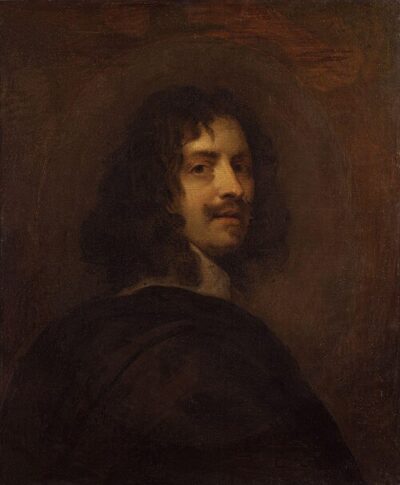
William Dobson
William Dobson was an English portrait painter. Born February 24, 1610, in London. Died October 28, 1646, in Oxford. Positions held include court painter. Known for Prince of Wales.
Facts
10 facts · 1 confirmed by two sources · 6 cited · 2 from one source · 1 where the sources disagree
What’s different
- Born: we show February 24, 1610 (Sources disagree). Wikipedia says March 4, 1611
Where this comes from
Papalocal keeps its own record. It started from these sources; what each one said is kept here as it was copied, so a change on their side never changes this page by itself. Tap one to read its version.
What Wikidata says · copied November 18, 2026 · revision 2568967009
- Described as
- English portrait painter (1610-1646)
- Other names
- William Dobson the Dwarf, E. Dobson, Dobson, Dopsoon, A. Dobson, Dobson the Dwarf, Mr. Dobson
- Born
- February 24, 1610
- Died
- October 28, 1646
- Born in
- London · 2 references
- Died in
- Oxford · 1 reference
- Buried in
- St Martin-in-the-Fields · 1 reference
- Citizen of
- Kingdom of England
- Occupation
- painter · 2 references
- Positions held
- court painter · 1 reference
- Genre
- portrait painting · 1 reference
- Known for
- Prince of Wales
- Wikipedias with a page
- 23
Wikidata item Q58303 (wikidata.org/wiki/Q58303), public domain (CC0). Copied November 18, 2026.
What Wikipedia says · copied November 18, 2026 · revision 1380301815
William Dobson (4 March 1611 (baptised); 28 October 1646 (buried)) was an English painter who specialised in portrait painting. One of the first significant English painters, he was praised by his contemporary John Aubrey as "the most excellent painter that England has yet bred". The art critic Waldemar Januszczak describes him as the first British born painter of genius.
After Dobson's first apprenticeship he joined the studio of the German-born artists Francis Cleyn. It is possible Dobson had access to the Royal Collection and copied works by Titian and Anthony van Dyck. Little is known of Dobson's career in the 1630s.
After van Dyck’s death in 1641, Dobson was able to gain royal commissions from Charles I of England. One unverified source claimed that he become serjeant painter to Charles, and Groom of the Chamber. It is not known how he gained an introduction to the king. Dobson's final years were disrupted by the English Civil War, which forced him to be based with the royal court at Oxford. There he painted leading cavaliers such as Charles Lucas, John Byron, 1st Baron Byron, Prince Rupert of the Rhine, and Maurice, Prince Palatine of the Rhine. Most of his surviving works are half-length portraits that date from 1642. There is evidence that his materials became increasingly scarce during the war. He returned to London in 1646, where he died in poverty at the age of 35.
There are examples of Dobson's paintings in art galleries in the UK, the US, and in New Zealand, as well as in several English country houses.
- Born, in its opening lines
- March 4, 1611
- Died, in its opening lines
- October 28, 1646
From the Wikipedia article “William Dobson” (en.wikipedia.org/wiki/William_Dobson), by its contributors, under CC BY-SA 4.0 (creativecommons.org/licenses/by-sa/4.0/). Copied November 18, 2026; not changed.
Confirmed Two sources agree. Cited One source, and it names where it got it. One source One source, without a reference of its own. Sources disagree The sources disagree. We show the best-supported value and keep theirs below.
