
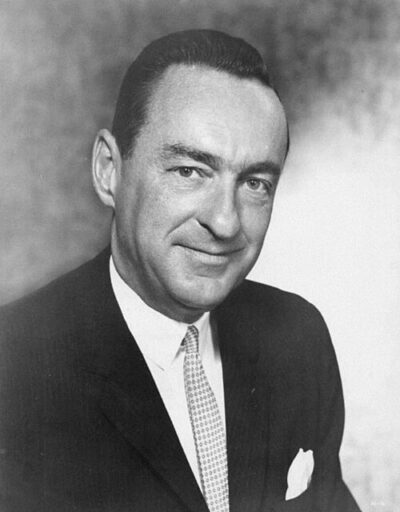
William E. Miller
William E. Miller was an American politician. Born March 22, 1914, in Lockport. Died June 24, 1983, in Buffalo. Positions held include United States representative (1951–1965). Educated at Lockport High School and University of Notre Dame.
Facts
20 facts · 2 confirmed by two sources · 9 cited · 9 from one source
Where this comes from
Papalocal keeps its own record. It started from these sources; what each one said is kept here as it was copied, so a change on their side never changes this page by itself. Tap one to read its version.
What Wikidata says · copied November 18, 2026 · revision 2566945111
- Described as
- American politician (1914–1983)
- Other names
- William Edward Miller, W.E. Miller, 1st Lt. W.E. Miller
- Born
- March 22, 1914 · 3 references
- Died
- June 24, 1983 · 3 references
- Born in
- Lockport · 1 reference
- Died in
- Buffalo · 1 reference
- Buried in
- Arlington National Cemetery (1983) · 1 reference
- Cause of death
- stroke · 1 reference
- Citizen of
- United States
- Occupation
- politician · 1 reference; lawyer · 1 reference
- Positions held
- United States representative (1951–1965)
- Political party
- Republican Party
- Worked for
- United States District Court for the Western District of New York (1942–); Republican National Committee (1961–1964)
- Education
- Lockport High School (–1931) · 1 reference; University of Notre Dame (–1935); Albany Law School (–1938)
- Field
- war crime (1945) · 2 references
- Children
- Stephanie Miller
- Military branch
- United States Army · 2 references
- Military rank
- first lieutenant · 1 reference
- Wikipedias with a page
- 16
Wikidata item Q1383137 (wikidata.org/wiki/Q1383137), public domain (CC0). Copied November 18, 2026.
What Wikipedia says · copied November 18, 2026 · revision 1364813748
William Edward Miller (March 22, 1914 – June 24, 1983) was an American politician who served in the United States House of Representatives from New York as a Republican. During the 1964 presidential election, he was the Republican nominee for vice president, the first Catholic nominated for the office by the Republican Party.
A native of Lockport, New York, Miller graduated from the University of Notre Dame in 1935, and from Albany Law School in 1938, afterwards becoming an attorney in Lockport. In 1942, he was appointed a commissioner for the U.S. District Court in Buffalo, New York. Miller served in the United States Army during World War II – first as a member of an intelligence unit in Richmond, Virginia, and then as a prosecutor of Nazi war criminals during the Nuremberg trials.
Miller was an assistant district attorney in Niagara County, New York, from 1946 to 1948. In January 1948, the district attorney's position became vacant, and the governor of New York appointed Miller. Miller was elected to a full term later that year, and served as district attorney until January 1951, when he resigned.
In 1950, Miller was a successful Republican candidate for the United States House of Representatives. He was re-elected six times, and served from January 1951 until January 1965. In 1960, he was selected to lead the National Republican Congressional Committee, and led Republicans to gain more than 20 seats in that year's elections. In 1961, he became chairman of the Republican National Committee, a position he used to advocate for the party to become more conservative. In 1964, Miller was selected as the Republican nominee for vice president. The ticket of Senator Barry Goldwater and Miller for vice president lost to the Democratic nominees, President Lyndon Johnson and Senator Hubert Humphrey.
After leaving Congress, Miller resumed practicing law in Lockport. He died in Buffalo on June 24, 1983, and was buried at Arlington National Cemetery.
- Born, in its opening lines
- March 22, 1914
- Died, in its opening lines
- June 24, 1983
From the Wikipedia article “William E. Miller” (en.wikipedia.org/wiki/William_E._Miller), by its contributors, under CC BY-SA 4.0 (creativecommons.org/licenses/by-sa/4.0/). Copied November 18, 2026; not changed.
Confirmed Two sources agree. Cited One source, and it names where it got it. One source One source, without a reference of its own. Sources disagree The sources disagree. We show the best-supported value and keep theirs below.
