
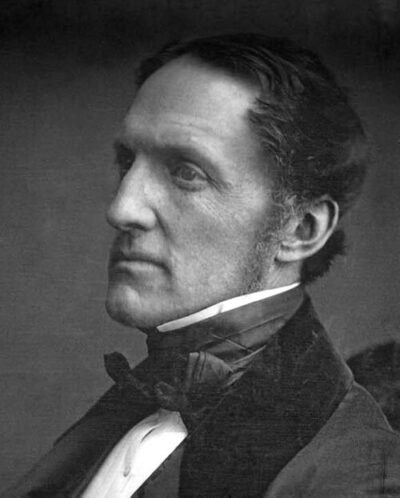
William Hickling Prescott
William Hickling Prescott was an American historian and Hispanist. Born May 4, 1796, in Salem. Died January 28, 1859, in Boston. Educated at Harvard University and Harvard College. Awards include Fellow of the American Academy of Arts and Sciences.
Facts
24 facts · 2 confirmed by two sources · 9 cited · 13 from one source
Where this comes from
Papalocal keeps its own record. It started from these sources; what each one said is kept here as it was copied, so a change on their side never changes this page by itself. Tap one to read its version.
What Wikidata says · copied November 15, 2026 · revision 2564816765
- Described as
- American historian and Hispanist (1796–1859)
- Other names
- William H. Prescott, William Prescott
- Born
- May 4, 1796 · 9 references
- Died
- January 28, 1859 · 4 references
- Born in
- Salem · 1 reference
- Died in
- Boston · 1 reference
- Buried in
- Mount Auburn Cemetery · 1 reference
- Cause of death
- stroke
- Citizen of
- United States
- Occupation
- historian · 2 references; writer · 2 references; jurist; hispanist · 1 reference
- Education
- Harvard University; Harvard College
- Member of
- American Academy of Arts and Sciences; Royal Prussian Academy of Sciences; Phi Beta Kappa Society; American Antiquarian Society
- Awards
- Fellow of the American Academy of Arts and Sciences
- Field
- history
- Spouse
- Susannah Prescott
- Children
- Elizabeth Lawrence · 1 reference; William Gardiner Prescott
- Father
- William Prescott, Jr. · 1 reference
- Mother
- Catherine Greene Prescott · 1 reference
- Wikipedias with a page
- 29
Wikidata item Q505844 (wikidata.org/wiki/Q505844), public domain (CC0). Copied November 15, 2026.
What Wikipedia says · copied November 15, 2026 · revision 1381328479
William Hickling Prescott (May 4, 1796 – January 28, 1859) was an American historian and Hispanist, who is widely recognized by historiographers to have been the first American scientific historian. Despite having serious visual impairment, which at times prevented him from reading or writing for himself, Prescott became one of the most eminent historians of 19th-century America. He is also noted for his eidetic memory, also called "photographic memory".
After an extensive period of study, during which he sporadically contributed to academic journals, Prescott specialized in late Renaissance Spain and the early Spanish Empire. His works on the subject, The History of the Reign of Ferdinand and Isabella the Catholic (1837), The History of the Conquest of Mexico (1843), A History of the Conquest of Peru (1847) and the unfinished History of the Reign of Phillip II (1856–1858) have become classic works in the field, and have had a great impact on the study of both Spain and Mesoamerica. During his lifetime, he was regarded as one of the greatest living American intellectuals and personally knew many of the leading political figures of the day, both in the United States and Britain. Prescott has become one of the most widely translated American historians and was an important figure in the development of history as a rigorous academic discipline.
Historians admire Prescott for his exhaustive, careful, and systematic use of archives, his accurate recreation of sequences of events, his balanced judgments, and his lively writing style. He was primarily focused on political and military affairs, largely ignoring the economic, social, intellectual, and cultural forces that historians have focused on in recent decades. Instead, he wrote narrative history, subsuming unstated causal forces in his driving storyline.
- Born, in its opening lines
- May 4, 1796
- Died, in its opening lines
- January 28, 1859
From the Wikipedia article “William H. Prescott” (en.wikipedia.org/wiki/William_H._Prescott), by its contributors, under CC BY-SA 4.0 (creativecommons.org/licenses/by-sa/4.0/). Copied November 15, 2026; not changed.
Confirmed Two sources agree. Cited One source, and it names where it got it. One source One source, without a reference of its own. Sources disagree The sources disagree. We show the best-supported value and keep theirs below.
