
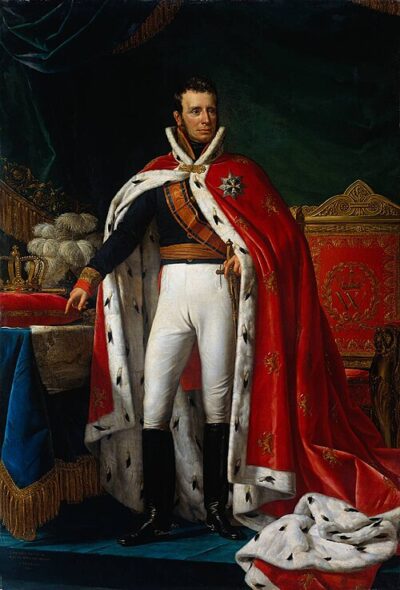
William I of the Netherlands
William I of the Netherlands was a King of the Netherlands and Grand Duke of Luxembourg 1815-1840. Born August 24, 1772, in The Hague. Died December 12, 1843, in Berlin. Positions held include Grand Duke of Luxembourg (1815–1840) and King of the Netherlands (1815–1840). Awards include Knight of the Order of the Golden Fleece, Knight Grand Cross of the Order of the Bath and Order of St. George, 4th class.
Facts
36 facts · 2 confirmed by two sources · 9 cited · 25 from one source
Where this comes from
Papalocal keeps its own record. It started from these sources; what each one said is kept here as it was copied, so a change on their side never changes this page by itself. Tap one to read its version.
What Wikidata says · copied November 16, 2026 · revision 2559997278
- Described as
- King of the Netherlands and Grand Duke of Luxembourg 1815-1840 (1772-1843)
- Other names
- King William of the Netherlands, King William I of the Netherlands, Prince William of Orange, Prince William of Orange-Nassau, Prince William of Nassau-Orange-Fulda, Willem Frederik Prins van Oranje-Nassau, Wilhelm Friedrich, Prince William VI of Orange
- Born
- August 24, 1772 · 11 references
- Died
- December 12, 1843 · 11 references
- Born in
- The Hague · 1 reference
- Died in
- Berlin · 1 reference
- Buried in
- Nieuwe Kerk Delft
- Citizen of
- Kingdom of the Netherlands
- Occupation
- head of state; monarch; art collector · 1 reference
- Positions held
- Grand Duke of Luxembourg (1815–1840); King of the Netherlands (1815–1840)
- Awards
- Knight of the Order of the Golden Fleece (1814); Knight Grand Cross of the Order of the Bath; Order of St. George, 4th class; Knight Grand Cross of the Military Order of William; Knight Grand Cross in the Order of the Netherlands Lion; Order of Saint Stephen of Hungary; Knight of the Garter (1814) · 1 reference; Royal Order of the Seraphim; Order of the Black Eagle · 1 reference; Grand Cross of the Sash of the Three Orders · 1 reference
- Field
- architecture · 1 reference
- Spouse
- Wilhelmine of Prussia, Queen of the Netherlands (1791–1837) · 1 reference; Henrietta d'Oultremont (1841–1843) · 1 reference
- Children
- William II of the Netherlands · 1 reference; Prince Frederik of the Netherlands; Princess Pauline of Orange-Nassau · 1 reference; Princess Marianne of the Netherlands; unnamed child von Nassau · 1 reference; stillborn son of Wilhelmina of Prussia
- Father
- William V, Prince of Orange
- Mother
- Wilhelmina of Prussia, Princess of Orange
- Siblings
- Princess Louise of Orange-Nassau; Prince Frederick of Orange-Nassau
- Religion
- Dutch Reformed Church
- Military rank
- general
- Wikipedias with a page
- 62
Wikidata item Q2079957 (wikidata.org/wiki/Q2079957), public domain (CC0). Copied November 16, 2026.
What Wikipedia says · copied November 16, 2026 · revision 1382264838
William I (Willem Frederik; 24 August 1772 – 12 December 1843) was King of the Netherlands and Grand Duke of Luxembourg from 1815 until his abdication in 1840.
Born as the son of William V, Prince of Orange, the last stadtholder of the Dutch Republic, and Wilhelmina of Prussia, William experienced significant political upheavals early in life. He fought against the French invasion during the Flanders campaign, and after the Batavian Revolution in 1795, his family went into exile. He briefly ruled the Principality of Nassau-Orange-Fulda before Napoleon's French troops' occupation forced him out of power. Following the defeat of Napoleon in 1814, William was invited back to the Netherlands, where he proclaimed himself Sovereign Prince of the United Netherlands.
In 1815, William raised the Netherlands to a kingdom and concurrently became the grand duke of Luxembourg. His reign saw the adoption of a new constitution, which granted him extensive powers. He was a strong proponent of economic development, founding several universities and promoting trade. However, his efforts to impose the Reformed faith and the Dutch language in the mostly Catholic and partly French-speaking southern provinces, combined with economic grievances, sparked the Belgian Revolution in 1830. Unable to suppress the rebellion, William ultimately accepted Belgian independence in 1839 under the Treaty of London.
William's later years were marked by dissatisfaction with constitutional changes and personal reasons, leading to his abdication in 1840 in favor of his son, King William II. He spent his final years in Berlin, where he died in 1843.
- Born, in its opening lines
- August 24, 1772
- Died, in its opening lines
- December 12, 1843
From the Wikipedia article “William I of the Netherlands” (en.wikipedia.org/wiki/William_I_of_the_Netherlands), by its contributors, under CC BY-SA 4.0 (creativecommons.org/licenses/by-sa/4.0/). Copied November 16, 2026; not changed.
Confirmed Two sources agree. Cited One source, and it names where it got it. One source One source, without a reference of its own. Sources disagree The sources disagree. We show the best-supported value and keep theirs below.
