
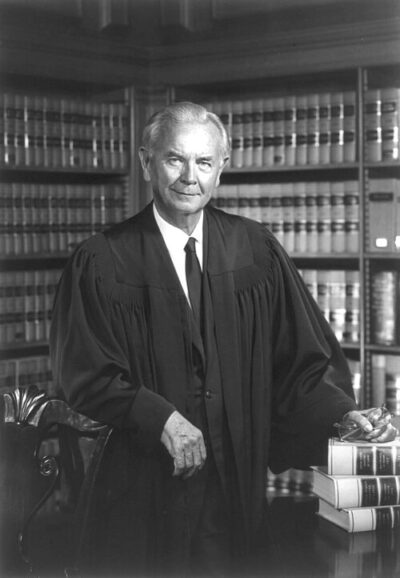
William J. Brennan
William J. Brennan was an U.S. Supreme Court justice from 1956 to 1990. Born April 25, 1906, in Newark. Died July 24, 1997, in Washington, D.C.. Positions held include Associate Justice of the Supreme Court of the United States (1956–1990). Educated at Harvard Law School and The Wharton School. Awards include Presidential Medal of Freedom, Four Freedoms Award – Freedom Medal and New Jersey Hall of Fame.
Facts
25 facts · 2 confirmed by two sources · 9 cited · 14 from one source
Where this comes from
Papalocal keeps its own record. It started from these sources; what each one said is kept here as it was copied, so a change on their side never changes this page by itself. Tap one to read its version.
What Wikidata says · copied November 16, 2026 · revision 2541932890
- Described as
- U.S. Supreme Court justice from 1956 to 1990
- Other names
- William Joseph Brennan, Jr., William Joseph Brennan Jr., William Brennan
- Born
- April 25, 1906 · 4 references
- Died
- July 24, 1997 · 4 references
- Born in
- Newark
- Died in
- Washington, D.C.
- Buried in
- Arlington National Cemetery (1997) · 1 reference
- Citizen of
- United States
- Occupation
- lawyer; judge; politician; jurist · 1 reference
- Positions held
- Associate Justice of the Supreme Court of the United States (1956–1990)
- Political party
- Democratic Party
- Worked for
- Georgetown University; Georgetown University Law Center · 1 reference
- Education
- Harvard Law School; The Wharton School
- Member of
- American Academy of Arts and Sciences
- Awards
- Presidential Medal of Freedom (1993) · 1 reference; Four Freedoms Award – Freedom Medal (1989) · 1 reference; New Jersey Hall of Fame (2010) · 1 reference; Laetare Medal (1969) · 1 reference; honorary doctor of the University of Miami (1991) · 1 reference
- Field
- law · 1 reference; justice and judicial activities · 1 reference
- Spouse
- Marjorie Leonard (1972–1982)
- Wikipedias with a page
- 22
Wikidata item Q717401 (wikidata.org/wiki/Q717401), public domain (CC0). Copied November 16, 2026.
What Wikipedia says · copied November 16, 2026 · revision 1384144446
William Joseph Brennan Jr. (April 25, 1906 – July 24, 1997) was an American lawyer and jurist who served as an associate justice of the Supreme Court of the United States from 1956 to 1990. He was the eighth-longest serving justice in Supreme Court history, and was known for being a leader of the Court's liberal wing.
Born to Irish immigrant parents in Newark, New Jersey, Brennan studied economics at the University of Pennsylvania and then attended Harvard Law School. He entered private legal practice in New Jersey and served in the U.S. Army during World War II. He was appointed in 1951 to the Supreme Court of New Jersey. Shortly before the 1956 presidential election, President Dwight D. Eisenhower used a recess appointment to place Brennan on the Supreme Court. Brennan won Senate confirmation the following year. He remained on the Court until his retirement in 1990, and was succeeded by David Souter.
On the Supreme Court, Brennan was known for his outspoken progressive views, including opposition to the death penalty as he dissented in more than 1,400 cases in which the Supreme Court refused to review a death sentence, and support for abortion rights and gay rights. He authored numerous landmark case opinions, including: Baker v. Carr (1962), establishing that the apportionment of legislative districts is a justiciable issue; New York Times Co. v. Sullivan (1964), which required "actual malice" in libel suits brought by public officials; Eisenstadt v. Baird (1972), which established a legal right to contraception for unmarried people and helped solidify the sexual revolution; and Craig v. Boren (1976) which established that laws which discriminate on the basis of sex are subject to heightened scrutiny under the Equal Protection Clause.
Due to his ability to shape a wide variety of opinions and bargain for votes in many cases, he was considered to be among the Court's most influential members. Associate Justice Antonin Scalia, who served alongside Brennan between 1986 and 1990, called Brennan "probably the most influential Justice of the [20th] century."
- Born, in its opening lines
- April 25, 1906
- Died, in its opening lines
- July 24, 1997
From the Wikipedia article “William J. Brennan Jr.” (en.wikipedia.org/wiki/William_J._Brennan_Jr.), by its contributors, under CC BY-SA 4.0 (creativecommons.org/licenses/by-sa/4.0/). Copied November 16, 2026; not changed.
Confirmed Two sources agree. Cited One source, and it names where it got it. One source One source, without a reference of its own. Sources disagree The sources disagree. We show the best-supported value and keep theirs below.
