
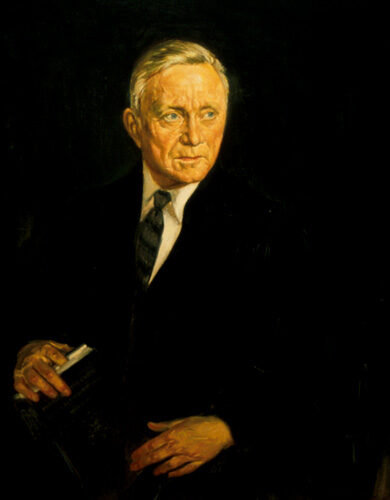
William O. Douglas
William O. Douglas was an US Supreme Court justice from 1939 to 1975. Born October 16, 1898, in Maine Township. Died January 19, 1980, in Bethesda. Positions held include Associate Justice of the Supreme Court of the United States (1939–1975) and Member of the United States Securities and Exchange Commission. Educated at Columbia Law School and Whitman College. Awards include George Polk Award, John Muir Award and Audubon Medal.
Facts
27 facts · 2 confirmed by two sources · 6 cited · 19 from one source
Where this comes from
Papalocal keeps its own record. It started from these sources; what each one said is kept here as it was copied, so a change on their side never changes this page by itself. Tap one to read its version.
What Wikidata says · copied November 15, 2026 · revision 2565600704
- Described as
- US Supreme Court justice from 1939 to 1975
- Other names
- William Orville Douglas, William Douglas
- Born
- October 16, 1898 · 5 references
- Died
- January 19, 1980 · 5 references
- Born in
- Maine Township
- Died in
- Bethesda
- Buried in
- Arlington National Cemetery (1980) · 1 reference
- Citizen of
- United States
- Occupation
- lawyer; judge · 1 reference; university teacher; trade unionist; jurist · 1 reference; travel writer · 1 reference
- Positions held
- Associate Justice of the Supreme Court of the United States (1939–1975); Member of the United States Securities and Exchange Commission
- Political party
- Democratic Party
- Worked for
- Yale Law School; Columbia Law School
- Education
- Columbia Law School; Whitman College · 1 reference; A.C. Davis High School · 1 reference
- Member of
- Phi Beta Kappa Society
- Awards
- George Polk Award (1958) · 1 reference; John Muir Award (1975); Audubon Medal (1962); American Library Association Honorary Membership (1975) · 2 references
- Mother
- Julia Bickford Douglas · 1 reference
- Religion
- Presbyterianism
- Wikipedias with a page
- 29
Wikidata item Q1391996 (wikidata.org/wiki/Q1391996), public domain (CC0). Copied November 15, 2026.
What Wikipedia says · copied November 15, 2026 · revision 1384927278
William Orville Douglas (October 16, 1898 – January 19, 1980) was an American jurist who served as an associate justice of the Supreme Court of the United States from 1939 to 1975. Douglas was known for his strong progressive and civil libertarian views and is often cited as the most liberal justice in the U.S. Supreme Court’s history. Nominated by President Franklin D. Roosevelt in 1939, Douglas was confirmed at the age of 40, becoming one of the youngest justices appointed to the court. He is the longest-serving U.S. Supreme Court justice in history, having served for 36 years and 209 days.
After a childhood in which he moved frequently, Douglas attended Whitman College on a scholarship. He graduated from Columbia Law School in 1925 and joined the Yale Law School faculty. After serving as the third chairman of the Securities and Exchange Commission, Douglas was successfully nominated to the Supreme Court in 1939, succeeding Justice Louis Brandeis. He was among those seriously considered for the 1944 Democratic vice presidential nomination and was subject to an unsuccessful draft movement prior to the 1948 U.S. presidential election. Douglas served on the Court until his retirement in 1975 and was succeeded by John Paul Stevens. Douglas holds a number of records as a Supreme Court justice, including the most opinions.
One of Douglas's most notable opinions was Griswold v. Connecticut (1965), which established the constitutional right to privacy and was foundational to later cases such as Eisenstadt v. Baird, Roe v. Wade, Lawrence v. Texas and Obergefell v. Hodges. His other notable opinions included Skinner v. Oklahoma (1942), United States v. Paramount Pictures, Inc. (1948), Terminiello v. City of Chicago (1949), Monroe v. Pape (1961) Brady v. Maryland (1963), and Harper v. Virginia State Board of Elections (1966). Douglas joined the unanimous opinion in Brown v. Board of Education (1954), which outlawed segregation in American public schools. He wrote notable concurring or dissenting opinions in Dennis v. United States (1951), United States v. O’Brien (1968), Terry v. Ohio (1968), and Brandenburg v. Ohio (1969). He was a strong opponent of the Vietnam War and an ardent advocate of environmentalism.
- Born, in its opening lines
- October 16, 1898
- Died, in its opening lines
- January 19, 1980
From the Wikipedia article “William O. Douglas” (en.wikipedia.org/wiki/William_O._Douglas), by its contributors, under CC BY-SA 4.0 (creativecommons.org/licenses/by-sa/4.0/). Copied November 15, 2026; not changed.
Confirmed Two sources agree. Cited One source, and it names where it got it. One source One source, without a reference of its own. Sources disagree The sources disagree. We show the best-supported value and keep theirs below.
