
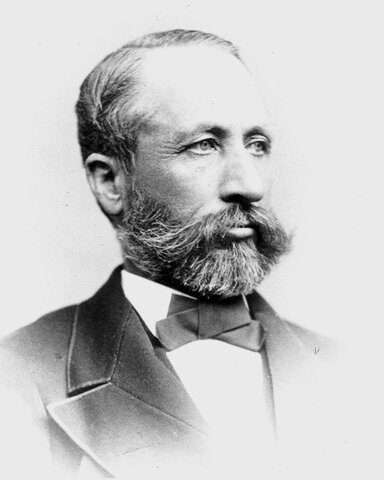
William Smith Clark
William Smith Clark was an American chemist, soldier, botanist and university teacher. Born July 31, 1826, in Ashfield. Died March 9, 1886, in Amherst. Positions held include member of the Massachusetts House of Representatives (1864–) and foreign government advisor in Meiji Japan (1876–1877). Educated at University of Göttingen and Amherst College. Awards include Eisenmann Medal and Fellow of the American Academy of Arts and Sciences.
Facts
32 facts · 2 confirmed by two sources · 10 cited · 20 from one source
Where this comes from
Papalocal keeps its own record. It started from these sources; what each one said is kept here as it was copied, so a change on their side never changes this page by itself. Tap one to read its version.
What Wikidata says · copied November 18, 2026 · revision 2561269743
- Described as
- American chemist, soldier, botanist and university teacher (1826 – 1886)
- Other names
- W. S. Clark, William Clark
- Born
- July 31, 1826 · 3 references
- Died
- March 9, 1886 · 4 references
- Born in
- Ashfield · 1 reference
- Died in
- Amherst · 1 reference
- Buried in
- Amherst West Cemetery · 1 reference
- Cause of death
- heart disease
- Citizen of
- United States · 1 reference
- Occupation
- chemist · 1 reference; politician; botanist · 2 references; university teacher; writer · 1 reference; botanical collector · 1 reference; mineralogist · 1 reference; agronomist · 1 reference
- Positions held
- member of the Massachusetts House of Representatives (1864–); foreign government advisor in Meiji Japan (1876–1877)
- Worked for
- University of Massachusetts Amherst; Sapporo Agricultural College; Amherst College · 1 reference
- Education
- University of Göttingen; Amherst College; University of Massachusetts Amherst; Williston Northampton School · 1 reference
- Member of
- American Academy of Arts and Sciences; Phi Beta Kappa Society; Connecticut Valley Botanical Society · 1 reference
- Awards
- Eisenmann Medal (2002); Fellow of the American Academy of Arts and Sciences
- Spouse
- Harriet Keopuolani Richards
- Children
- Hubert Lyman Clark
- Lived in
- Massachusetts
- Wikipedias with a page
- 16
Wikidata item Q901202 (wikidata.org/wiki/Q901202), public domain (CC0). Copied November 18, 2026.
What Wikipedia says · copied November 18, 2026 · revision 1382016577
William Smith Clark (July 31, 1826 – March 9, 1886) was an American professor of chemistry, botany, and zoology; a colonel during the American Civil War; and a leader in agricultural education. Raised and schooled in Easthampton, Massachusetts, Clark spent most of his adult life in Amherst, Massachusetts. He graduated from Amherst College in 1848 and obtained a doctorate in chemistry from Georgia Augusta University in Göttingen in 1852. He then served as professor of chemistry at Amherst College from 1852 to 1867. During the Civil War, he was granted leave from Amherst to serve with the 21st Regiment Massachusetts Volunteer Infantry, eventually achieving the rank of colonel and the command of that unit.
In 1867, Clark became the third president of the Massachusetts Agricultural College (MAC), now the University of Massachusetts Amherst. He was the first to appoint a faculty and admit a class of students. Although initially successful, MAC was criticized by politicians and newspaper editors who felt it was a waste of funding in a state that was growing increasingly industrial. Farmers of western Massachusetts were slow to support the college. Despite these obstacles, Clark's success in organizing an innovative academic institution earned him international attention.
Japanese officials, striving to achieve rapid modernization of that country in the wake of the Meiji Restoration, were especially intrigued by Clark's work. In 1876, the Japanese government hired Clark as a foreign advisor to establish the Sapporo Agricultural College (SAC), now Hokkaido University. During his eight months in Sapporo, Clark successfully organized SAC, had a significant impact on the scientific and economic development of the island of Hokkaido, and made a lasting imprint on Japanese culture. Clark's visage overlooks Sapporo from several statues and his parting words to his Japanese students, "Boys, be ambitious!" (少年よ大志を抱け Shōnen yo, taishi o idake) have become a nationally known motto in Japan.
After resigning the presidency of MAC in 1879, Clark left academia to become the president of a mining company, Clark & Bothwell. The company, in operation from 1881 to 1882, purchased several silver mines, mostly in Utah and California. Clark's partner, John R. Bothwell, proved to be corrupt and the company quickly folded, destroying Clark's reputation, his own finances and the fortunes of many of his friends and family. The subsequent scandal ruined Clark's health. He died of heart disease at his home in Amherst in 1886.
- Born, in its opening lines
- July 31, 1826
- Died, in its opening lines
- March 9, 1886
From the Wikipedia article “William S. Clark” (en.wikipedia.org/wiki/William_S._Clark), by its contributors, under CC BY-SA 4.0 (creativecommons.org/licenses/by-sa/4.0/). Copied November 18, 2026; not changed.
Confirmed Two sources agree. Cited One source, and it names where it got it. One source One source, without a reference of its own. Sources disagree The sources disagree. We show the best-supported value and keep theirs below.
