
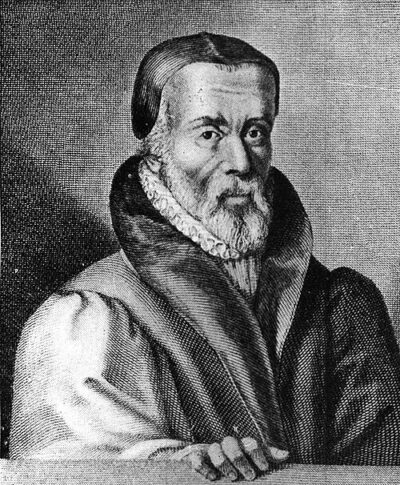
William Tyndale
William Tyndale was an English Bible translator and reformer. Born 1494, in Gloucester. Died October 6, 1536, in Vilvoorde. Known for Tyndale Bible and The Practyse of Prelates. Educated at Hertford College and Magdalen College School.
Facts
24 facts · 2 confirmed by two sources · 8 cited · 14 from one source
Where this comes from
Papalocal keeps its own record. It started from these sources; what each one said is kept here as it was copied, so a change on their side never changes this page by itself. Tap one to read its version.
What Wikidata says · copied November 16, 2026 · revision 2567487401
- Described as
- English Bible translator and reformer
- Other names
- William Tynsdale, Tindale, William Tindall, Tyndale, Wyllyam Tyndale
- Born
- 1494 · 1 reference
- Died
- October 6, 1536 · 2 references
- Born in
- Gloucester
- Died in
- Vilvoorde · 1 reference
- Cause of death
- strangling
- Citizen of
- Kingdom of England
- Occupation
- theologian; linguist; translator; writer · 1 reference; Bible translator; Christian reformer · 1 reference; scholar · 1 reference; priest · 1 reference
- Education
- Hertford College; Magdalen College School; Katharine Lady Berkeley's School
- Known for
- Tyndale Bible; The Practyse of Prelates
- Field
- Christianity · 1 reference; Bible translation · 1 reference; church reform · 1 reference
- Religion
- Catholic Church; Protestantism
- Wikipedias with a page
- 56
Wikidata item Q219639 (wikidata.org/wiki/Q219639), public domain (CC0). Copied November 16, 2026.
What Wikipedia says · copied November 16, 2026 · revision 1385871015
William Tyndale (; sometimes spelled Tynsdale, Tindall, Tindill, Tyndall; c. 1494 – October 1536) was an English Biblical scholar and linguist who became a leading figure in the Protestant Reformation in the years leading up to his execution. He translated much of the Bible into English and was influenced by the works of prominent Protestant Reformers such as Martin Luther.
Tyndale's translations were the first English scriptures to draw directly from Hebrew and Greek texts, the first English translation to take advantage of the printing press, the first of the new English Bibles of the Reformation, and the first English translation to use Jehovah ("Iehouah") as God's name. It was taken to be a direct challenge to the authority of the Catholic Church and of those laws of England maintaining the church's position. The work of Tyndale continued to play a key role in spreading Reformation ideas across the English-speaking world.
In The Obedience of a Christian Man (1528), Tyndale argued for Caesaropapism, the idea that the monarch rather than the Pope should control a country's church. This was the first instance of advocating the divine right of kings in England (sometimes mistakenly attributed to the Catholic Church). The book came into the hands of King Henry VIII, providing a rationale for breaking the church in England away from the Catholic Church in 1534. In 1530, Tyndale wrote The Practice of Prelates, opposing Henry's plan to seek the annulment of his marriage on the grounds that it contravened Scripture. This work made him enemy of both the state and the church, therefore he fled England and sought refuge in the Flemish territory of the Catholic Charles V, Holy Roman Emperor. In 1535 Tyndale was arrested and jailed in the castle of Vilvoorde (Filford) outside Brussels. The following year he was convicted of heresy and executed by strangulation, after which his body was burnt at the stake.
Tyndale's translation choices of biblical phrases were substantially also adopted by subsequent English editions.
- Born, in its opening lines
- c. 1494
- Died, in its opening lines
- October 1536
From the Wikipedia article “William Tyndale” (en.wikipedia.org/wiki/William_Tyndale), by its contributors, under CC BY-SA 4.0 (creativecommons.org/licenses/by-sa/4.0/). Copied November 16, 2026; not changed.
Confirmed Two sources agree. Cited One source, and it names where it got it. One source One source, without a reference of its own. Sources disagree The sources disagree. We show the best-supported value and keep theirs below.
