
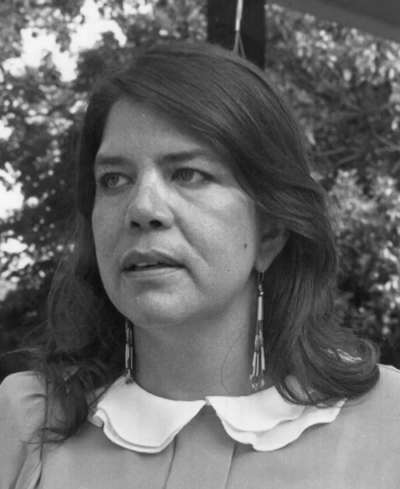
Wilma Mankiller
Wilma Mankiller was a Principle Chief of the Cherokee Nation. Born November 18, 1945, in Tahlequah. Died April 6, 2010, in Adair County. Positions held include Principal Chief of the Cherokee Nation (1985–1995). Educated at Skyline College and San Francisco State University. Awards include National Women's Hall of Fame, National Cowgirl Museum and Hall of Fame and Oklahoma Women's Hall of Fame.
Facts
22 facts · 2 confirmed by two sources · 9 cited · 11 from one source
Where this comes from
Papalocal keeps its own record. It started from these sources; what each one said is kept here as it was copied, so a change on their side never changes this page by itself. Tap one to read its version.
What Wikidata says · copied November 15, 2026 · revision 2567390732
- Described as
- Principle Chief of the Cherokee Nation (1945–2010)
- Other names
- Chief Wilman Mankiller, A-ji-luhsgi Asgaya-dihi, Wilma Pearl Mankiller
- Born
- November 18, 1945 · 5 references
- Died
- April 6, 2010 · 6 references
- Born in
- Tahlequah · 1 reference
- Died in
- Adair County
- Buried in
- Stilwell
- Cause of death
- pancreatic cancer · 1 reference
- Citizen of
- United States
- Occupation
- writer; traditional leader or chief · 1 reference; autobiographer · 1 reference; poet; author · 1 reference
- Positions held
- Principal Chief of the Cherokee Nation (1985–1995)
- Political party
- Democratic Party
- Education
- Skyline College; San Francisco State University
- Awards
- National Women's Hall of Fame (1993) · 1 reference; National Cowgirl Museum and Hall of Fame; Oklahoma Women's Hall of Fame (1986) · 1 reference; Presidential Medal of Freedom (1998) · 1 reference; Humanitarian of the Year (1986) · 1 reference; Elizabeth Blackwell Award (1996) · 1 reference
- Wikipedias with a page
- 33
Wikidata item Q2327358 (wikidata.org/wiki/Q2327358), public domain (CC0). Copied November 15, 2026.
What Wikipedia says · copied November 15, 2026 · revision 1385725458
Wilma Pearl Mankiller (Cherokee: ᎠᏥᎳᏍᎩ ᎠᏍᎦᏯᏗᎯ, romanized: Atsilasgi Asgayadihi; November 18, 1945 – April 6, 2010) was a Native American activist, social worker, community developer and the first woman elected to serve as Principal Chief of the Cherokee Nation. Born in Tahlequah, Oklahoma, she lived on her family's allotment in Adair County, Oklahoma, until the age of 11, when her family relocated to San Francisco as part of a federal government program to urbanize Indigenous Americans. After high school, she married a well-to-do Ecuadorian and raised two daughters. Inspired by the social and political movements of the 1960s, Mankiller became involved in the Occupation of Alcatraz and later participated in the land and compensation struggles with the Pit River Tribe. For five years in the early 1970s, she was employed as a social worker, focusing mainly on children's issues.
When Mankiller returned to Oklahoma in 1976, the Cherokee Nation hired her as an economic stimulus coordinator. With her expertise at preparing documentation, she became a successful grant writer, and by the early 1980s was directing the newly created Community Development Department of the Cherokee Nation. As Director she designed and supervised innovative community projects allowing rural citizens to identify their own challenges and, through their labor, participate in solving them. Her project in Bell, Oklahoma, was featured in the movie The Cherokee Word for Water, directed by Charlie Soap and Tim Kelly. In 2015, the movie was selected as the top American Indian film of the past 40 years by the American Indian Film Institute. Her project in Kenwood received the Department of Housing and Urban Development's Certificate of National Merit.
Her management ability came to the notice of the incumbent Principal Chief, Ross Swimmer, who invited her to run as his deputy in the 1983 tribal elections. When the duo won, she became the first elected woman to serve as Deputy Chief of the Cherokee Nation. She was elevated to Principal Chief when Swimmer took a position in the federal administration of the Bureau of Indian Affairs, serving until 1995. During her administration, the Cherokee government built new health clinics, created a mobile eye-care clinic, established ambulance services, and created early education, adult education and job training programs. She developed revenue streams, including factories, retail stores, restaurants and bingo operations, while establishing self-governance, allowing the tribe to manage its own finances.
Mankiller returned to her activist role as an advocate working to improve the image of Native Americans and combat the misappropriation of native heritage, by authoring books including a bestselling autobiography, Mankiller: A Chief and Her People, and giving numerous lectures on health care, tribal sovereignty, women's rights and cancer awareness after retiring from politics. Throughout her life, she had serious health problems, including polycystic kidney disease, myasthenia gravis, lymphoma and breast cancer, and needed two kidney transplants. She died in 2010 from pancreatic cancer, and was honored with many local, state and national awards, including the nation's highest civilian honor, the Presidential Medal of Freedom.
In 2021 it was announced that Mankiller's likeness would appear on the quarter-dollar coin as a part of the United States Mint's "American Women quarters" program.
- Born, in its opening lines
- November 18, 1945
- Died, in its opening lines
- April 6, 2010
From the Wikipedia article “Wilma Mankiller” (en.wikipedia.org/wiki/Wilma_Mankiller), by its contributors, under CC BY-SA 4.0 (creativecommons.org/licenses/by-sa/4.0/). Copied November 15, 2026; not changed.
Confirmed Two sources agree. Cited One source, and it names where it got it. One source One source, without a reference of its own. Sources disagree The sources disagree. We show the best-supported value and keep theirs below.
