
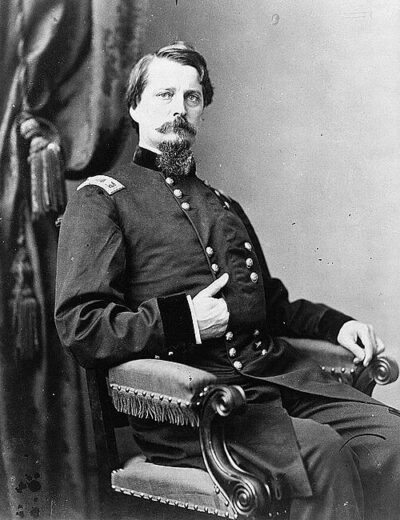
Winfield Scott Hancock
Winfield Scott Hancock was an United States Army officer. Born February 14, 1824, in Montgomeryville. Died February 9, 1886, in Governors Island. Educated at United States Military Academy.
Facts
18 facts · 2 confirmed by two sources · 2 cited · 14 from one source
Where this comes from
Papalocal keeps its own record. It started from these sources; what each one said is kept here as it was copied, so a change on their side never changes this page by itself. Tap one to read its version.
What Wikidata says · copied November 15, 2026 · revision 2568770931
- Described as
- United States Army officer (1824–1886)
- Other names
- Winfield S. Hancock, Winfield Hancock
- Born
- February 14, 1824 · 5 references
- Died
- February 9, 1886 · 5 references
- Born in
- Montgomeryville
- Died in
- Governors Island
- Buried in
- Montgomery Cemetery
- Cause of death
- infectious disease
- Citizen of
- United States
- Occupation
- military officer; politician · 1 reference
- Political party
- Democratic Party
- Education
- United States Military Academy
- Father
- Benjamin Franklin Hancock · 1 reference
- Siblings
- Hilary Baker Hancock
- Military branch
- Union Army; United States Army; infantry · 1 reference
- Military rank
- major general; general · 1 reference
- Wikipedias with a page
- 28
Wikidata item Q435517 (wikidata.org/wiki/Q435517), public domain (CC0). Copied November 15, 2026.
What Wikipedia says · copied November 15, 2026 · revision 1379665604
Winfield Scott Hancock (February 14, 1824 – February 9, 1886) was a major general in the United States Army and the Democratic nominee for President of the United States in 1880. He served with distinction in the Army for four decades, including service in the Mexican–American War and as a Union general in the American Civil War. Known to his Army as "Hancock the Superb", he was noted in particular for his personal leadership at the Battle of Gettysburg in 1863. His military service continued after the Civil War, as Hancock participated in the military Reconstruction of the South and the United States's western expansion and war with the Native Americans at the Western frontier. This concluded with the Medicine Lodge Treaty. From 1881 to 1885 he was president of the Aztec Club of 1847 for veteran officers of the Mexican-American War.
Hancock's reputation as a war hero at Gettysburg, combined with his status as a Unionist and supporter of states' rights, made him a potential presidential candidate. When the Democrats nominated him for president in 1880, he ran a strong campaign, but was narrowly defeated by Ohio congressman and Republican Party nominee James A. Garfield. Hancock's last public service involved the oversight of President Ulysses S. Grant's funeral procession in 1885.
- Born, in its opening lines
- February 14, 1824
- Died, in its opening lines
- February 9, 1886
From the Wikipedia article “Winfield Scott Hancock” (en.wikipedia.org/wiki/Winfield_Scott_Hancock), by its contributors, under CC BY-SA 4.0 (creativecommons.org/licenses/by-sa/4.0/). Copied November 15, 2026; not changed.
Confirmed Two sources agree. Cited One source, and it names where it got it. One source One source, without a reference of its own. Sources disagree The sources disagree. We show the best-supported value and keep theirs below.
