
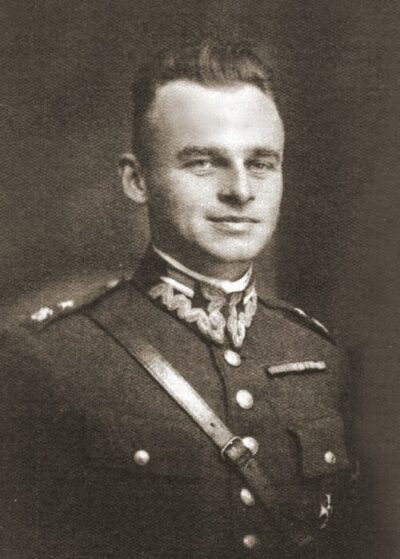
Witold Pilecki
Witold Pilecki was a Polish underground resistance soldier, World War II concentration camp resistance leader. Born May 13, 1901, in Olonets. Died May 25, 1948, in Warsaw. Known for Pilecki's Report. Educated at Vilnius University. Awards include Order of the White Eagle, Commander of the Order of Polonia Restituta and Cross of Valour.
Facts
30 facts · 2 confirmed by two sources · 6 cited · 22 from one source
Where this comes from
Papalocal keeps its own record. It started from these sources; what each one said is kept here as it was copied, so a change on their side never changes this page by itself. Tap one to read its version.
What Wikidata says · copied November 16, 2026 · revision 2563006905
- Described as
- Polish underground resistance soldier, World War II concentration camp resistance leader (1901-1948)
- Other names
- Captain Pilecki
- Born
- May 13, 1901 · 4 references
- Died
- May 25, 1948 · 3 references
- Born in
- Olonets · 2 references
- Died in
- Warsaw · 3 references
- Buried in
- Powązki Cemetery
- Cause of death
- execution by shooting · 1 reference
- Citizen of
- Poland · 1 reference
- Occupation
- farmer; resistance fighter · 2 references; military officer; soldier · 2 references
- Education
- Vilnius University
- Known for
- Pilecki's Report
- Awards
- Order of the White Eagle (2006); Commander of the Order of Polonia Restituta (1995); Cross of Valour; Auschwitz Cross; Silver Cross of Merit (1938); Cross of Merit of the Army of Central Lithuania; Decade of Independence Regained (1928); Commemorative Medal for the War of 1918–1921; Warsaw Uprising Cross; Order of the Star of Perseverance (1984)
- Spouse
- Maria Pilecka
- Military branch
- cavalry of Second Polish Republic; Secret Polish Army · 1 reference; Armia Krajowa · 1 reference
- Military rank
- sub-lieutenant (1925); lieutenant (1941); cavalry master (1943)
- Wikipedias with a page
- 48
Wikidata item Q315691 (wikidata.org/wiki/Q315691), public domain (CC0). Copied November 16, 2026.
What Wikipedia says · copied November 16, 2026 · revision 1381665038
Witold Pilecki (Polish: [ˈvitɔlt piˈlɛt͡skʲi] ; 13 May 1901 – 25 May 1948), known by the codenames Roman Jezierski, Tomasz Serafiński, Druh and Witold, was a Polish World War II cavalry officer, intelligence agent, and resistance leader.
As a youth, Pilecki joined Polish underground scouting; in the aftermath of World War I, he joined the Polish militia and, later, the Polish Army. He participated in the Polish–Soviet War, which ended in 1921. In 1939, he participated in the unsuccessful defence of Poland against the invasion by Nazi Germany, the Slovak Republic, and the Soviet Union. Shortly afterward, he joined the Polish resistance, co-founding the Secret Polish Army resistance movement. In 1940, Pilecki let himself be captured by the occupying Germans in order to be voluntarily sent to the Auschwitz concentration camp and infiltrate it. At Auschwitz, he organized a resistance movement that eventually included hundreds of inmates, and he secretly drew up reports detailing German atrocities at the camp, which were smuggled out to Home Army headquarters and shared with the Western Allies. After escaping from Auschwitz in April 1943, Pilecki fought in the Warsaw Uprising of August–October 1944. Following its suppression, he was interned in a German prisoner-of-war camp.
After the communist takeover of Poland, Pilecki remained loyal to the London-based Polish government-in-exile. He returned to Poland in 1945 to report back on the situation there to the government-in-exile. Before travelling home, and anticipating that he might be killed by Poland's new communist authorities, Pilecki completed the compilation known as Witold's Report which recorded his Auschwitz experiences in detail. Pilecki's fears were well founded: in 1947, he was arrested by the secret police on charges of working for "foreign imperialism" and the following year, after being subjected to torture and a show trial, he was executed in Warsaw aged 47.
Pilecki's story, inconvenient to the Polish communist authorities, remained mostly unknown for several decades. One of the first accounts of Pilecki's mission to Auschwitz was given by Polish historian Józef Garliński—himself a former Auschwitz inmate who emigrated to Britain after the war—in Fighting Auschwitz: The Resistance Movement in the Concentration Camp (1975). Several monographs appeared in subsequent years, particularly after the fall of communism in Poland allowed for research into his life by Polish historians.
- Born, in its opening lines
- May 13, 1901
- Died, in its opening lines
- May 25, 1948
From the Wikipedia article “Witold Pilecki” (en.wikipedia.org/wiki/Witold_Pilecki), by its contributors, under CC BY-SA 4.0 (creativecommons.org/licenses/by-sa/4.0/). Copied November 16, 2026; not changed.
Confirmed Two sources agree. Cited One source, and it names where it got it. One source One source, without a reference of its own. Sources disagree The sources disagree. We show the best-supported value and keep theirs below.
