
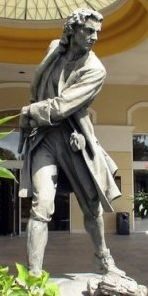
Woodes Rogers
Woodes Rogers was a British sea captain and governor of the Bahamas. Born 1679, in Bristol. Died July 15, 1732, in Nassau. Positions held include Governor of the Bahamas (2 times) (1718–1732).
Facts
14 facts · 2 confirmed by two sources · 3 cited · 9 from one source
Where this comes from
Papalocal keeps its own record. It started from these sources; what each one said is kept here as it was copied, so a change on their side never changes this page by itself. Tap one to read its version.
What Wikidata says · copied November 17, 2026 · revision 2569071732
- Described as
- British sea captain and governor of the Bahamas (1679–1732)
- Born
- 1679 · 4 references
- Died
- July 15, 1732 · 1 reference
- Born in
- Bristol
- Died in
- Nassau
- Citizen of
- Kingdom of England; Kingdom of Great Britain
- Occupation
- privateer; colonial administrator; slave trader · 1 reference; governor · 1 reference; sea captain · 1 reference
- Positions held
- Governor of the Bahamas (2 times) (1718–1732)
- Religion
- Catholicism
- Lived in
- Queen Square · 1 reference
- Wikipedias with a page
- 25
Wikidata item Q114206 (wikidata.org/wiki/Q114206), public domain (CC0). Copied November 17, 2026.
What Wikipedia says · copied November 17, 2026 · revision 1365311226
Woodes Rogers (c. 1679 – 15 July 1732) was an English sea captain, privateer and colonial administrator who served as the governor of the Bahamas from 1718 to 1721 and again from 1728 to 1732. He is remembered as the captain of the vessel that rescued marooned Scottish sailor Alexander Selkirk, whose plight is generally believed to have inspired Daniel Defoe's novel Robinson Crusoe. Rogers came from an experienced seafaring family, grew up in Poole and Bristol, and served a marine apprenticeship to a Bristol sea captain. His father, who held shares in many ships, died when Rogers was in his mid-twenties, leaving Rogers in control of the family shipping business.
In 1707, Rogers was approached by Captain William Dampier, who sought support for a privateering voyage against the Spanish, with whom the British were at war. Rogers led the expedition, which consisted of two well-armed ships, Duke and Duchess, and was the captain of Duke. In three years, Rogers and his men went around the world, capturing several ships in the Pacific Ocean. En route, the expedition rescued Selkirk, finding him on Juan Fernández Island on 1 February 1709. When the expedition returned to England in October 1711, Rogers had circumnavigated the globe, while retaining his original ships and most of his men, and the investors in the expedition doubled their money.
The expedition made Rogers a national hero, but his brother was killed and Rogers was badly wounded in fights in the Pacific. On his return, he was sued by his crew on the grounds that they had not received their fair share of the expedition profits, and Rogers was forced into bankruptcy. He wrote of his maritime experiences in the book A Cruising Voyage Round the World, which sold well, in part due to public fascination at Selkirk's rescue. Rogers was twice appointed Governor of the Bahamas, where he succeeded in warding off threats from the Spanish, and in ridding the colony of pirates. His first term as governor was financially ruinous, and on his return to England, he was imprisoned for debt. During his second term as governor, Rogers died in Nassau, aged about 53.
- Born, in its opening lines
- c. 1679
- Died, in its opening lines
- July 15, 1732
From the Wikipedia article “Woodes Rogers” (en.wikipedia.org/wiki/Woodes_Rogers), by its contributors, under CC BY-SA 4.0 (creativecommons.org/licenses/by-sa/4.0/). Copied November 17, 2026; not changed.
Confirmed Two sources agree. Cited One source, and it names where it got it. One source One source, without a reference of its own. Sources disagree The sources disagree. We show the best-supported value and keep theirs below.
