
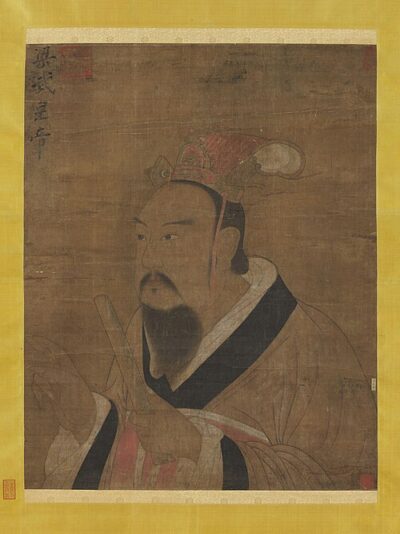
Wu
Wu was a Founding Liang emperor from 502 to 549. Born 464, in Changzhou. Died September 13, 549, in Nanjing. Positions held include Emperor of China (502–549).
Facts
39 facts · 1 confirmed by two sources · 10 cited · 27 from one source · 1 where the sources disagree
What’s different
- Died: we show September 13, 549 (Sources disagree). Wikipedia says June 12, 549
Where this comes from
Papalocal keeps its own record. It started from these sources; what each one said is kept here as it was copied, so a change on their side never changes this page by itself. Tap one to read its version.
What Wikidata says · copied November 17, 2026 · revision 2550860876
- Described as
- Founding Liang emperor from 502 to 549
- Other names
- Xiao Yan, Wu Di, Liang Wudi, Liang Wu Di, Martial Emperor of Liang, Martial Emperor of the Liang, Wudi, Liang Wu-ti, Liang Wu Ti, Wu-ti, Wu Ti, Xiao Shuda
- Born
- 464 · 1 reference
- Died
- September 13, 549 · 1 reference
- Born in
- Changzhou · 1 reference
- Died in
- Nanjing
- Citizen of
- Liang dynasty · 1 reference
- Occupation
- philosopher; poet; ruler
- Positions held
- Emperor of China (502–549)
- Spouse
- Chi Hui; Ding Lingguang; Ruan Lingying; Wu Jinghui; Ge Xiurong
- Children
- Xiao Tong · 1 reference; Emperor Jianwen of Liang · 1 reference; Xiao Ji · 1 reference; Emperor Yuan of Liang · 1 reference; Xiao Zong · 1 reference; Xiao Lun · 1 reference; Xiao Ji · 1 reference; Xiao Xu · 1 reference; Xiao Yuyao; Xiao Yuwan; Xiao Yuhuan; Princess Fuyang
- Father
- Xiao Shunzhi · 1 reference
- Mother
- Zhang Shangrou
- Siblings
- Xin'anmu princess; Xiao Lingyi; Xiao Yi; Xiao Hong; Xiao Wei; Xiao Hui; Xiao Dan; Xiao Xiu; Xiao Rong; Xiao Fu
- Religion
- Buddhism
- Wikipedias with a page
- 25
Wikidata item Q736726 (wikidata.org/wiki/Q736726), public domain (CC0). Copied November 17, 2026.
What Wikipedia says · copied November 17, 2026 · revision 1373697773
Emperor Wu of Liang (Chinese: 梁武帝) (464 – 12 June 549), personal name Xiao Yan (蕭衍), courtesy name Shuda (叔達), childhood name Lian'er (練兒), was the founding emperor of the Chinese Liang dynasty, during the Northern and Southern dynasties period. His reign, until its end, was one of the most stable and prosperous among the Southern dynasties. He came from the same Xiao clan of Lanling (蘭陵蕭氏) that ruled the preceding Southern Qi dynasty, but from a different branch.
Emperor Wu established universities and extended the Confucian civil service exams, demanding that sons of nobles (士族) study. He was well read himself and wrote poetry and patronized the arts. Although for governmental affairs he was Confucian in values, he embraced Buddhism as well. He himself was attracted to many Indian traditions. He banned the sacrifice of animals and was against execution. It was said that he received the Buddhist precepts during his reign, earning him the nickname The Bodhisattva Emperor. The emperor is the namesake of the Emperor Liang Jeweled Repentance (梁皇寳懺; Liang Huang Bao Chan), a widely read and major Buddhist text in China and Korea.
At the end of his reign, his unduly lenient attitude towards his clan's and officials' corruption and lack of dedication to the state came at a heavy price; when the general Hou Jing rebelled (侯景之亂), few came to his aid, and Hou captured the imperial capital Jiankang, holding Emperor Wu and his successor Emperor Jianwen under close control and plunging the entire Liang state into anarchy. After Emperor Wu was imprisoned, he was thirsty and asked Hou for honey, but Hou refused to give it to him. After shouting several times, the Emperor supposedly died of hunger and thirst.
- Born, in its opening lines
- 464
- Died, in its opening lines
- June 12, 549
From the Wikipedia article “Emperor Wu of Liang” (en.wikipedia.org/wiki/Emperor_Wu_of_Liang), by its contributors, under CC BY-SA 4.0 (creativecommons.org/licenses/by-sa/4.0/). Copied November 17, 2026; not changed.
Confirmed Two sources agree. Cited One source, and it names where it got it. One source One source, without a reference of its own. Sources disagree The sources disagree. We show the best-supported value and keep theirs below.
