
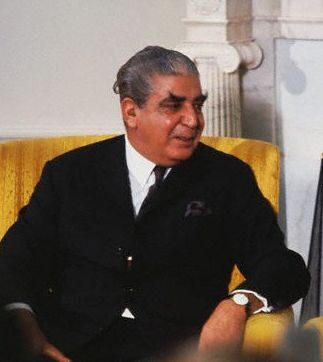
Yahya Khan
Yahya Khan was a former Pakistani president. Born February 4, 1917, in Chakwal. Died August 10, 1980, in Rawalpindi. Positions held include President of Pakistan (1969–1971), Federal Minister for Foreign Affairs (1969–1971) and Federal Minister for Defence (1969–1971). Educated at United States Army Command and General Staff College and Royal Military Academy Sandhurst. Awards include Nishan-e-Pakistan, Order of Pahlavi and anniversary medal at the occasion of the 2500th anniversary of the founding of the Iranian Empire.
Facts
24 facts · 2 confirmed by two sources · 3 cited · 19 from one source
Where this comes from
Papalocal keeps its own record. It started from these sources; what each one said is kept here as it was copied, so a change on their side never changes this page by itself. Tap one to read its version.
What Wikidata says · copied November 16, 2026 · revision 2568888677
- Described as
- former Pakistani president (1917–1980)
- Other names
- Agha Muhammad Yahya Khan Qizilbash, Yahya Khan Qizilbash, Agha Muhammad Yahya Khan
- Born
- February 4, 1917 · 6 references
- Died
- August 10, 1980 · 5 references
- Born in
- Chakwal · 1 reference
- Died in
- Rawalpindi · 2 references
- Buried in
- Peshawar · 1 reference
- Citizen of
- Pakistan; British Raj
- Occupation
- diplomat; politician; military personnel
- Positions held
- President of Pakistan (1969–1971); Federal Minister for Foreign Affairs (1969–1971); Federal Minister for Defence (1969–1971); Commander in Chief (Pakistan Army) (1966–1971)
- Education
- United States Army Command and General Staff College; Royal Military Academy Sandhurst; University of the Punjab; Indian Military Academy · 1 reference
- Awards
- Nishan-e-Pakistan; Order of Pahlavi; anniversary medal at the occasion of the 2500th anniversary of the founding of the Iranian Empire
- Religion
- Islam
- Military branch
- British Indian Army · 1 reference
- Military rank
- general · 2 references
- Wikipedias with a page
- 63
Wikidata item Q333981 (wikidata.org/wiki/Q333981), public domain (CC0). Copied November 16, 2026.
What Wikipedia says · copied November 16, 2026 · revision 1384886738
Agha Muhammad Yahya Khan (4 February 1917 – 10 August 1980) was a Pakistani four-star rank general who served as the third president of Pakistan from 1969 to 1971, under martial law. His presidency oversaw a civil war in East Pakistan, resulting in Bangladesh's secession. He also served as the fifth commander-in-chief of the Pakistan Army from 1966 to 1971.
Khan was commissioned into the British Indian Army in 1939 and fought in the Second World War in the Mediterranean theatre. Following the partition of British India, he joined the Pakistan Army and was placed in charge of organising the Staff College in Quetta. In 1965, he played a vital role in executing Operation Grand Slam in Indian-administered Kashmir during the second Indo-Pakistani war and was assigned to assume the command of the army in September 1966 by President Ayub Khan. In the wake of nationwide protests against Ayub Khan's government, he resigned from the presidency and transferred authority to Yahya Khan in March 1969.
Upon taking over the presidency, Khan declared martial law and suspended the constitution. He issued the Legal Framework Order in July 1970 and held the country's first general election in December 1970, with which the Awami League from East Pakistan emerged victorious with a national majority. He barred power transition to the party's leader Sheikh Mujibur Rahman, leading to mass protests and civil disobedience in the east and a call for sovereignty. On 25 March 1971, Khan ordered Operation Searchlight in an effort to suppress Bengali nationalism which initiated a genocide; and led to the declaration of independence of East Pakistan as Bangladesh by Sheikh Mujibur Rahman, and start of a civil war in the east. He is considered a chief architect of the Bangladesh genocide along with his deputies Abdul Hamid Khan and Tikka Khan. In December 1971, Khan ordered pre-emptive strikes against the Mukti Bahini-allied Indian Army, resulting in another war with India. The two simultaneous wars resulted in the surrender of Pakistani forces in the east and Bangladesh's secession, after which Yahya Khan resigned from the army command and transferred the presidency to Zulfikar Ali Bhutto. Khan remained under house surveillance prior to 1979 when he was released by Fazle Haq. Khan died the following year in Rawalpindi and was buried in Peshawar.
Khan's brief period in power is widely regarded as a pivotal factor in the division of Pakistan. His refusal to hand over power to the Awami League, despite their electoral victory in East Pakistan, sparked political unrest. This culminated in Operation Searchlight: a brutal military crackdown resulting in the Bengali genocide and causing widespread death and displacement. Khan is viewed negatively in both Bangladesh, where he is considered the architect of the genocide, and Pakistan, where his failure to prevent the country's disintegration is regarded as a national tragedy.
- Born, in its opening lines
- February 4, 1917
- Died, in its opening lines
- August 10, 1980
From the Wikipedia article “Yahya Khan” (en.wikipedia.org/wiki/Yahya_Khan), by its contributors, under CC BY-SA 4.0 (creativecommons.org/licenses/by-sa/4.0/). Copied November 16, 2026; not changed.
Confirmed Two sources agree. Cited One source, and it names where it got it. One source One source, without a reference of its own. Sources disagree The sources disagree. We show the best-supported value and keep theirs below.
