
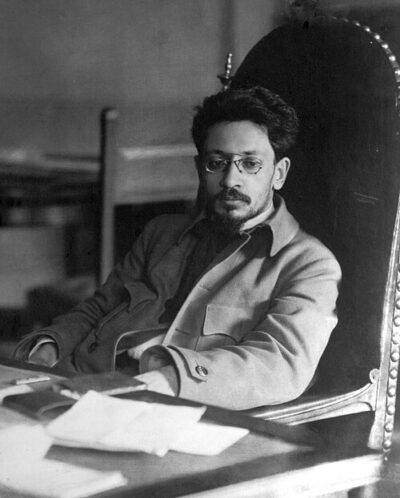
Yakov Sverdlov
Yakov Sverdlov was a Soviet politician. Born May 22, 1885, in Nizhny Novgorod. Died March 16, 1919, in Moscow. Positions held include chairperson (1917–1919), Member of the Russian Constituent Assembly and Member of the Politburo of the CPSU Central Committee (1917–1919). Educated at gymnasium and Nizhny Novgorod Gymnasium.
Facts
26 facts · 1 confirmed by two sources · 5 cited · 18 from one source · 2 where the sources disagree
What’s different
- Born: we show May 22, 1885 (Sources disagree). Wikipedia says June 3, 1885
- Cause of death: we show 1918–1920 flu pandemic (Sources disagree). Wikidata also lists influenza
Where this comes from
Papalocal keeps its own record. It started from these sources; what each one said is kept here as it was copied, so a change on their side never changes this page by itself. Tap one to read its version.
What Wikidata says · copied November 16, 2026 · revision 2562534399
- Described as
- Soviet politician
- Other names
- Yakov Mikhaylovich Sverdlov, Yakov Mikhailovich Sverdlov
- Born
- May 22, 1885 · 1 reference
- Died
- March 16, 1919 · 7 references
- Born in
- Nizhny Novgorod · 2 references
- Died in
- Moscow · 2 references
- Buried in
- Kremlin Wall Necropolis
- Cause of death
- 1918–1920 flu pandemic; influenza
- Citizen of
- Russian Empire; Russian Republic; Russian Socialist Federative Soviet Republic
- Occupation
- politician; revolutionary · 1 reference
- Positions held
- chairperson (1917–1919); Member of the Russian Constituent Assembly; Member of the Politburo of the CPSU Central Committee (1917–1919)
- Political party
- Communist Party of the Soviet Union; Russian Social Democratic Labour Party (bolshevik)
- Education
- gymnasium; Nizhny Novgorod Gymnasium · 1 reference
- Member of
- All-Russian Central Executive Committee
- Field
- political activity · 2 references; bolshevism · 2 references
- Spouse
- Klavdija Timofejevna Novgorodtseva
- Children
- Andrei Sverdlov
- Siblings
- Zinovy Peshkov; Veniamin Sverdlov
- Religion
- atheism · 1 reference
- Wikipedias with a page
- 49
Wikidata item Q298384 (wikidata.org/wiki/Q298384), public domain (CC0). Copied November 16, 2026.
What Wikipedia says · copied November 16, 2026 · revision 1382870510
Yakov Mikhailovich Sverdlov (3 June [O.S. 22 May] 1885 – 16 March 1919) was a Russian revolutionary and Soviet politician. A key Bolshevik organizer of the October Revolution of 1917, Sverdlov served as chairman of the Secretariat of the Russian Communist Party from 1918 until his death in 1919, and as chairman of the All-Russian Central Executive Committee (head of state) from 1917 until his death in 1919.
Born in Nizhny Novgorod to a Jewish family active in revolutionary politics, Sverdlov joined the Russian Social Democratic Labour Party in 1902 and supported Vladimir Lenin's Bolshevik faction from 1903. He was active in the Urals during the failed Revolution of 1905, and over the next decade was subjected to constant imprisonment and exile.
After the 1917 February Revolution overthrew the monarchy, Sverdlov returned to Petrograd and was appointed a secretary of the party's central committee. In this capacity, he played a key role in planning the October Revolution, in which the Bolsheviks came to power. Sverdlov became one of the most powerful figures in the Soviet regime, with Lenin, Leon Trotsky, and Joseph Stalin.
In November 1917, Sverdlov was elected chairman of the All-Russian Central Executive Committee, the de facto head of state. He worked to consolidate Bolshevik control of the new regime and supported the Red Terror campaign and decossackization policies. He played major roles in the dissolution of the Constituent Assembly in January 1918, in persuading party members to support the Treaty of Brest-Litovsk signed with the Central Powers that March, and in authorising the execution of the Romanov family that July. He also served briefly as acting head of government after Lenin was injured in an assassination attempt in August.
In March 1919, Sverdlov died at age 33 of the Spanish flu, and was buried in the Kremlin Wall Necropolis. The city of Yekaterinburg (Sverdlovsk) and Theatre Square in Moscow were renamed in his honour. Some historians regard his untimely death as a key factor which enabled the rise of Stalin after Lenin's death in 1924, as Sverdlov was a natural candidate for the post of General Secretary held by Stalin from 1922.
- Born, in its opening lines
- June 3, 1885
- Died, in its opening lines
- March 16, 1919
From the Wikipedia article “Yakov Sverdlov” (en.wikipedia.org/wiki/Yakov_Sverdlov), by its contributors, under CC BY-SA 4.0 (creativecommons.org/licenses/by-sa/4.0/). Copied November 16, 2026; not changed.
Confirmed Two sources agree. Cited One source, and it names where it got it. One source One source, without a reference of its own. Sources disagree The sources disagree. We show the best-supported value and keep theirs below.
