
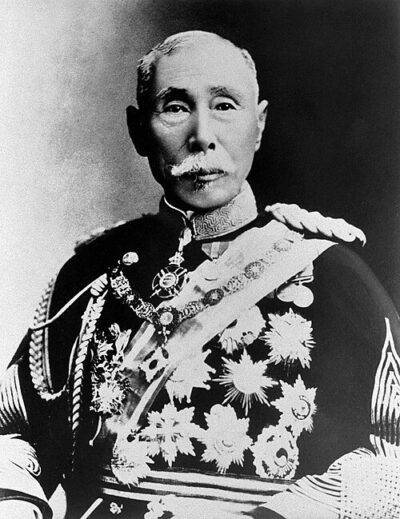
Yamagata Aritomo
Yamagata Aritomo was a Japanese military leader and statesman. Born June 14, 1838, in Hagi. Died February 1, 1922, in Koki-an. Positions held include Prime Minister of Japan (2 times) (1889–1900), Lord of Home Affairs (1883–1885) and member of the House of Peers. Educated at Shōkasonjuku Academy. Awards include Collar of the Supreme Order of the Chrysanthemum, Order of the Golden Kite, 1st Class and Grand Cordon of the Supreme Order of the Chrysanthemum.
Facts
40 facts · 2 confirmed by two sources · 2 cited · 36 from one source
Where this comes from
Papalocal keeps its own record. It started from these sources; what each one said is kept here as it was copied, so a change on their side never changes this page by itself. Tap one to read its version.
What Wikidata says · copied November 16, 2026 · revision 2562946473
- Described as
- Japanese military leader and statesman (1838–1922)
- Born
- June 14, 1838 · 2 references
- Died
- February 1, 1922 · 6 references
- Born in
- Hagi
- Died in
- Koki-an
- Buried in
- Gokoku-ji Temple · 1 reference
- Cause of death
- pneumonia
- Citizen of
- Japan
- Occupation
- politician; military personnel
- Positions held
- Prime Minister of Japan (2 times) (1889–1900) · 2 references; Lord of Home Affairs (1883–1885) · 1 reference; member of the House of Peers; Chairman of the Privy Council of Japan (2 times) (1893–1922); Minister of Home Affairs (1885–1890); Ministry of the Army (1873–1878); Imperial Japanese Army General Staff Office (3 times) (1878–1905)
- Education
- Shōkasonjuku Academy
- Member of
- Kiheitai
- Awards
- Collar of the Supreme Order of the Chrysanthemum (1906) · 1 reference; Order of the Golden Kite, 1st Class (1906) · 1 reference; Grand Cordon of the Supreme Order of the Chrysanthemum (1902) · 1 reference; Order of the Rising Sun with Paulownia Flowers, 1st class (1895); Order of the Rising Sun, 1st class (1877) · 1 reference; Silver Medal with Yellow Ribbon (1891); Knight Grand Cross of the Order of St Michael and St George (1918); Order of St. Alexander Nevsky with diamond signs (1916); Order of Taejo (1908); Honorary member of the Order of Merit (1906); Grand Cross of the Order of the Red Eagle (1899); Grand Cross of the Legion of Honour (1897); Knight Grand Cross of the Iron Crown (Austria) (1890); Order of the White Eagle (1889); Knight Grand Cross of the Order of Saints Maurice and Lazarus (1889)
- Spouse
- Tomoko Yamagata
- Military branch
- Imperial Japanese Army · 1 reference
- Military rank
- field marshal
- Lived in
- Tōgyō-an Temple; Murin-an; Chinzan-sō Garden; Koki-an
- Wikipedias with a page
- 48
Wikidata item Q297636 (wikidata.org/wiki/Q297636), public domain (CC0). Copied November 16, 2026.
What Wikipedia says · copied November 16, 2026 · revision 1381869117
Prince Yamagata Aritomo (Japanese: 山縣 有朋; 14 June 1838 – 1 February 1922) was a Japanese statesman and general who twice served as prime minister of Japan, in 1889–1891 and 1898–1900. He was a leading member of the genrō, a group of senior courtiers and statesmen who dominated the politics of Japan during the Meiji era. As the Imperial Japanese Army's inaugural Chief of Staff, he was the chief architect of its nationalist and reactionary ideology, which has led some historians to consider him the "father" of Japanese militarism.
Born to a low-ranking samurai family in the Chōshū Domain, Yamagata became a leader in the loyalist movement to overthrow the Tokugawa shogunate. As a commander in the Boshin War, he helped lead the military forces of the Satsuma–Chōshū Alliance to victory in the Meiji Restoration. Following the Restoration, he traveled to Europe to study Western military systems and returned to become the central figure in the creation of the modern Imperial Japanese Army, implementing a nationwide conscription system. He led the new conscript army to victory over the Satsuma Rebellion in 1877, which validated his military reforms and destroyed the last vestiges of the samurai class, including the right to bear swords. He further secured the army's independence from civilian control by creating an autonomous Imperial Army General Staff which reported directly to the Emperor of Japan.
Entering civilian government, Yamagata served as Home Minister, where he established an efficient, centralized police and local government system. As Prime Minister from 1889 to 1891, he oversaw the opening of the first Imperial Diet under the new Meiji Constitution. Thereafter, he engaged in a protracted political contest with Itō Hirobumi over the nature of constitutional government. Whereas Itō grew to favor a system of compromise with the political parties, Yamagata remained a staunch advocate of a "transcendental" government where the cabinet would be composed of non-partisan bureaucrats accountable only to the emperor. After the First Sino-Japanese War of 1894–1895, he served a second term as Prime Minister from 1898 to 1900, during which he passed laws to prevent political party members from holding key bureaucratic posts.
From the outset of the 1900s, Yamagata vied against Itō for supremacy among the Meiji oligarchy. Upon Ito's assassination on 26 October 1909, he consolidated power to become the dominant figure in the Emperor's court. However, a political scandal that involved his meddling in Crown Prince Hirohito's engagement led to him losing power shortly before his death in February 1922.
- Born, in its opening lines
- June 14, 1838
- Died, in its opening lines
- February 1, 1922
From the Wikipedia article “Yamagata Aritomo” (en.wikipedia.org/wiki/Yamagata_Aritomo), by its contributors, under CC BY-SA 4.0 (creativecommons.org/licenses/by-sa/4.0/). Copied November 16, 2026; not changed.
Confirmed Two sources agree. Cited One source, and it names where it got it. One source One source, without a reference of its own. Sources disagree The sources disagree. We show the best-supported value and keep theirs below.
