
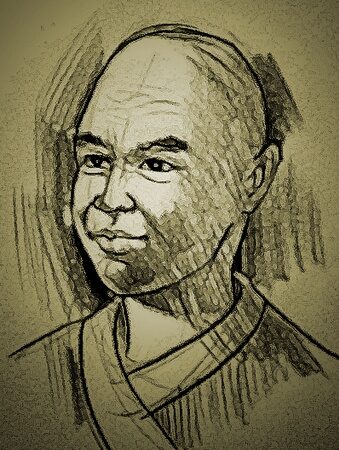
Yijing
Yijing was a (635–713), Chinese Buddhist monk, traveler, and writer. Born 635, in Yanjing. Died February 16, 713, in Chang'an.
Facts
10 facts · 2 confirmed by two sources · 2 cited · 6 from one source
Where this comes from
Papalocal keeps its own record. It started from these sources; what each one said is kept here as it was copied, so a change on their side never changes this page by itself. Tap one to read its version.
What Wikidata says · copied November 16, 2026 · revision 2557347701
- Described as
- (635–713), Chinese Buddhist monk, traveler, and writer
- Other names
- I-Tsing, I-tsing, I-ching, I Tsing, I Ching, Zhang Wenming
- Born
- 635 · 6 references; 635 · 1 reference
- Died
- February 16, 713
- Born in
- Yanjing
- Died in
- Chang'an
- Citizen of
- Tang dynasty · 1 reference
- Occupation
- Buddhist monk; translator; writer; monk · 1 reference
- Religion
- Buddhism
- Wikipedias with a page
- 30
Wikidata item Q457629 (wikidata.org/wiki/Q457629), public domain (CC0). Copied November 16, 2026.
What Wikipedia says · copied November 16, 2026 · revision 1357333738
Yijing (635–713 CE), formerly romanized as I-ching or I-tsing, born Zhang Wenming, was a Tang-era Chinese Buddhist monk and renowned travel writer. His account of his travels are an important source for the history of the medieval kingdoms along the sea route between China and India, especially Srivijaya in Indonesia. He also gave accounts of the Gupta Period in ancient India. A student of the Buddhist university at Nālandā (now in Bihar, India), he was also responsible for the translation of many Buddhist texts from Sanskrit and Pali into Chinese.
- Born, in its opening lines
- 635
- Died, in its opening lines
- 713
From the Wikipedia article “Yijing (monk)” (en.wikipedia.org/wiki/Yijing_(monk)), by its contributors, under CC BY-SA 4.0 (creativecommons.org/licenses/by-sa/4.0/). Copied November 16, 2026; not changed.
Confirmed Two sources agree. Cited One source, and it names where it got it. One source One source, without a reference of its own. Sources disagree The sources disagree. We show the best-supported value and keep theirs below.
