
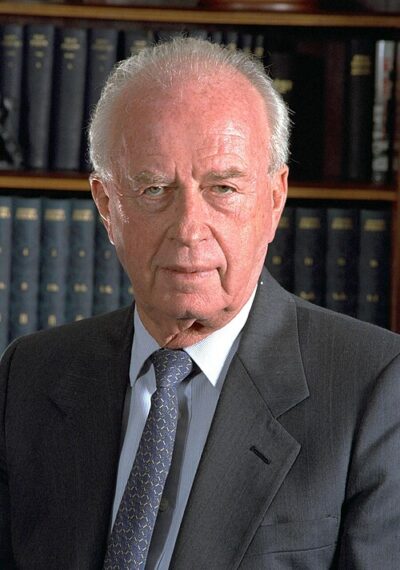
Yitzhak Rabin
Yitzhak Rabin was an Israeli politician, statesman and general. Born March 1, 1922, in Jerusalem. Died November 4, 1995, in Tel Aviv. Positions held include Prime Minister of Israel (2 times) (1974–1995), Chief of the General Staff (1964–1968) and Minister of Communications (1974–1975). Educated at Kadoorie Agricultural High School. Awards include Ronald Reagan Freedom Award, Nobel Peace Prize and Félix Houphouët-Boigny Peace Prize.
Facts
38 facts · 2 confirmed by two sources · 13 cited · 23 from one source
Where this comes from
Papalocal keeps its own record. It started from these sources; what each one said is kept here as it was copied, so a change on their side never changes this page by itself. Tap one to read its version.
What Wikidata says · copied November 16, 2026 · revision 2565551108
- Described as
- Israeli politician, statesman and general (1922–1995)
- Other names
- Itshak Rabin, יצחק רבין, Rabin, Yitzak Rabin, Itzhak Rabin
- Born
- March 1, 1922 · 9 references
- Died
- November 4, 1995 · 8 references
- Born in
- Jerusalem · 3 references
- Died in
- Tel Aviv · 1 reference
- Buried in
- Mount Herzl
- Cause of death
- gunshot wound
- Citizen of
- Israel
- Occupation
- diplomat; military officer; politician · 1 reference
- Positions held
- Prime Minister of Israel (2 times) (1974–1995); Chief of the General Staff (1964–1968); Minister of Communications (1974–1975) · 1 reference; Minister of Defense of Israel (2 times) (1984–1995) · 1 reference; Minister of Health (1994) · 1 reference; Knesset member (1974–1995) · 1 reference; Ambassador of Israel to the United States (1968–1973); Minister of Religious Services (1992–1995) · 1 reference
- Political party
- Israeli Labor Party
- Education
- Kadoorie Agricultural High School
- Member of
- The Playground Gang
- Awards
- Ronald Reagan Freedom Award; Nobel Peace Prize (1994) · 2 references; Félix Houphouët-Boigny Peace Prize (1993); Princess of Asturias Award for International Cooperation; honorary doctor of Ben-Gurion University; honorary doctor of the Bar-Ilan University; honorary doctor of the University of Miami (1970) · 1 reference
- Spouse
- Leah Rabin (1948–1995) · 1 reference
- Children
- Dalia Rabin-Pelossof; Yuval Rabin
- Father
- Nehemiah Rabin · 1 reference
- Mother
- Rosa Cohen · 1 reference
- Siblings
- Rachel Rabin
- Military branch
- Haganah; Israel Defense Forces
- Military rank
- rav aluf (1963–1995); general · 1 reference
- Wikipedias with a page
- 114
Wikidata item Q34060 (wikidata.org/wiki/Q34060), public domain (CC0). Copied November 16, 2026.
What Wikipedia says · copied November 16, 2026 · revision 1377339624
Yitzhak Rabin (; Hebrew: יִצְחָק רַבִּין, IPA: [itsˈχak ˈʁabin]; 1 March 1922 – 4 November 1995) was an Israeli statesman and general who was the prime minister of Israel, having served from 1974 to 1977 and again from 1992 until his assassination in 1995. He was the first prime minister to have been born in the region of Palestine, at the time under British control.
Rabin was born in Jerusalem to Jewish immigrants from Eastern Europe and was raised in a Labor Zionist household. He learned agriculture in school and excelled as a student. As a teenager, he joined the Palmach, the commando force of the Yishuv. He eventually rose through its ranks to become its chief of operations during the 1948 Arab–Israeli War. In late 1948, he joined the newly formed Israel Defense Forces and continued to rise as a promising officer, with a 27-year career as a professional soldier. He ultimately attained the rank of Rav Aluf, the most senior rank in the Israeli Defense Force (often translated as lieutenant general). In the 1950s, Rabin helped shape the training doctrine of the IDF and he led its Operations Directorate from 1959 to 1963. He was appointed chief of the general staff in 1964 and oversaw Israel's victory in the 1967 Six-Day War.
Rabin served as Israel's ambassador to the United States from 1968 to 1973, during a period of deepening U.S.–Israel ties. He was appointed Prime Minister of Israel in 1974 after the resignation of Golda Meir. In his first term, Rabin signed the Sinai Interim Agreement and ordered the Entebbe raid. He resigned in 1977 in the wake of a financial scandal. Rabin was Israel's minister of defense for much of the 1980s, including during the outbreak of the First Intifada.
In 1992, Rabin was re-elected as prime minister on a platform embracing the Israeli–Palestinian peace process. He signed several historic agreements with the Palestinian leadership as part of the Oslo Accords. In 1994, Rabin won the Nobel Peace Prize together with long-time political rival Shimon Peres and Palestinian leader Yasser Arafat. Rabin also signed a peace treaty with Jordan in 1994. In November 1995, he was assassinated by Yigal Amir, an extremist who opposed the terms of the Oslo Accords. Amir was convicted of Rabin's murder and sentenced to life imprisonment. Rabin was the first native-born prime minister of Israel, the only prime minister to be assassinated, and the second to die in office after Levi Eshkol. Rabin has become a symbol of the Israeli–Palestinian peace process.
- Born, in its opening lines
- March 1, 1922
- Died, in its opening lines
- November 4, 1995
From the Wikipedia article “Yitzhak Rabin” (en.wikipedia.org/wiki/Yitzhak_Rabin), by its contributors, under CC BY-SA 4.0 (creativecommons.org/licenses/by-sa/4.0/). Copied November 16, 2026; not changed.
Confirmed Two sources agree. Cited One source, and it names where it got it. One source One source, without a reference of its own. Sources disagree The sources disagree. We show the best-supported value and keep theirs below.
