
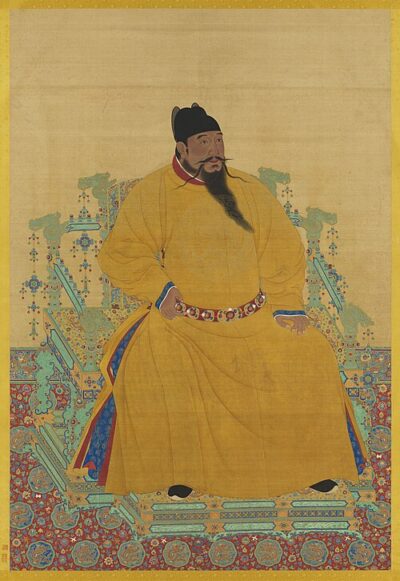
Yongle Emperor
Yongle Emperor was an emperor of Ming dynasty China from 1402 to 1424. Born May 2, 1360, in Nanjing. Died August 12, 1424, in Inner Mongolia. Positions held include Emperor of China (1402–1424) and prince (1370–1402).
Facts
39 facts · 2 confirmed by two sources · 9 cited · 28 from one source
What’s different
- Died: we show August 12, 1424 (Confirmed). Wikidata also lists August 5, 1424
Where this comes from
Papalocal keeps its own record. It started from these sources; what each one said is kept here as it was copied, so a change on their side never changes this page by itself. Tap one to read its version.
What Wikidata says · copied November 16, 2026 · revision 2569074277
- Described as
- emperor of Ming dynasty China from 1402 to 1424
- Other names
- Yung-lo Emperor, Wen Di, Cheng Zu, Chengzu, Yancheng, Emperor Chengzu of Ming, Emperor of China Yongli, Yonglo Emperor, Titianhongdaogaomingguangyunshengwushengongchunrenzhixiaowenhuangdi, Taizong, Qitian Hongdao Gaoming Zhaoyun Shengwu Shengong Chunren Zhixiao Wen, Qitianhongdaogaomingzhaoyunshengwushengongchunrenzhixiaowenhuangdi
- Born
- May 2, 1360 · 3 references
- Died
- August 12, 1424 · 2 references; August 5, 1424 · 1 reference
- Born in
- Nanjing
- Died in
- Inner Mongolia
- Buried in
- Changling Mausoleum (Ming dynasty)
- Cause of death
- stroke
- Citizen of
- Ming dynasty · 1 reference; Yuan dynasty
- Positions held
- Emperor of China (1402–1424) · 2 references; prince (1370–1402)
- Spouse
- Empress Xu · 2 references; Noble Consort Zhaoxian; Consort Gwon; Consort Yu (Yongle); Consort Han (Yongle); Consort Ren Shunfei
- Children
- Hongxi Emperor · 2 references; Zhu Gaoxu · 1 reference; Zhu Gaosui · 1 reference; Zhu Gaoxi · 1 reference; Princess Yong'an; Princess Yongping; Princess Ancheng; Princess Xianning; Princess Changning
- Father
- Hongwu Emperor · 2 references
- Mother
- Empress Ma · 2 references
- Siblings
- Princess Huaiqing; Princess Yongjia; Princess Runing; Princess Ruyang; Princess Nankang; Princess Hanshan; Princess Shouchun; Princess Daming; Princess Chongning; Princess Anqing
- Religion
- Confucianism
- Military rank
- admiral
- Wikipedias with a page
- 57
Wikidata item Q9965 (wikidata.org/wiki/Q9965), public domain (CC0). Copied November 16, 2026.
What Wikipedia says · copied November 16, 2026 · revision 1385127300
The Yongle Emperor (2 May 1360 – 12 August 1424), personal name Zhu Di, was the third emperor of the Ming dynasty of China, reigning from 1402 to 1424. He was the fourth son of the Hongwu Emperor, the founder of the dynasty.
In 1370, Zhu Di was granted the title of Prince of Yan. By 1380, he had relocated to Beiping (present-day Beijing) and was responsible for protecting the northeastern borderlands. In the 1380s and 1390s, he proved himself to be a skilled military leader, gaining popularity among soldiers and achieving success as a statesman. In 1399, he rebelled against his nephew, the Jianwen Emperor, and launched a civil war known as the Jingnan campaign. After three years of intense fighting, he emerged victorious and declared himself emperor in 1402.
After ascending the throne, the Yongle Emperor elevated Beiping to the status of a second capital, diminishing the importance of Nanjing. Construction of the new capital between 1407 and 1420 employed hundreds of thousands of workers. He also supervised the reconstruction of the Grand Canal, essential for supplying Beijing and the northern armies. The Emperor strongly supported both Confucianism and Buddhism and sponsored the compilation of the vast Yongle Encyclopedia, employing around two thousand scholars. He also ordered Neo-Confucian texts to be systematized and used as textbooks for training officials. The civil service examinations, held every three years, produced qualified candidates for government service. Unlike his father, he avoided frequent purges, resulting in longer ministerial tenures and a more professional, stable administration.
The Emperor made considerable efforts to reinforce the empire's hegemonic position in East Asia through an active foreign policy. Diplomatic missions and military expeditions were dispatched to regions both near and distant, including Manchuria, Korea, Japan, the Philippines, and the Timurid Empire in Central Asia. Maritime expeditions led by the eunuch admiral Zheng He extended even further, reaching the shores of Southeast Asia, India, Persia, and East Africa. The Mongols—including southeastern Uriankhai, eastern Mongols and western Oirats—remained the empire's greatest security threat, prompting the Ming court to alternately support and confront the various groups. The Emperor personally led five campaigns into Mongolia, and his decision to transfer the government from Nanjing to Beijing was driven largely by the need to closely monitor the unstable northern frontier. Although a skilled military leader, his wars were ultimately unsuccessful, as the campaign in Đại Việt lasted until the end of his reign and his Mongolian campaigns failed to secure China's northern border.
- Born, in its opening lines
- May 2, 1360
- Died, in its opening lines
- August 12, 1424
From the Wikipedia article “Yongle Emperor” (en.wikipedia.org/wiki/Yongle_Emperor), by its contributors, under CC BY-SA 4.0 (creativecommons.org/licenses/by-sa/4.0/). Copied November 16, 2026; not changed.
Confirmed Two sources agree. Cited One source, and it names where it got it. One source One source, without a reference of its own. Sources disagree The sources disagree. We show the best-supported value and keep theirs below.
