
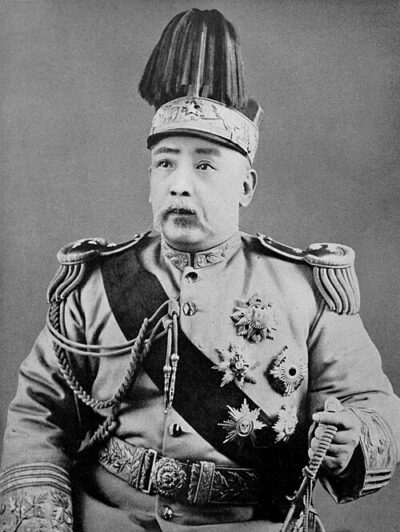
Yuan Shikai
Yuan Shikai was a Chinese military and government official. Born September 16, 1859, in Xiangcheng City. Died June 6, 1916, in Beijing. Positions held include Prime Minister of the Imperial Cabinet (1911–1912), Great President of the Republic of China (1912–1916) and Viceroy of Zhili (1901–1908). Awards include Order of the Paulownia Flowers.
Facts
30 facts · 2 confirmed by two sources · 7 cited · 21 from one source
Where this comes from
Papalocal keeps its own record. It started from these sources; what each one said is kept here as it was copied, so a change on their side never changes this page by itself. Tap one to read its version.
What Wikidata says · copied November 16, 2026 · revision 2563066770
- Described as
- Chinese military and government official (1859–1916)
- Other names
- Yangshoutang, Rongan, Huanshangdiaotu, Xiazhulou, Huanshangyuren, Chunyizhai, Yangshouyuan, Weiting, Muyexinnong, Songyun
- Born
- September 16, 1859 · 3 references
- Died
- June 6, 1916 · 5 references
- Born in
- Xiangcheng City
- Died in
- Beijing · 2 references
- Buried in
- Tomb of Yuan Shikai
- Cause of death
- uremia · 1 reference
- Citizen of
- Qing dynasty; Republic of China · 1 reference; Empire of China · 1 reference
- Occupation
- politician · 1 reference; military personnel; military leader · 1 reference
- Positions held
- Prime Minister of the Imperial Cabinet (1911–1912); Great President of the Republic of China (1912–1916) · 1 reference; Viceroy of Zhili (1901–1908); Junji dachen; Emperor of China (1915–1916) · 1 reference
- Political party
- Republican Party
- Awards
- Order of the Paulownia Flowers · 1 reference
- Field
- politics · 2 references
- Children
- Yuan Kequan; Yuan Keding · 1 reference; Yuan Ko-wen · 2 references; Yuan Kehuan; Yuan Kezhen; Yuan Jingxue
- Father
- Yuan Baozhong
- Military branch
- Beiyang Army · 1 reference
- Military rank
- President of the Republic of China; general · 1 reference
- Wikipedias with a page
- 62
Wikidata item Q210329 (wikidata.org/wiki/Q210329), public domain (CC0). Copied November 16, 2026.
What Wikipedia says · copied November 16, 2026 · revision 1383674444
Yuan Shikai (traditional Chinese: 袁世凱; simplified Chinese: 袁世凯; pinyin: Yuán Shìkǎi; Wade–Giles: Yüan² Shih⁴-k'ai³; 16 September 1859 – 6 June 1916) was a Chinese general and statesman. As leader of the Beiyang Army, he played a decisive role in securing the abdication of the Qing court. He served as the second provisional president and the first formal president of the Republic of China, with his administration known as the Beiyang government. He declared himself Emperor of the Chinese Empire in December 1915 but was forced to abdicate in March 1916.
Born to an affluent Han family in Xiangcheng county, Yuan failed the imperial examinations in his early years and instead joined the Huai Army, with which he was stationed in Joseon (Korea) in 1882. He was appointed imperial resident and supreme adviser to the Korean government after thwarting the Kapsin Coup in 1885. He was recalled to China in 1894 and tasked with training of the New Army the next year, which laid the foundation for his Beiyang Army. Yuan joined a reformist society and played an active role in both the Self-Strengthening Movement and the late Qing reforms, including the abolition of the imperial examination system in favor of modern education. However, the Hundred Days' Reformists accused him of betrayal for tipping Ronglu off to their coup plan, which brought Yuan into Empress Dowager Cixi's favor. Promoted to Viceroy of Zhili in 1902, Yuan expanded the Beiyang Army into the best trained and most effective military force in China. Upon Cixi's death, he was dismissed by Prince Regent Zaifeng.
Following the Wuchang Uprising in October 1911, the Qing court recalled Yuan from retirement and appointed him Prime Minister of the Imperial Cabinet. Yuan's Beiyang Army engaged in brief fighting with Sun Yat-sen's revolutionaries before opening negotiations, brokering a deal whereby Sun would step aside in Yuan's favor if Yuan secured the abdication of the Qing court. As a result, Yuan was elected provisional president of the Republic of China, before he became the president.
In 1913, Yuan's alleged involvement in the assassination of Song Jiaoren and the reorganisation loan affair provoked Sun Yat-sen's Second Revolution, which was decisively crushed. He then outlawed the Kuomintang, dissolved the National Assembly, and replaced the provisional constitution. In December 1915, Yuan proclaimed himself Hongxian Emperor (洪憲), provoking the National Protection War. In March 1916, faced with widespread opposition to his monarchy, Yuan abdicated and restored the Republic, having been emperor for only 83 days. He died of kidney failure in June at the age of 56, leaving behind a significantly weakened Beiyang government and a fragmented political landscape, which soon plunged China into a period of warlordism.
- Born, in its opening lines
- September 16, 1859
- Died, in its opening lines
- June 6, 1916
From the Wikipedia article “Yuan Shikai” (en.wikipedia.org/wiki/Yuan_Shikai), by its contributors, under CC BY-SA 4.0 (creativecommons.org/licenses/by-sa/4.0/). Copied November 16, 2026; not changed.
Confirmed Two sources agree. Cited One source, and it names where it got it. One source One source, without a reference of its own. Sources disagree The sources disagree. We show the best-supported value and keep theirs below.
