
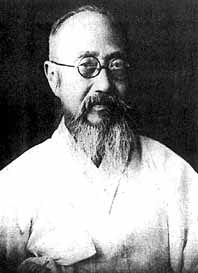
Yun Ch'iho
Yun Ch'iho was a Korean independence activist. Born 1865, in Asan. Died December 6, 1945, in Kaesong. Positions held include member of the House of Peers. Known for Diary of Yun Chi-ho. Educated at Vanderbilt University and Emory University.
Facts
32 facts · 2 confirmed by two sources · 6 cited · 24 from one source
What’s different
- Born: we show 1865 (Confirmed). Wikidata also lists December 26, 1864
Where this comes from
Papalocal keeps its own record. It started from these sources; what each one said is kept here as it was copied, so a change on their side never changes this page by itself. Tap one to read its version.
What Wikidata says · copied November 16, 2026 · revision 2556828379
- Described as
- Korean independence activist (1864-1945)
- Other names
- Yun Tchi-ho, Yoon Chi-ho, Yoon Tchi-ho, Jwaong, Yun Chi-ho, Tchi-Ho Yun
- Born
- December 26, 1864; 1865 · 1 reference
- Died
- December 6, 1945 · 1 reference
- Born in
- Asan
- Died in
- Kaesong
- Citizen of
- Joseon (–1897); Korean Empire (1897–1910); Empire of Japan (1910–)
- Occupation
- politician · 1 reference; philosopher; journalist; teacher; autobiographer; official · 1 reference; diplomat · 1 reference; interpreter · 1 reference
- Positions held
- member of the House of Peers
- Education
- Vanderbilt University (1888–1891) · 1 reference; Emory University · 1 reference; Keio University; Dojinsha; Oxford College of Emory University; Vanderbilt University Divinity School
- Known for
- Diary of Yun Chi-ho
- Spouse
- Ma eh-bang
- Children
- Yun Young-sun; Yun Munhui; Yun Gwang-sun; Washington Yoon; Yoon Bo-hui; Yoon Jang-seon
- Father
- Yun Ung-nyeol
- Religion
- Methodism
- Wikipedias with a page
- 82
Wikidata item Q192111 (wikidata.org/wiki/Q192111), public domain (CC0). Copied November 16, 2026.
What Wikipedia says · copied November 16, 2026 · revision 1378393586
Yun Ch'iho (Korean: 윤치호; 23 January 1865 – 6 December 1945) was a Korean politician. His name is sometimes spelled Yun Tchi-Ho, his art name was Chwaong (좌옹), and his courtesy name was Sŏnghŭm (성흠).
Yun was born a member of a prominent aristocratic (yangban) family. He was the son of General Yun Ung-nyeol, who served as a minister in the Joseon government. Yun's connections earned him the rare opportunity to study abroad, and he did so in China, Japan and the United States. In the United States, he attended both Vanderbilt University and Emory University.
Yun was a prominent politician during the late Joseon and Korean Empire periods. He was a member of a number of reformist organizations, including the Independence Club, the People's Joint Association, and the New People's Association. He was a strong nationalist especially in his early years. He served in various government positions. He was also an ardent Methodist Christian, and an early leader of the Korean YMCA.
Although Yun was widely considered a nationalist for much of his early career, as Japan tightened its grip over Korea and eventually colonized it in 1910, Yun began to support the cause of the Japanese. He notably did not support many of the actions of the Korean independence movement, such as the March First Movement. As such, many recent Koreans remember him as a collaborator ("chinilpa").
- Born, in its opening lines
- January 23, 1865
- Died, in its opening lines
- December 6, 1945
From the Wikipedia article “Yun Ch'iho” (en.wikipedia.org/wiki/Yun_Ch'iho), by its contributors, under CC BY-SA 4.0 (creativecommons.org/licenses/by-sa/4.0/). Copied November 16, 2026; not changed.
Confirmed Two sources agree. Cited One source, and it names where it got it. One source One source, without a reference of its own. Sources disagree The sources disagree. We show the best-supported value and keep theirs below.
