
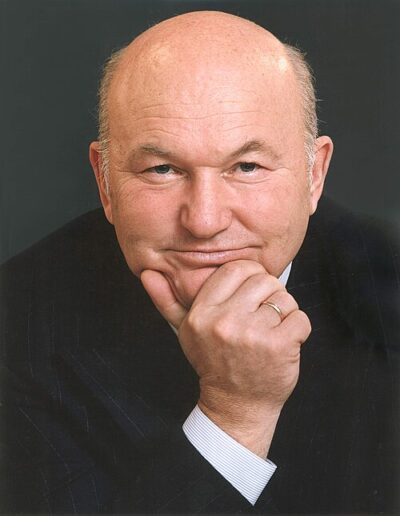
Yury Luzhkov
Yury Luzhkov was a Russian politician. Born September 21, 1936, in Moscow. Died December 10, 2019, in Munich. Positions held include mayor of Moscow (1992–2010), member of the Federation Council of Russia and Deputy Premier of the Soviet Union (1991). Educated at Gubkin University. Awards include USSR State Prize, Bavarian Order of Merit and Order of Lenin.
Facts
43 facts · 2 confirmed by two sources · 9 cited · 31 from one source · 1 where the sources disagree
What’s different
- Cause of death: we show surgical complications (Sources disagree). Wikidata also lists myocardial infarction
Where this comes from
Papalocal keeps its own record. It started from these sources; what each one said is kept here as it was copied, so a change on their side never changes this page by itself. Tap one to read its version.
What Wikidata says · copied November 16, 2026 · revision 2565604313
- Described as
- Russian politician (1936–2019)
- Other names
- Yury Mikhailovich Luzhkov, Yuri Luzhkov
- Born
- September 21, 1936 · 4 references
- Died
- December 10, 2019 · 5 references
- Born in
- Moscow · 1 reference
- Died in
- Munich · 1 reference
- Buried in
- Novodevichy Cemetery
- Cause of death
- surgical complications · 3 references; myocardial infarction
- Citizen of
- Soviet Union (1936–1991); Russia (1991–2019)
- Occupation
- politician · 1 reference; scientist; statesperson; mayor · 1 reference; engineer · 1 reference
- Positions held
- mayor of Moscow (1992–2010) · 1 reference; member of the Federation Council of Russia; Deputy Premier of the Soviet Union (1991); Prime Minister of Moscow (1991–2001) · 1 reference; Chairman of United Russia (2001–2004) · 1 reference
- Political party
- Communist Party of the Soviet Union (1968–1991) · 1 reference; United Russia (2001–2010) · 1 reference
- Education
- Gubkin University
- Member of
- Federation Council
- Awards
- USSR State Prize; Bavarian Order of Merit; Order of Lenin (1981); Order of Honour (2000); Gold Olympic Order (1999) · 1 reference; Medal "In Commemoration of the 300th Anniversary of Saint Petersburg"; European handicraft prize (2002) · 1 reference; Order "For Merit to the Fatherland", 2nd class (1995); Medal "For Strengthening of Brotherhood in Arms"; Order of St. Mesrop Mashtots; Medal "In Commemoration of the 850th Anniversary of Moscow"; Medal "Defender of a Free Russia" (1993); Order of the Red Banner of Labour (1976); Knight of the National Order of the Cedar; Order of Akhmad Kadyrov
- Field
- politics · 1 reference
- Spouse
- Elena Baturina (1991–2019) · 1 reference
- Father
- Mikhail Luzhkov
- Mother
- Anna Luzhkova
- Religion
- Russian Orthodox Church
- Website
- http://www.luzhkov.ru
- Wikipedias with a page
- 66
Wikidata item Q156379 (wikidata.org/wiki/Q156379), public domain (CC0). Copied November 16, 2026.
What Wikipedia says · copied November 16, 2026 · revision 1381191744
Yury Mikhailovich Luzhkov (Russian: Юрий Михайлович Лужков, IPA: [ˈjʉrʲɪj mʲɪˈxajləvʲɪtɕ lʊˈʂkof]; 21 September 1936 – 10 December 2019) was a Russian politician who served as mayor of Moscow from 1992 to 2010. Before the election of Gavriil Popov as the first mayor of Moscow, he also headed the capital in 1990–1991 as chairman of the Mosgorispolkom. He was the vice-chairman and one of the founders of the ruling United Russia party. During Luzhkov's time, Moscow's economy expanded and he presided over large construction projects in the city, including the building of a new financial district. At the same time, he was accused of corruption, bulldozing historic buildings, and poor handling of traffic, as well as the city's smog crisis during the 2010 Russian wildfires. On 28 September 2010, Luzhkov was fired from his post by a decree issued by then-President Dmitry Medvedev.
- Born, in its opening lines
- September 21, 1936
- Died, in its opening lines
- December 10, 2019
From the Wikipedia article “Yury Luzhkov” (en.wikipedia.org/wiki/Yury_Luzhkov), by its contributors, under CC BY-SA 4.0 (creativecommons.org/licenses/by-sa/4.0/). Copied November 16, 2026; not changed.
Confirmed Two sources agree. Cited One source, and it names where it got it. One source One source, without a reference of its own. Sources disagree The sources disagree. We show the best-supported value and keep theirs below.
