
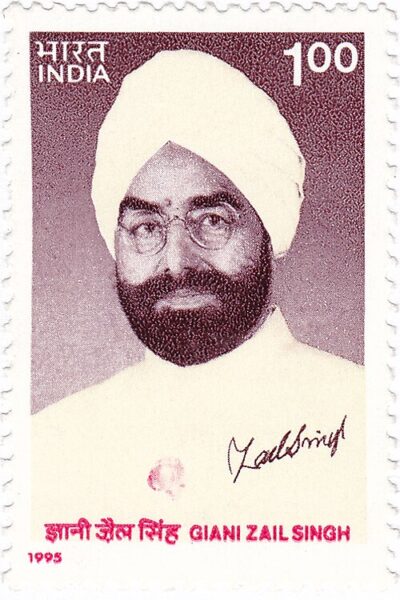
Zail Singh
Zail Singh was a President of India from 1982 to 1987. Born May 5, 1916, in Sandhwan. Died December 25, 1994, in Chandigarh. Positions held include Minister of Home Affairs (1980–1982), Member of the Lok Sabha and Chief Minister of Punjab (1972–1977). Awards include honorary doctor of Comenius University.
Facts
22 facts · 2 confirmed by two sources · 1 cited · 19 from one source
Where this comes from
Papalocal keeps its own record. It started from these sources; what each one said is kept here as it was copied, so a change on their side never changes this page by itself. Tap one to read its version.
What Wikidata says · copied November 16, 2026 · revision 2569408762
- Described as
- President of India from 1982 to 1987
- Other names
- Gyani Zail Singh
- Born
- May 5, 1916 · 5 references
- Died
- December 25, 1994 · 4 references
- Born in
- Sandhwan
- Died in
- Chandigarh
- Cause of death
- traffic collision
- Citizen of
- India (1950–); British Raj (–1947); Dominion of India (1947–1950)
- Occupation
- politician; badminton executive and administrator; freedom fighter
- Positions held
- Minister of Home Affairs (1980–1982); Member of the Lok Sabha; Chief Minister of Punjab (1972–1977); President of India (1982–1987); Member of the Punjab Legislative Assembly; Secretary General of the Non-Aligned Movement (1983–1986); Member of the 7th Lok Sabha
- Political party
- Indian National Congress
- Awards
- honorary doctor of Comenius University (1983) · 1 reference
- Children
- Joginder Singh
- Religion
- Sikhism
- Wikipedias with a page
- 57
Wikidata item Q334851 (wikidata.org/wiki/Q334851), public domain (CC0). Copied November 16, 2026.
What Wikipedia says · copied November 16, 2026 · revision 1385837712
Giani Zail Singh (, born Jarnail Singh; 5 May 1916 – 25 December 1994) was an Indian politician who served as President of India from 1982 to 1987 and chief minister of Punjab in the 1970s. He was the first Sikh to become president.
Born in Sandhwan in the princely state of Faridkot, Singh trained to be a granthi and was given the title of giani, meaning a learned man, while training at the Sikh Missionary School in Amritsar. Singh was associated with peasant agitations and the movement seeking a representative government in Faridkot. His political activism in the Praja Mandal, an organisation allied with the Indian National Congress, saw him sentenced to solitary confinement between 1938 and 1943. He led a flag satyagraha and formed a parallel government in Faridkot State which were called off only after the intervention of Jawaharlal Nehru and Vallabhbhai Patel. The stints in jail inspired him to change his name to Zail Singh.
After independence, Faridkot was merged with the Patiala and East Punjab States Union and Singh served as its minister of revenue and agriculture during 1949–51 and oversaw the introduction of land reforms in Punjab. Singh was a member of the Rajya Sabha during 1956–62 and member of the Punjab Legislative Assembly during 1962–67 during which time he served briefly as a minister under Partap Singh Kairon. He had served as president of PEPSU Pradesh Congress Committee during 1955–56 and became president of Punjab Pradesh Congress Committee in 1966 serving in that post until his election as chief minister of Punjab in 1972.
As chief minister, Singh is credited with having established India’s first semiconductor manufacturing unit in Mohali, legislating the Punjab Land Reforms Act of 1972, ensuring reservation for Mazhabi Sikhs and Valmikis in education and public employment and repatriating the remains of Udham Singh which were then cremated in Punjab with state honours. Singh’s policies aimed to undercut the influence of the Shiromani Akali Dal party by championing Sikh religious causes. Following the defeat of the Congress party in the elections of 1977, Singh and Sanjay Gandhi extended political and financial support to Jarnail Singh Bhindranwale, a radical Sikh preacher. Bhindranwale soon became the flagbearer of Sikh separatism and an insurgency seeking the establishment of Khalistan broke out in Punjab.
Elected to the Lok Sabha in 1980, Singh was appointed India’s home minister by Prime Minister Indira Gandhi. His tenure witnessed the worsening of the insurgency in Punjab where his rivalry with the state's new chief minister and support for Bhindranwale prevented resolute action against the insurgents. In 1982, he was elected president of India, succeeding Neelam Sanjiva Reddy. The initial years of his presidency saw the Operation Blue Star, the assassination of Indira Gandhi, and the 1984 anti-Sikh riots. After Rajiv Gandhi became prime minister, relations with Singh turned frosty as Gandhi refused to meet with or inform Singh on matters of policy and placing curbs on his foreign and domestic travels. Singh hit back by questioning government policy and subjecting proposals sent to him to minute scrutiny. In 1986, he employed a pocket veto on the Indian Post Office (Amendment) Bill passed by Parliament. Allegations of corruption in the procurement of howitzers from Bofors, the government’s refusal to furnish the documents sought for by President Singh and his much-publicized reproach to the government led to speculation that Singh intended to dismiss the government of Rajiv Gandhi. Singh however retired at the end of his tenure in 1987 and was succeeded as president by R. Venkataraman.
Singh died in 1994 of injuries sustained in a road accident. His samadhi is at the Ekta Sthal in Delhi. Singh’s memoirs were published in 1997. His birth centenary was celebrated in 2016 when a documentary film and a book on his life were released.
- Born, in its opening lines
- May 5, 1916
- Died, in its opening lines
- December 25, 1994
From the Wikipedia article “Zail Singh” (en.wikipedia.org/wiki/Zail_Singh), by its contributors, under CC BY-SA 4.0 (creativecommons.org/licenses/by-sa/4.0/). Copied November 16, 2026; not changed.
Confirmed Two sources agree. Cited One source, and it names where it got it. One source One source, without a reference of its own. Sources disagree The sources disagree. We show the best-supported value and keep theirs below.
