
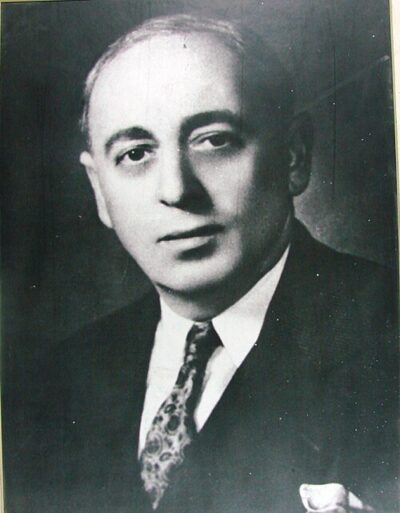
Zaki al-Arsuzi
Zaki al-Arsuzi was a Syrian philosopher. Born June 1899, in İskenderun. Died July 2, 1968, in Damascus. Educated at University of Paris.
Facts
13 facts · 2 confirmed by two sources · 1 cited · 9 from one source · 1 where the sources disagree
What’s different
- Born in: we show İskenderun (Sources disagree). Wikidata also lists Latakia
Where this comes from
Papalocal keeps its own record. It started from these sources; what each one said is kept here as it was copied, so a change on their side never changes this page by itself. Tap one to read its version.
What Wikidata says · copied November 18, 2026 · revision 2554069939
- Described as
- Syrian philosopher (1899–1968)
- Born
- June 1899
- Died
- July 2, 1968 · 2 references
- Born in
- İskenderun; Latakia
- Died in
- Damascus
- Buried in
- The cemetery of Dahdah · 1 reference
- Citizen of
- Syria
- Occupation
- politician; writer; philosopher; sociologist
- Political party
- Arab Socialist Ba'ath Party – Syria Region
- Education
- University of Paris
- Religion
- Alawites
- Wikipedias with a page
- 24
Wikidata item Q144693 (wikidata.org/wiki/Q144693), public domain (CC0). Copied November 18, 2026.
What Wikipedia says · copied November 18, 2026 · revision 1374838242
Zaki al-Arsuzi (Arabic: زكي الأرسوزي, romanized: Zakī al-Arsūzī; June 1899 – 2 July 1968) was a Syrian philosopher, philologist, sociologist, historian, and Arab nationalist. His ideas played a significant role in the development of Ba'athism and its political movement. He published several books during his lifetime, most notably The Genius of Arabic in its Tongue (1943).
Born into a middle-class Alawite family in Latakia, Syria, al-Arsuzi studied at the Sorbonne, where he became interested in nationalism. In 1930, he returned to Syria, where he became a member of the League of National Action (LNA) in 1933. In 1938, he moved to Damascus because of his disillusionment with party work, and in 1939, he left the LNA. In Damascus al-Arsuzi established and headed a group consisting of mostly secondary school pupils who would often discuss European history, nationalism and philosophy. Shortly after leaving the LNA, al-Arsuzi established the Arab National Party, an Arab nationalist party with a "defined creed". It was not a success and, on his return to Syria in November 1940 after a brief stay in Baghdad, al-Arsuzi established a new party, the Arab Ba'ath; by 1944, however, most of its members had left and joined Michel Aflaq's and Salah al-Din al-Bitar's Arab Ba'ath Movement, which subscribed to a nearly identical doctrine.
In 1947, the two movements merged, forming a single Arab Ba'ath Party. Despite the merger, Al-Arsuzi neither attended its founding conference nor was given membership.
During the rest of the 1940s and 1950s, al-Arsuzi stayed out of politics and worked as a teacher. He made a comeback during the 1960s power struggle in the Ba'ath Party between Aflaq and al-Bitar on one hand and Salah Jadid and Hafez al-Assad on the other. When Aflaq and al-Bitar lost the power struggle and were forced to escape from Syria in 1966, al-Arsuzi replaced Aflaq as the main ideologue of the Syrian-led faction of the Ba'ath Party (Neo-Ba'athist)
Al-Arsuzi's theories about society, language and nationalism, which are collectively part of Ba'athist thought, hold that the Arab Nation will be unified when the Arab people reestablish the Arab identity they have lost over the past 1000 years. The key to Arab unification, according to al-Arsuzi, is through language. In contrast to the Latin language, al-Arsuzi argued, Arabic was far less arbitrary and far more intuitive. Despite his contributions to Ba'athist thought, al-Arsuzi is barely mentioned in Western or Arab scholarship. This omission may be linked to the fact that Sati' al-Husri, a contemporary Arab nationalist, had many of the same ideas as al-Arsuzi but was better able to articulate them.
- Born, in its opening lines
- June 1899
- Died, in its opening lines
- July 2, 1968
From the Wikipedia article “Zaki al-Arsuzi” (en.wikipedia.org/wiki/Zaki_al-Arsuzi), by its contributors, under CC BY-SA 4.0 (creativecommons.org/licenses/by-sa/4.0/). Copied November 18, 2026; not changed.
Confirmed Two sources agree. Cited One source, and it names where it got it. One source One source, without a reference of its own. Sources disagree The sources disagree. We show the best-supported value and keep theirs below.
