
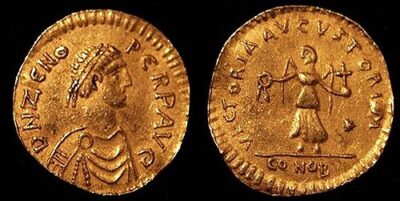
Zeno was a Byzantine Emperor. Born 425, in Zenopolis in Isauria. Died April 9, 491, in Constantinople. Positions held include Byzantine emperor (474–491), ancient Roman senator and Roman consul.
Facts
19 facts · 2 confirmed by two sources · 1 cited · 16 from one source
Where this comes from
Papalocal keeps its own record. It started from these sources; what each one said is kept here as it was copied, so a change on their side never changes this page by itself. Tap one to read its version.
What Wikidata says · copied November 16, 2026 · revision 2560186610
- Described as
- Byzantine Emperor (425–491)
- Other names
- Flavius Zeno, Tarasikodissa, Zenonus, Zeno Augustus, Imperator Caesar Zeno Augustus, Caesar Zeno Augustus
- Born
- 425
- Died
- April 9, 491 · 1 reference
- Born in
- Zenopolis in Isauria
- Died in
- Constantinople · 1 reference
- Buried in
- Church of the Holy Apostles
- Cause of death
- dysentery
- Citizen of
- Byzantine Empire
- Occupation
- politician; monarch
- Positions held
- Byzantine emperor (474–491); ancient Roman senator; Roman consul
- Spouse
- Arcadia; Ariadne
- Children
- Leo II
- Father
- Rusumbladeotos
- Mother
- Lallis
- Siblings
- Longinus
- Religion
- Christianity
- Wikipedias with a page
- 65
Wikidata item Q183452 (wikidata.org/wiki/Q183452), public domain (CC0). Copied November 16, 2026.
What Wikipedia says · copied November 16, 2026 · revision 1384097402
Zeno (; Latin: Zeno; Ancient Greek: Ζήνων, romanized: Zēnōn; c. 425 – 9 April 491) was Eastern Roman emperor from 474 to 475 and again from 476 to 491. His reign was plagued by domestic revolts and religious dissension, but was more successful on the foreign front. He is credited with further stabilizing the Eastern empire, while the Western Roman Empire fell following the deposition of Romulus Augustulus.
Born in Isauria, Zeno was known as Tarasis before adopting his Roman name and becoming an ally of Emperor Leo I, who saw the Isaurian general as an important counterweight against the Germanic leader Aspar. In 466, he married Leo I's daughter, Ariadne, with whom he had a son, Leo. On the death of Leo I in 474, Zeno's seven-year-old son took the throne as Leo II, with Zeno made co-emperor shortly after. Leo II died of an illness later that year, leaving Zeno as the sole emperor.
Despite his early success in making peace with the Vandals, Zeno was an unpopular emperor due to his barbarian origins. In early 475, he was forced to flee Constantinople in a revolt orchestrated in part by dowager Empress Verina, which with Leo I's brother-in-law Basiliscus installing himself as emperor. Seeking refuge in his native Isauria, Zeno later took advantage of Basiliscus's own flagging popularity, convinced the generals Illus and Armatus to defect, marched on the capital and reclaimed the throne in mid-476. Meanwhile, in the western empire, Germanic leader Odoacer deposed the final Western Roman emperor, Romulus Augustulus, and sent the imperial regalia to Constantinople. He expressly acknowledged the suzerainty of Zeno over the West, making Zeno the theoretical sole ruler of a reunified empire. In return, Zeno recognised Odoacer's de facto reign in Italy.
In the late 470s and 480s Zeno faced several revolts, including one from his brother-in-law Marcianus and one from Illus, both of which he ultimately suppressed. He also attempted to deal with hostilities from the two Ostrogothic leaders, Theodoric the Amal (Theodoric the Great) and Theodoric Strabo, by playing them against each other. Following Strabo's early death, Zeno was able to achieve a lasting peace with Theodoric by sending him to Italy, where he defeated Odoacer and established the Ostrogothic Kingdom.
In religious matters, Zeno issued the Henotikon in 482 on the advice of Acacius, the Patriarch of Constantinople, in an unsuccessful attempt to reconcile the differences between the Chalcedonians and the Miaphysites over the nature of Christ. Pope Felix III condemned the document and excommunicated Acacius in 484, beginning the Acacian schism which lasted until 519. Zeno died without an heir in 491 and was succeeded by Anastasius I Dicorus, a courtier chosen by Empress Ariadne.
- Born, in its opening lines
- c. 425
- Died, in its opening lines
- April 9, 491
From the Wikipedia article “Zeno (emperor)” (en.wikipedia.org/wiki/Zeno_(emperor)), by its contributors, under CC BY-SA 4.0 (creativecommons.org/licenses/by-sa/4.0/). Copied November 16, 2026; not changed.
Confirmed Two sources agree. Cited One source, and it names where it got it. One source One source, without a reference of its own. Sources disagree The sources disagree. We show the best-supported value and keep theirs below.
