
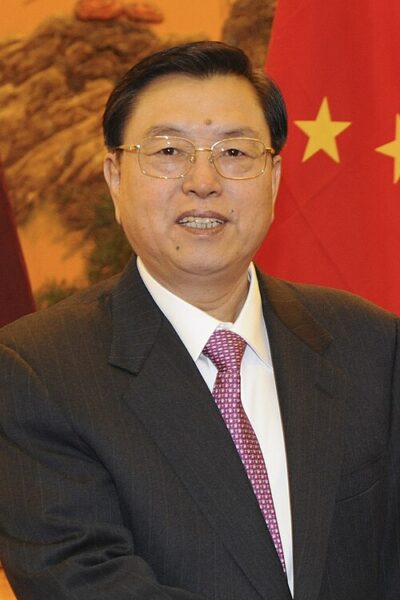
Zhang Dejiang is a Chinese retired politician. Born November 4, 1946, in Tai'an County. Positions held include Chairman of the Standing Committee of the National People's Congress (2013–2018), Vice Premier of the State Council of the People's Republic of China (2008–2013) and Secretary of the Jilin Committee of the Chinese Communist Party (1995–1998). Educated at Kim Il-sung University. Awards include Order of Friendship.
Facts
18 facts · 1 confirmed by two sources · 2 cited · 15 from one source
Where this comes from
Papalocal keeps its own record. It started from these sources; what each one said is kept here as it was copied, so a change on their side never changes this page by itself. Tap one to read its version.
What Wikidata says · copied November 16, 2026 · revision 2567416442
- Described as
- Chinese retired politician
- Born
- November 4, 1946
- Born in
- Tai'an County
- Citizen of
- People's Republic of China
- Occupation
- politician · 1 reference
- Positions held
- Chairman of the Standing Committee of the National People's Congress (2013–2018); Vice Premier of the State Council of the People's Republic of China (2008–2013); Secretary of the Jilin Committee of the Chinese Communist Party (1995–1998); Secretary of the CPC Zhejiang Committee (1998–2002); Secretary of the CCP Guangdong Committee (2002–2007); Secretary of the CCP Chongqing Committee (2012); member of the Politburo of the Chinese Communist Party (2002–2017); member of the Politburo Standing Committee of the Chinese Communist Party (2012–2017); National People's Congress deputy
- Political party
- Chinese Communist Party · 1 reference
- Education
- Kim Il-sung University (1978–1980)
- Awards
- Order of Friendship
- Spouse
- Xin Shusen
- Religion
- atheism
- Wikipedias with a page
- 31
Wikidata item Q197178 (wikidata.org/wiki/Q197178), public domain (CC0). Copied November 16, 2026.
What Wikipedia says · copied November 16, 2026 · revision 1378334910
Zhang Dejiang (; born 4 November 1946) is a Chinese retired politician who served as the chairman of the Standing Committee of the National People's Congress between 2013 and 2018. He was also the third-ranking member of the Politburo Standing Committee of the Chinese Communist Party from 2012 to 2017.
Born in Tai'an County, Liaoning, Zhang attended Yanbian University and Kim Il Sung University. Entering politics in 1983, he served as the deputy party secretary of the Yanji from 1983 to 1985 and the deputy party secretary of the Yanbian Korean Autonomous Prefecture from 1985 to 1986, when he became a vice minister of Civil Affairs. In 1990, he became the Party Secretary of Yanbian. In 1995, he was appointed as the Party Secretary of Jilin, serving there until 1998. In that year, he became the Party Secretary of Zhejiang, where he served until 2002. That year, he was promoted to the CCP Politburo and was appointed as the Party Secretary of Guangdong. During his tenure, the SARS outbreak began in Guangdong.
From 2008 to 2013, he served as vice premier in charge of energy, telecommunications, and transportation under Premier Wen Jiabao, widely known for being Wen's 'troubleshooter' of choice, leading various disaster response task forces, such as during the 2009 Heilongjiang mine explosion and the 2011 Wenzhou train collision. In March 2012, Zhang briefly replaced Bo Xilai as the party secretary of Chongqing, who was removed due to a political scandal. In 2013, he was promoted to become the third-ranking member of the CCP Politburo Standing Committee. He also became the deputy head of the National Security Commission and the top official responsible for Hong Kong and Macau affairs. He was appointed as the chairman of the NPCSC in 2013. In 2017, Zhang retired from the Politburo Standing Committee, and was succeeded by Li Zhanshu as NPCSC chair in 2018.
- Born, in its opening lines
- November 4, 1946
From the Wikipedia article “Zhang Dejiang” (en.wikipedia.org/wiki/Zhang_Dejiang), by its contributors, under CC BY-SA 4.0 (creativecommons.org/licenses/by-sa/4.0/). Copied November 16, 2026; not changed.
Confirmed Two sources agree. Cited One source, and it names where it got it. One source One source, without a reference of its own. Sources disagree The sources disagree. We show the best-supported value and keep theirs below.
