
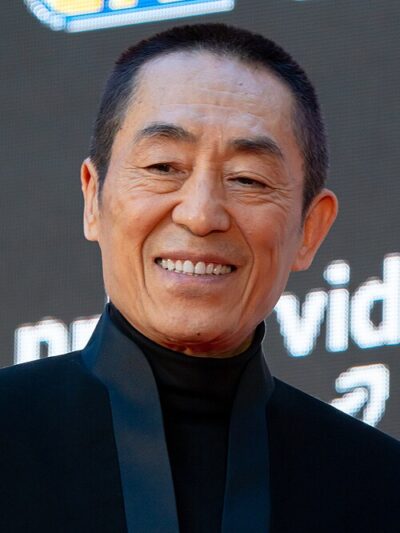
Zhang Yimou
Zhang Yimou is a Chinese filmmaker. Born April 2, 1950, in Xi'an. Positions held include member of the National Committee of the Chinese People's Political Consultative Conference. Known for Red Sorghum, Raise the Red Lantern and House of Flying Daggers. Educated at Beijing Film Academy. Awards include Asian Film Award for Lifetime Achievement, Golden Rooster Award for Best Director (3 times) and Golden Rooster Award for Best Actor.
Facts
29 facts · 0 confirmed by two sources · 5 cited · 23 from one source · 1 where the sources disagree
What’s different
- Born: we show April 2, 1950 (Sources disagree). Wikidata also lists November 14, 1951
Where this comes from
Papalocal keeps its own record. It started from these sources; what each one said is kept here as it was copied, so a change on their side never changes this page by itself. Tap one to read its version.
What Wikidata says · copied November 16, 2026 · revision 2569083976
- Described as
- Chinese filmmaker
- Other names
- Yi-Mou Zhang, Yimou Zhang
- Born
- April 2, 1950 · 2 references; November 14, 1951 · 2 references
- Born in
- Xi'an · 1 reference
- Citizen of
- People's Republic of China
- Occupation
- film director · 1 reference; actor · 1 reference; screenwriter; film producer; cinematographer
- Positions held
- member of the National Committee of the Chinese People's Political Consultative Conference
- Education
- Beijing Film Academy
- Known for
- Red Sorghum; Raise the Red Lantern; House of Flying Daggers; 2008 Summer Olympics opening ceremony; Ju Dou; The Story of Qiu Ju; To Live; Not One Less; The Road Home; Happy Times
- Awards
- Asian Film Award for Lifetime Achievement (2010) · 1 reference; Golden Rooster Award for Best Director (3 times) (1999, 2000, 2003); Golden Rooster Award for Best Actor (1988); Fukuoka Asian Culture Prize (2002); Cannes Film Festival Grand Prix (1994); Silver Bear Grand Jury Prize (2000); Silver Lion (1991); BAFTA Award for Best Film Not in the English Language (2 times) (1993, 1995); honorary doctor of Yale University (2010) · 1 reference
- Wikipedias with a page
- 57
Wikidata item Q55430 (wikidata.org/wiki/Q55430), public domain (CC0). Copied November 16, 2026.
What Wikipedia says · copied November 16, 2026 · revision 1385822398
Zhang Yimou (simplified Chinese: 张艺谋; traditional Chinese: 張藝謀; pinyin: Zhāng Yìmóu) is a Chinese filmmaker. A leading figure of China's Fifth Generation directors, he is considered as one of the most successful filmmakers in the world.
After graduating from the Beijing Film Academy, Zhang was assigned as a cinematographer at the Guangxi Film Studio in 1982. He made his acting debut in Old Well (1987), for which he won the Best Actor at the Tokyo International Film Festival, and made his directorial debut with Red Sorghum (1988), which won the Golden Bear at the Berlin International Film Festival. One of Zhang's early recurring themes is the resilience of ordinary people, as in To Live (1994) and Not One Less (1999). Beginning with Hero (2002), which marked the Chinese film industry's transition into large-scale commercial productions, his work increasingly engaged with grand narratives on politics and history, as in Curse of the Golden Flower (2006), The Flowers Of War (2011) and Under the Light (2023). His films are also noted for their rich use of colour, as in Raise the Red Lantern (1991) and House of Flying Daggers (2004), and for their portrayals of women that propelled "Mou Girls" to stardom, such as Gong Li, Zhang Ziyi and Ni Ni. His highest-budgeted film to date is the all-star The Great Wall (2016), which also became his greatest bomb. His highest-grossing film to date is Full River Red (2023), which became the seventh highest-grossing film of all time in China.
Zhang directed the opening and closing ceremonies of the 2008 Beijing Summer Olympic Games as well as the opening and closing ceremonies of the 2022 Beijing Winter Olympic Games. Since 2004, Zhang has collaborated with local governments across China to promote tourism through the “Impression” series of outdoor live stage productions, beginning with "Impression Liu Sanjie" in Yangshuo. Despite his frequent official affiliations, Zhang has, at various points in his career, fallen foul of Chinese censors.
Zhang was awarded an honorary doctorate from Yale University in 2010 and from Boston University in 2018. In 2022, he joined the Beijing Film Academy as a distinguished professor.
From the Wikipedia article “Zhang Yimou” (en.wikipedia.org/wiki/Zhang_Yimou), by its contributors, under CC BY-SA 4.0 (creativecommons.org/licenses/by-sa/4.0/). Copied November 16, 2026; not changed.
Confirmed Two sources agree. Cited One source, and it names where it got it. One source One source, without a reference of its own. Sources disagree The sources disagree. We show the best-supported value and keep theirs below.
