
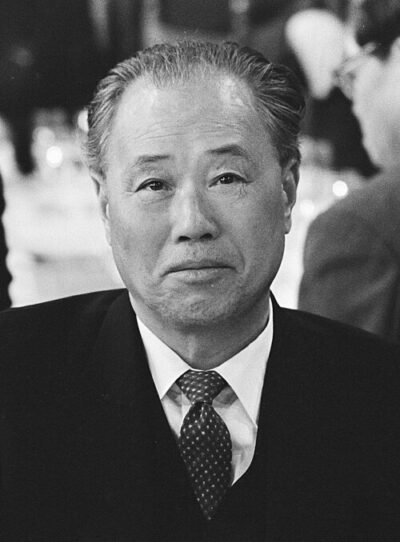
Zhao Ziyang
Zhao Ziyang was a former General Secretary of the Chinese Communist Party (CCP). Born October 17, 1919, in Hua County. Died January 17, 2005, in Beijing. Positions held include Premier of the People's Republic of China, General Secretary of the Chinese Communist Party (1987–1989) and Vice Chairman of the Chinese Communist Party (1981–1982).
Facts
22 facts · 2 confirmed by two sources · 6 cited · 14 from one source
Where this comes from
Papalocal keeps its own record. It started from these sources; what each one said is kept here as it was copied, so a change on their side never changes this page by itself. Tap one to read its version.
What Wikidata says · copied November 16, 2026 · revision 2569200833
- Described as
- former General Secretary of the Chinese Communist Party (CCP)
- Other names
- Zhao Zi Yang, Zhaoziyang
- Born
- October 17, 1919 · 11 references
- Died
- January 17, 2005 · 10 references
- Born in
- Hua County
- Died in
- Beijing · 1 reference
- Buried in
- Babaoshan Revolutionary Cemetery
- Cause of death
- stroke
- Name at birth
- 赵修业
- Citizen of
- Republic of China (–1949); People's Republic of China (1949–)
- Occupation
- politician · 1 reference
- Positions held
- Premier of the People's Republic of China; General Secretary of the Chinese Communist Party (1987–1989); Vice Chairman of the Chinese Communist Party (1981–1982); Secretary of the CCP Guangdong Committee (2 times) (1965–1975); member of the National Committee of the Chinese People's Political Consultative Conference; member of the Politburo Standing Committee of the Chinese Communist Party (1980–1989)
- Political party
- Chinese Communist Party (1938–) · 1 reference
- Member of
- Communist Youth League of China (1932–) · 1 reference
- Spouse
- Liang Boqi (1944–2005) · 1 reference
- Children
- Zhao Erjun; Wang Yannan
- Lived in
- Beijing (1989–2005) · 1 reference
- Wikipedias with a page
- 64
Wikidata item Q99829 (wikidata.org/wiki/Q99829), public domain (CC0). Copied November 16, 2026.
What Wikipedia says · copied November 16, 2026 · revision 1382553397
Zhao Ziyang (17 October 1919 – 17 January 2005) was a Chinese politician. He served as the premier of China from 1980 to 1987, as vice chairman of the Chinese Communist Party (CCP) from 1981 to 1982, and as the general secretary of the Chinese Communist Party from 1987 to 1989. He was in charge of the political reforms in China from 1986, but lost power for his support of the 1989 Tiananmen Square protests.
Zhao joined the Chinese Communist Party (CCP) in February 1938. During the Second Sino-Japanese War, he served as the chief officer of CCP Hua County Committee, Director of the Organization Department of the CCP Yubei Prefecture Party Committee, Secretary of the CCP Hebei-Shandong-Henan Border Region Prefecture Party Committee and Political Commissar of the 4th Military Division of the Hebei-Shandong-Henan Military Region. During the Chinese Civil War of 1945–1949, Zhao served as the Deputy Political Commissar of Tongbai Military Region, Secretary of the CCP Nanyang Prefecture Party Committee and Political Commissar of Nanyang Military Division.
After the establishment of the People's Republic of China, Zhao became Deputy Secretary of the South China Branch of the CCP Central Committee. He also served as Secretary of the Secretariat of the Guangdong Provincial Committee of the CCP, Second Secretary and First Secretary of the Guangdong Provincial Committee of the CCP. He was persecuted during the Cultural Revolution and spent time in political exile. After being rehabilitated, Zhao then was appointed Secretary of the CCP Inner Mongolia Autonomous Region Committee, First Secretary of the CCP Guangdong Provincial Committee, First Secretary of the CCP Sichuan Provincial Committee and First Political Commissar of the Chengdu Military Region, Vice Chairman of the National Committee of the Chinese People's Political Consultative Conference.
As a senior government official, Zhao was critical of Maoist policies and instrumental in implementing free-market reforms, first in Sichuan and subsequently nationwide. He emerged on the national scene due to support from Deng Xiaoping after the Cultural Revolution, being appointed as premier in 1980. An advocate of the privatization of state-owned enterprises, the separation of the party and the state, and reform and opening up, he sought measures to streamline China's bureaucracy and fight corruption and issues that challenged the party's legitimacy in the 1980s. Many of these views were shared by the then CCP general secretary Hu Yaobang. After Hu's downfall in 1987, Zhao succeeded him as Party general secretary.
His economic reform policies and sympathies with student demonstrators during the Tiananmen Square protests of 1989 placed him at odds with some members of the party leadership, including Central Advisory Commission Chairman Chen Yun, CPPCC Chairman Li Xiannian, and Premier Li Peng. Zhao also began to lose favor with Deng Xiaoping, who was the Chairman of the Central Military Commission. In the aftermath of the events, Zhao was purged politically and effectively placed under house arrest for the rest of his life. After his house arrest, he became much more radical in his political beliefs, supporting China's full transition to liberal democracy. He died from a stroke in Beijing in January 2005. Because of his political fall from grace, he was not given the funeral rites generally accorded to senior Chinese officials. His secret memoirs were smuggled out and published in English and in Chinese in 2009, but the details of his life remain censored in China.
- Born, in its opening lines
- October 17, 1919
- Died, in its opening lines
- January 17, 2005
From the Wikipedia article “Zhao Ziyang” (en.wikipedia.org/wiki/Zhao_Ziyang), by its contributors, under CC BY-SA 4.0 (creativecommons.org/licenses/by-sa/4.0/). Copied November 16, 2026; not changed.
Confirmed Two sources agree. Cited One source, and it names where it got it. One source One source, without a reference of its own. Sources disagree The sources disagree. We show the best-supported value and keep theirs below.
