
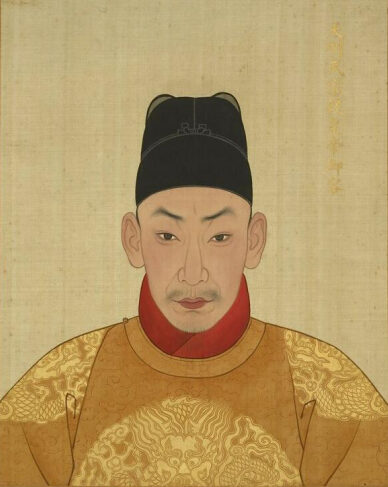
Zhengde Emperor
Zhengde Emperor was an emperor of the Ming Dynasty. Born October 26, 1491, in Beijing. Died April 20, 1521, in Beijing. Positions held include Emperor of China (1505–1521) and crown prince (1493–1505).
Facts
15 facts · 1 confirmed by two sources · 2 cited · 11 from one source · 1 where the sources disagree
What’s different
- Born: we show October 26, 1491 (Sources disagree). Wikipedia says November 14, 1491
Where this comes from
Papalocal keeps its own record. It started from these sources; what each one said is kept here as it was copied, so a change on their side never changes this page by itself. Tap one to read its version.
What Wikidata says · copied November 16, 2026 · revision 2569074314
- Described as
- emperor of the Ming Dynasty
- Other names
- Zhengde, Chengtiandadaoyingsuruizhezhaodexiangonghongwensixiaoyihuangdi, Wu Zong, Zhu Houzhao, Daqingfawang, Yi Di, Shou
- Born
- October 26, 1491
- Died
- April 20, 1521
- Born in
- Beijing
- Died in
- Beijing
- Buried in
- Kangling Mausoleum (Ming dynasty)
- Citizen of
- Ming dynasty · 1 reference
- Occupation
- ruler
- Positions held
- Emperor of China (1505–1521); crown prince (1493–1505)
- Spouse
- Empress Xiaojingyi; Wang fei · 1 reference
- Father
- Hongzhi Emperor
- Mother
- Empress Xiaochengjing
- Siblings
- Zhu Houwei; Princess Taikang
- Wikipedias with a page
- 38
Wikidata item Q10007 (wikidata.org/wiki/Q10007), public domain (CC0). Copied November 16, 2026.
What Wikipedia says · copied November 16, 2026 · revision 1383201935
The Zhengde Emperor (14 November 1491 – 20 April 1521), personal name Zhu Houzhao, was the 11th emperor of the Ming dynasty of China, reigning from 1505 to 1521. He succeeded his father, the Hongzhi Emperor.
The Zhengde Emperor was the eldest and only surviving son of the Hongzhi Emperor. As heir to the throne, he received a Confucian education and was known for his intelligence during his studies. However, upon taking power, it became evident that he had a strong aversion to the Confucian-oriented bureaucracy and rejected the rituals and duties associated with it. He frequently clashed with ministers and grand secretaries, instead relying on court eunuchs, particularly the "Eight Tigers", with whom he had grown up. From 1506 to 1510, the eunuch Liu Jin effectively controlled the government, appointing his allies and supporters to important positions. The Emperor even moved out of the Forbidden City to the newly built "Leopard Quarter" where he surrounded himself with eunuchs and officers. After Liu Jin's downfall, the actor Zang Xian and officers Qian Ning and Jiang Bin became the Emperor's favorites, while Grand Secretary Yang Tinghe managed the general administration.
Liu Jin's administration was marked by high tax pressure and a decline in the government's authority, which ultimately led to multiple large-scale rebellions. These included the Prince of Anhua rebellion, the rebellion of 1510, and the Prince of Ning rebellion, the last of which was eventually quelled by the statesman and philosopher Wang Yangming. Looking for new sources of income, the Emperor lifted the ban on private foreign trade. This coincided with the arrival of Portuguese sailors in southern China, who began trading with Chinese partners.
In 1517, the Emperor spent the majority of his time on the Sino-Mongol border northwest of Beijing, primarily in the garrison town of Datong. During this time, he successfully repelled a major Mongol raid led by Dayan Khan. In 1519, he traveled to Nanjing, remaining there for most of 1520. On his return journey, he fell into the water while drunk and became ill. He died a few months later, leaving no children. Yang Tinghe, with the support of the deceased emperor's mother, Empress Dowager Zhang, placed his closest male relative, his thirteen-year-old cousin Zhu Houcong, on the throne.
- Born, in its opening lines
- November 14, 1491
- Died, in its opening lines
- April 20, 1521
From the Wikipedia article “Zhengde Emperor” (en.wikipedia.org/wiki/Zhengde_Emperor), by its contributors, under CC BY-SA 4.0 (creativecommons.org/licenses/by-sa/4.0/). Copied November 16, 2026; not changed.
Confirmed Two sources agree. Cited One source, and it names where it got it. One source One source, without a reference of its own. Sources disagree The sources disagree. We show the best-supported value and keep theirs below.
