
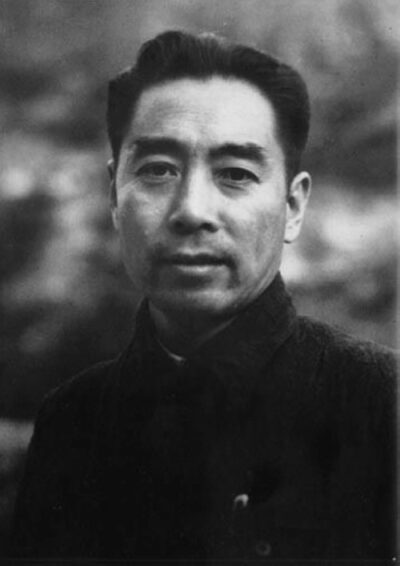
Zhou Enlai
Zhou Enlai was the 1st Premier of the People's Republic of China. Born March 5, 1898, in Huai'an District. Died January 8, 1976, in Beijing. Positions held include Premier of the People's Republic of China (1954–1976), Vice Chairman of the Chinese Communist Party (1956–1966) and Chairman of the National Committee of the Chinese People's Political Consultative Conference (1954–1976). Educated at Meiji University and Waseda University. Awards include First Class Red Star Medal, Deshikottam and People's Liberation Army Strategist.
Facts
34 facts · 2 confirmed by two sources · 6 cited · 26 from one source
Where this comes from
Papalocal keeps its own record. It started from these sources; what each one said is kept here as it was copied, so a change on their side never changes this page by itself. Tap one to read its version.
What Wikidata says · copied November 16, 2026 · revision 2564229438
- Described as
- 1st Premier of the People's Republic of China
- Other names
- Enlai Zhou, Chou En-lai, Premier Zhou
- Born
- March 5, 1898 · 5 references
- Died
- January 8, 1976 · 9 references
- Born in
- Huai'an District
- Died in
- Beijing · 2 references
- Cause of death
- bladder cancer
- Citizen of
- People's Republic of China (1949–); Qing dynasty (–1912); Republic of China (1912–1949)
- Occupation
- minister · 1 reference; foreign minister (1949–1958); politician · 2 references
- Positions held
- Premier of the People's Republic of China (1954–1976); Vice Chairman of the Chinese Communist Party (1956–1966); Chairman of the National Committee of the Chinese People's Political Consultative Conference (1954–1976); Minister of Foreign Affairs of the People's Republic of China (1949–1958); member of the Politburo Standing Committee of the Chinese Communist Party (2 times) (1931–1976); National People's Congress deputy (1954–1976); member of the National Political Assembly
- Political party
- Chinese Communist Party (1921–); Kuomintang (1923–1927)
- Worked for
- People's Republic of China
- Education
- Meiji University; Waseda University; Nankai University · 1 reference
- Awards
- First Class Red Star Medal (1933) · 1 reference; Deshikottam (1957) · 1 reference; People's Liberation Army Strategist; Grand Cross of the Order of Polonia Restituta · 1 reference
- Spouse
- Deng Yingchao (1925–1976) · 1 reference
- Mother
- Wan Shi · 1 reference
- Siblings
- Zhou Enshou
- Religion
- atheism
- Military branch
- National Revolutionary Army · 1 reference
- Military rank
- general
- Wikipedias with a page
- 102
Wikidata item Q17410 (wikidata.org/wiki/Q17410), public domain (CC0). Copied November 16, 2026.
What Wikipedia says · copied November 16, 2026 · revision 1383982102
Zhou Enlai (Chinese: 周恩来; pinyin: Zhōu Ēnlái; Wade–Giles: Chou¹ Ên¹-lai²; 5 March 1898 – 8 January 1976) was a Chinese statesman, diplomat, and revolutionary who served as the first Premier of the People's Republic of China from October 1949 until his death in January 1976. Zhou was among the Chinese Communist Party's earliest leaders, though he was subordinate to Mao Zedong following the Zunyi Conference. After the founding of the PRC, he helped Mao consolidate party power and shape foreign policy, while striving to maintain state operations amid tumultuous politics.
As a diplomat, Zhou served as the PRC's foreign minister from 1949 to 1958. Advocating peaceful coexistence with the West after the Korean War, he attended the 1954 Geneva Conference and the 1955 Bandung Conference, helped orchestrate Richard Nixon's 1972 visit to China, and steered China's relations with major countries including the United States and the Soviet Union.
As premier, Zhou was the main force maintaining the Chinese government and economy during the Cultural Revolution. He remained deferential to Mao, but attempted to mitigate the damage and to shield some from purges and persecution. Deng Xiaoping maintained that without Zhou, the Cultural Revolution might have been worse, but might not have dragged on for as long. Following the fall of Lin Biao, Zhou was elected the first-ranking Vice Chairman of the Communist Party by the 10th Central Committee in 1973, while contending with the Gang of Four. After the 4th National People's Congress on 13 January 1975, he withdrew from public life for medical treatment and died the following year. The outpouring of grief turned into the 1976 Tiananmen Incident and signaled the beginning of the end for the Cultural Revolution. After his death, his widow, Deng Yingchao, became instrumental in the post-Mao reform and opening up, as one of the Eight Elders.
- Born, in its opening lines
- March 5, 1898
- Died, in its opening lines
- January 8, 1976
From the Wikipedia article “Zhou Enlai” (en.wikipedia.org/wiki/Zhou_Enlai), by its contributors, under CC BY-SA 4.0 (creativecommons.org/licenses/by-sa/4.0/). Copied November 16, 2026; not changed.
Confirmed Two sources agree. Cited One source, and it names where it got it. One source One source, without a reference of its own. Sources disagree The sources disagree. We show the best-supported value and keep theirs below.
