
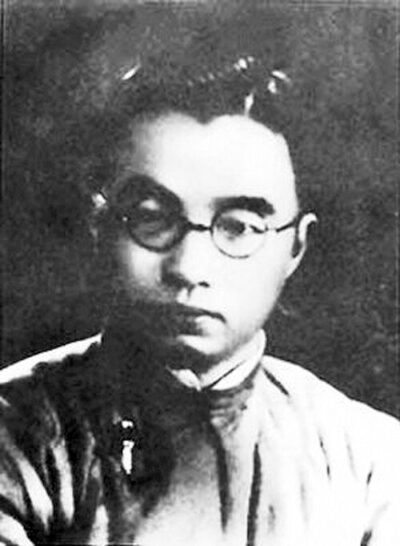
Zhu Ziqing
Zhu Ziqing was a Chinese poet. Born November 22, 1898, in Haizhou Zhilizhou. Died August 12, 1948, in Beijing. Educated at Peking University and Tsinghua University.
Facts
16 facts · 2 confirmed by two sources · 2 cited · 12 from one source
Where this comes from
Papalocal keeps its own record. It started from these sources; what each one said is kept here as it was copied, so a change on their side never changes this page by itself. Tap one to read its version.
What Wikidata says · copied November 18, 2026 · revision 2556605966
- Described as
- Chinese poet (1898–1948)
- Other names
- Peixian, Ziqing Zhu, Qiushi
- Born
- November 22, 1898 · 1 reference
- Died
- August 12, 1948
- Born in
- Haizhou Zhilizhou · 1 reference
- Died in
- Beijing
- Citizen of
- People's Republic of China · 1 reference
- Occupation
- poet; writer; scholar; prose writer; essayist
- Worked for
- Peking University; Tsinghua University · 1 reference
- Education
- Peking University; Tsinghua University
- Children
- Zhu Maixian
- Siblings
- Zhu Wuhua
- Wikipedias with a page
- 21
Wikidata item Q618396 (wikidata.org/wiki/Q618396), public domain (CC0). Copied November 18, 2026.
What Wikipedia says · copied November 18, 2026 · revision 1372858512
Zhu Ziqing (22 November 1898 – 12 August 1948), born Zhu Zihua, courtesy name Peixian (佩弦) and art name Shiqiu (實秋), was a Chinese essayist, poet, scholar and educator. A native of Shaoxing, Zhejiang, and born in what is now Donghai County, Jiangsu, he is chiefly remembered for his essays in vernacular Chinese and for his early new poetry. He is especially associated with such prose pieces as Retreating Figure and Moonlight over the Lotus Pond. He served as a professor and later head of the Department of Chinese at Tsinghua University and, during the Second Sino-Japanese War, at the National Southwestern Associated University.
Zhu occupies a foundational position in the history of modern Chinese prose. His essays are frequently praised for their structural coherence, emotional restraint, colloquial precision, and capacity to fuse landscape observation with inward feeling. At the same time, his work has attracted scholarly debate, particularly regarding its lyrical ornamentation and rhetorical finish. In modern Chinese literary history, he is generally regarded as one of the canonical prose writers of the Republican period.
- Born, in its opening lines
- November 22, 1898
- Died, in its opening lines
- August 12, 1948
From the Wikipedia article “Zhu Ziqing” (en.wikipedia.org/wiki/Zhu_Ziqing), by its contributors, under CC BY-SA 4.0 (creativecommons.org/licenses/by-sa/4.0/). Copied November 18, 2026; not changed.
Confirmed Two sources agree. Cited One source, and it names where it got it. One source One source, without a reference of its own. Sources disagree The sources disagree. We show the best-supported value and keep theirs below.
