
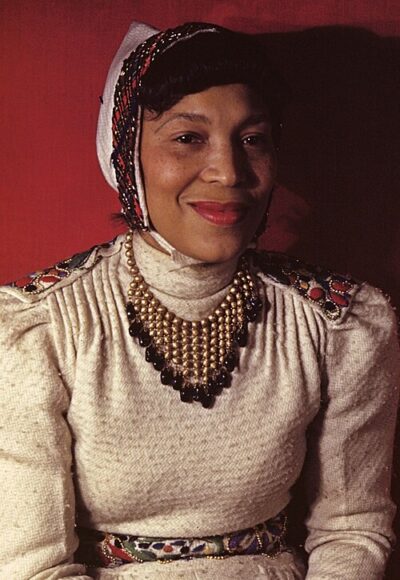
Zora Neale Hurston
Zora Neale Hurston was an African American folklorist, novelist, short story writer, and Civic Rights advocate. Born January 7, 1891, in Notasulga. Died January 28, 1960, in Fort Pierce. Known for Their Eyes Were Watching God. Educated at Howard University and Columbia University. Awards include Guggenheim Fellowship (2 times), National Women's Hall of Fame and Florida Women's Hall of Fame.
Facts
29 facts · 2 confirmed by two sources · 17 cited · 10 from one source
Where this comes from
Papalocal keeps its own record. It started from these sources; what each one said is kept here as it was copied, so a change on their side never changes this page by itself. Tap one to read its version.
What Wikidata says · copied November 13, 2026 · revision 2565601775
- Described as
- African American folklorist, novelist, short story writer, and Civic Rights advocate (1891–1960)
- Other names
- Zora N. Hurston
- Born
- January 7, 1891 · 11 references
- Died
- January 28, 1960 · 11 references
- Born in
- Notasulga · 1 reference
- Died in
- Fort Pierce · 1 reference
- Buried in
- Garden of Heavenly Rest Cemetery · 3 references
- Cause of death
- stroke
- Citizen of
- United States
- Occupation
- anthropologist · 3 references; historian; novelist · 1 reference; writer · 3 references; journalist; folklorist · 1 reference; civil rights advocate; playwright · 2 references
- Political party
- Republican Party
- Education
- Howard University · 1 reference; Columbia University · 2 references; Barnard College (1925–1928) · 2 references
- Known for
- Their Eyes Were Watching God · 1 reference
- Awards
- Guggenheim Fellowship (2 times) (1936, 1937) · 1 reference; National Women's Hall of Fame (1994) · 1 reference; Florida Women's Hall of Fame (1984) · 1 reference; Florida Artists Hall of Fame; Anisfield-Wolf Book Awards (1943); Alabama Women's Hall of Fame (2013) · 1 reference
- Religion
- atheism
- Lived in
- Zora Neale Hurston House (1957–1960) · 1 reference
- Website
- https://zoranealehurston.com
- Wikipedias with a page
- 66
Wikidata item Q220480 (wikidata.org/wiki/Q220480), public domain (CC0). Copied November 13, 2026.
What Wikipedia says · copied November 13, 2026 · revision 1385500077
Zora Neale Hurston (January 7, 1891 – January 28, 1960) was an American writer, anthropologist, folklorist, and documentary filmmaker. She portrayed racial struggles in the early-20th-century American South and published research on Hoodoo and Caribbean Vodou. The most popular of her four novels is Their Eyes Were Watching God, published in 1937. She also wrote more than 50 short stories, plays, an autobiography, ethnographies, and many essays.
Some of her work, namely Tell My Horse (1937), explored ethnomusicological methods of study long before there were formal boundaries for the discipline, especially not boundaries that included the respectful study of communities of color. Hurston's unique background and exceptional approach to anthropology laid key foundations for the growth of ethnography, literature, and Africana Studies.
Hurston was born in Notasulga, Alabama, and moved with her family to Eatonville, Florida, in 1894. She later used Eatonville as the setting for many of her stories.
In her early career, Hurston conducted anthropological and ethnographic research with anthropologist Franz Boas as a scholar at Barnard College and Columbia University. She had an interest in Black American and Caribbean folklore, and how these contributed to the community's identity.
She also wrote about contemporary issues in the Black community and became a central figure of the Harlem Renaissance. Her short satires, drawing from the African-American experience and racial division, were published in anthologies such as The New Negro and Fire!!. After moving back to Florida, Hurston wrote and published her literary anthology on African-American folklore in North Florida, Mules and Men (1935), and her first three novels: Jonah's Gourd Vine (1934); Their Eyes Were Watching God (1937); and Moses, Man of the Mountain (1939). Also published during this time was Tell My Horse: Voodoo and Life in Haiti and Jamaica (1938), documenting her research on rituals in Jamaica and Haiti.
Hurston's works concerned both the African-American experience and her struggles as an African-American woman. Her novels went relatively unrecognized by the literary world for decades. In 1975, fifteen years after Hurston's death, interest in her work was revived after author Alice Walker published an article, "In Search of Zora Neale Hurston" (later retitled "Looking for Zora"), in Ms. magazine.
In 2001, Hurston's manuscript Every Tongue Got to Confess, a collection of folktales gathered in the 1920s, was published after being discovered in the Smithsonian archives. Her nonfiction book Barracoon: The Story of the Last "Black Cargo" (2018), about the life of Cudjoe Lewis (Kossola), one of the last survivors of slaves brought illegally to the US in 1860, was also published posthumously.
- Born, in its opening lines
- January 7, 1891
- Died, in its opening lines
- January 28, 1960
From the Wikipedia article “Zora Neale Hurston” (en.wikipedia.org/wiki/Zora_Neale_Hurston), by its contributors, under CC BY-SA 4.0 (creativecommons.org/licenses/by-sa/4.0/). Copied November 13, 2026; not changed.
Confirmed Two sources agree. Cited One source, and it names where it got it. One source One source, without a reference of its own. Sources disagree The sources disagree. We show the best-supported value and keep theirs below.
