
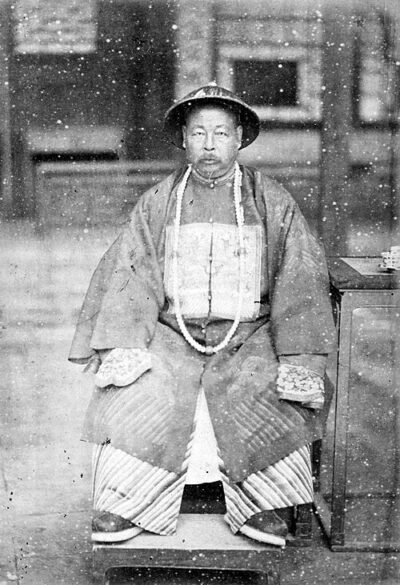
Zuo Zongtang
Zuo Zongtang was a Qing dynasty general. Born November 10, 1812, in Xiangyin County. Died September 5, 1885, in Fuzhou. Positions held include Viceroy of Liangjiang (1881–1884), Gouverneur général du Shānxi et du Gansu (1866–1880) and Viceroy of Min-Zhe (1863–1866).
Facts
21 facts · 2 confirmed by two sources · 5 cited · 14 from one source
Where this comes from
Papalocal keeps its own record. It started from these sources; what each one said is kept here as it was copied, so a change on their side never changes this page by itself. Tap one to read its version.
What Wikidata says · copied November 17, 2026 · revision 2553996235
- Described as
- Qing dynasty general (1812-1885)
- Other names
- Xiangshangnongren, Jigao, Pucun, Wenxiang, Shangnongren, Tso Tsung-t'ang, General Tso, Tso Tsung-tang, Tsung-t'ang Tso
- Born
- November 10, 1812 · 2 references
- Died
- September 5, 1885 · 2 references
- Born in
- Xiangyin County
- Died in
- Fuzhou
- Buried in
- Tomb of Zuo Zongtang
- Cause of death
- disease
- Citizen of
- Qing dynasty
- Occupation
- politician; warrior; artist
- Positions held
- Viceroy of Liangjiang (1881–1884); Gouverneur général du Shānxi et du Gansu (1866–1880); Viceroy of Min-Zhe (1863–1866); xunfu; Junji dachen
- Spouse
- Zhou Yiduan · 1 reference
- Children
- Zuo Xiaoyu · 2 references; Zuo Xiaoqi · 2 references; Zuo Xiaolin · 2 references; Zuo Xiaopian · 2 references
- Military rank
- general
- Wikipedias with a page
- 25
Wikidata item Q230200 (wikidata.org/wiki/Q230200), public domain (CC0). Copied November 17, 2026.
What Wikipedia says · copied November 17, 2026 · revision 1382375921
Zuo Zongtang (左宗棠, Xiang Chinese: [tso˧˩ tsoŋ˧ tan˩˧]; Wade-Giles spelling: Tso Tsung-t'ang; 10 November 1812 – 5 September 1885), sometimes referred to as General Tso, was a Chinese statesman and army officer of the late Qing dynasty.
Born in Xiangyin County, Hunan Province, Zuo started his career in the Qing military by participating in the campaign against the Taiping Rebellion in 1851. After capturing Hangzhou from the Taiping rebels in 1864, he was enfeoffed as a first class count. In 1866, Zuo oversaw the construction of the Foochow Arsenal and naval academy. That same year, he was reassigned to serve as the Viceroy of Shaan-Gan, where he oversaw industrialization in Gansu Province. In 1867, he was appointed as an Imperial Commissioner in charge of military affairs in Gansu.
During his term as Imperial Commissioner in Gansu, Zuo participated in the suppression of the Nian Rebellion and Dungan Revolt. By the late 1870s, he had crushed the Dungan rebels and recaptured Xinjiang Province from rebel forces. In 1878, because of his achievements, Zuo was promoted from a first class count to a second class marquis. He was appointed to the Grand Council in 1884, before being made an Imperial Commissioner again to oversee naval affairs. He died in 1885 in Fuzhou, Fujian Province, and was given the posthumous name Wenxiang.
Zuo is mostly acknowledged outside China for his military exploits, but he also contributed to Chinese agricultural science and education. In particular, he promoted cotton cultivation to northwestern China as a replacement for the cash crop opium and established a large modern press in Shaanxi and Gansu provinces, which published Confucian classics and newer works on agricultural science.
- Born, in its opening lines
- November 10, 1812
- Died, in its opening lines
- September 5, 1885
From the Wikipedia article “Zuo Zongtang” (en.wikipedia.org/wiki/Zuo_Zongtang), by its contributors, under CC BY-SA 4.0 (creativecommons.org/licenses/by-sa/4.0/). Copied November 17, 2026; not changed.
Confirmed Two sources agree. Cited One source, and it names where it got it. One source One source, without a reference of its own. Sources disagree The sources disagree. We show the best-supported value and keep theirs below.
