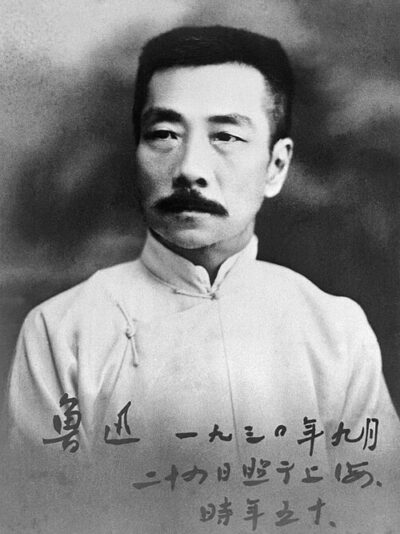
A Madman's Diary
A Madman's Diary is a 1918 short story by Lu Xun.
- Published
- 1918
- Written by
- Lu Xun
- Country of origin
- People's Republic of China
All 5 facts, and where they come from
Facts
5 facts · 0 confirmed by two sources · 0 cited · 5 from one source
Where this comes from
Papalocal keeps its own record. It started from these sources; what each one said is kept here as it was copied, so a change on their side never changes this page by itself. Tap one to read its version.
What Wikidata says · copied November 17, 2026 · revision 2505658282
- Described as
- 1918 short story by Lu Xun
- Other names
- Diary of a Madman, Kuangren riji
- What it is
- literary work
- Written by
- Lu Xun
- Published
- 1918
- Language
- written vernacular Chinese
- Country of origin
- People's Republic of China
- Wikipedias with a page
- 24
Wikidata item Q967831 (wikidata.org/wiki/Q967831), public domain (CC0). Copied 2026-11-17.
What Wikipedia says · copied November 17, 2026 · revision 1356686279
"Diary of a Madman", also translated as "A Madman's Diary" (Chinese: 狂人日記; pinyin: Kuángrén Rìjì) is a short story by the Chinese writer Lu Xun, published in 1918. It was an early work written in vernacular Chinese in Republican-era China and became associated with the New Culture Movement. Lu Xun's stories often critiqued early 20th-century Chinese society, and "Diary of a Madman" established a new language and revolutionary figure of Chinese literature, an attempt to challenge conventional thinking and traditional understanding.
The diary form and the idea of the madman who sees reality more clearly than those around him were inspired by Nikolai Gogol's short story "Diary of a Madman". Lu Xun's "madman" sees "cannibalism" both in his family and the village around him, and he then finds cannibalism in the Confucian classics which had long been credited with a humanistic concern for the mutual obligations of society, and thus used to justify the superiority of Confucian civilization. The story can be read as a sardonic attack on traditional Chinese culture and society and a call for a new cultural direction.
"Diary of a Madman" is the opening story in Lu Xun's first collection, and has often been referred to as "China's first modern short story". Along with Chen Hengzhe's "One Day", it was among the most influential modern vernacular Chinese works published after the Xinhai Revolution. It was selected as one of the 100 best books in history by the Bokklubben World Library, and listed as one of the ten best Asian novels of all time by The Telegraph in 2014.
From the Wikipedia article “Diary of a Madman (Lu Xun short story)” (en.wikipedia.org/wiki/Diary_of_a_Madman_(Lu_Xun_short_story)), by its contributors, under CC BY-SA 4.0 (creativecommons.org/licenses/by-sa/4.0/). Copied 2026-11-17; not changed.
Confirmed Two sources agree. Cited One source, and it names where it got it. One source One source, without a reference of its own. Sources disagree The sources disagree. We show the best-supported value and keep theirs below.
Picture: Wikimedia Commons: A Madman's Diary - Lu Xun.JPG · See Commons file page