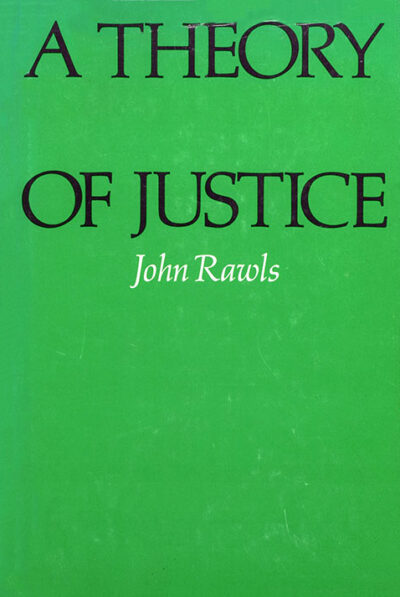
A Theory of Justice
A Theory of Justice is a work of political philosophy and ethics by John Rawls. It came out in 1971.
- Published
- 1971
- Written by
- John Rawls
- Genre
- philosophical non-fiction literature
- Country of origin
- United States
All 8 facts, and where they come from
Facts
8 facts · 0 confirmed by two sources · 1 cited · 7 from one source
Where this comes from
Papalocal keeps its own record. It started from these sources; what each one said is kept here as it was copied, so a change on their side never changes this page by itself. Tap one to read its version.
What Wikidata says · copied November 16, 2026 · revision 2555873055
- Described as
- work of political philosophy and ethics by John Rawls
- Other names
- Theory of Justice, Rawlsian Justice, A theory of justice, A theory of social justice, A Theory Of Justice, theory of justice
- What it is
- written work
- Written by
- John Rawls
- Publisher
- Harvard University Press
- Genre
- philosophical non-fiction literature · 1 reference; essay
- Published
- 1971 · 1 reference
- Language
- English
- Country of origin
- United States · 1 reference
- Wikipedias with a page
- 29
Wikidata item Q300588 (wikidata.org/wiki/Q300588), public domain (CC0). Copied 2026-11-16.
What Wikipedia says · copied November 16, 2026 · revision 1384224835
A Theory of Justice is a 1971 work of political philosophy and ethics by the philosopher John Rawls (1921–2002) in which the author attempts to provide a moral theory alternative to utilitarianism and that addresses the problem of distributive justice (the socially just distribution of goods in a society).
The theory uses an updated form of Kantian philosophy and a variant form of conventional social contract theory. Rawls's theory of justice is fully a political theory of justice as opposed to other forms of justice discussed in other disciplines and contexts.
The resultant theory was challenged and refined several times in the decades following its original publication in 1971. A significant reappraisal was published in the 1985 essay "Justice as Fairness" and the 2001 book Justice as Fairness: A Restatement in which Rawls further developed his two central principles for his discussion of justice. Together, they assert that society should be structured to provide the greatest possible degree of liberty to its members, limited only by the principle that one individual's liberty must not infringe upon the liberty of others. Secondly, inequalities – either social or economic – are only to be allowed if the worst off will be better off than they might be under an equal distribution. Finally, if an inequality is to be justified on the grounds of its benefits, it must not create additional barriers for those without resources to access positions of power, such as public office.
From the Wikipedia article “A Theory of Justice” (en.wikipedia.org/wiki/A_Theory_of_Justice), by its contributors, under CC BY-SA 4.0 (creativecommons.org/licenses/by-sa/4.0/). Copied 2026-11-16; not changed.
Confirmed Two sources agree. Cited One source, and it names where it got it. One source One source, without a reference of its own. Sources disagree The sources disagree. We show the best-supported value and keep theirs below.
Picture: No individually credited designer. Published by the Belknap Press of Harvard University Press., via Wikimedia Commons · Public domain