
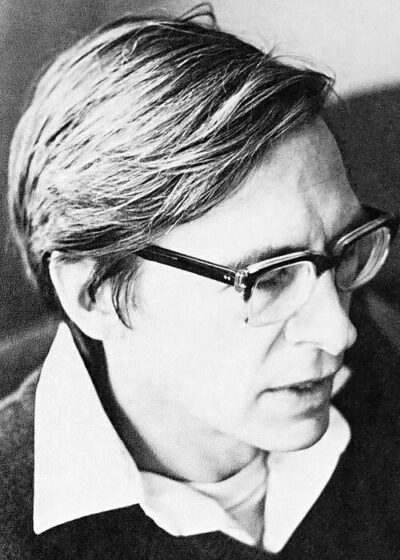
John Rawls
John Rawls was an American philosopher, philosophy teacher. Born February 21, 1921, in Baltimore. Died November 24, 2002, in Lexington. Known for A Theory of Justice, Political Liberalism and The Law of Peoples. Educated at Princeton University and Kent School. Awards include Guggenheim Fellowship, National Humanities Medal and Rolf Schock Prize in Logic and Philosophy.
Facts
36 facts · 2 confirmed by two sources · 11 cited · 23 from one source
Where this comes from
Papalocal keeps its own record. It started from these sources; what each one said is kept here as it was copied, so a change on their side never changes this page by itself. Tap one to read its version.
What Wikidata says · copied November 13, 2026 · revision 2568298642
- Described as
- American philosopher, philosophy teacher
- Other names
- John Bordley Rawls, J. Roljŭ, Jon Rōruzu, Rawls
- Born
- February 21, 1921 · 9 references
- Died
- November 24, 2002 · 11 references
- Born in
- Baltimore · 4 references
- Died in
- Lexington · 2 references
- Buried in
- Mount Auburn Cemetery · 1 reference
- Citizen of
- United States · 1 reference
- Occupation
- philosopher · 1 reference; pedagogue; university teacher · 1 reference; politician · 1 reference
- Worked for
- Princeton University; Harvard University (1962–1991) · 1 reference; Massachusetts Institute of Technology (1960–1962) · 1 reference; Cornell University (1953–1959) · 1 reference
- Education
- Princeton University (1939–1950) · 1 reference; Kent School; Calvert School
- Member of
- American Academy of Arts and Sciences (1966–); American Philosophical Society (1974–) · 1 reference; British Academy · 1 reference
- Known for
- A Theory of Justice; Political Liberalism; The Law of Peoples
- Awards
- Guggenheim Fellowship (1964) · 1 reference; National Humanities Medal (1999) · 1 reference; Rolf Schock Prize in Logic and Philosophy (1999) · 1 reference; Ralph Waldo Emerson Award (1972) · 1 reference; Fulbright Scholarship (1952–1953) · 1 reference; Spitz Prize
- Field
- political philosophy · 1 reference; political science · 1 reference; philosophy of law
- Spouse
- Margaret Warfield Fox (1949–) · 1 reference
- Children
- Anne Warfield Rawls
- Lived in
- Lexington (1960–2002) · 1 reference; Baltimore
- Wikipedias with a page
- 86
Wikidata item Q172544 (wikidata.org/wiki/Q172544), public domain (CC0). Copied November 13, 2026.
What Wikipedia says · copied November 13, 2026 · revision 1382182855
John Bordley Rawls (; February 21, 1921 – November 24, 2002) was an American philosopher, most active in moral, legal, and political philosophy. Rawls has been described as one of the most influential modern liberal political philosophers of the 20th century.
In 1990, Will Kymlicka wrote in his introduction to the field that "it is generally accepted that the recent rebirth of normative political philosophy began with the publication of John Rawls's A Theory of Justice in 1971". Rawls's theory of "justice as fairness" recommends equal basic liberties, equality of opportunity, and facilitating the maximum benefit to the least advantaged members of society in any case where inequalities may occur. His argument for these principles of social justice uses a thought experiment called the "original position", in which people deliberatively select what kind of society they would choose to live in if they did not know which social position they would personally occupy. In his later work Political Liberalism (1993), he addresses the question of how political power can be exercised legitimately in a society where citizens hold diverse and often conflicting moral, religious, and philosophical points of view.
Rawls received both the Schock Prize for Logic and Philosophy and the National Humanities Medal in 1999. The latter was presented by President Bill Clinton in recognition of how his works "revived the disciplines of political and ethical philosophy with his argument that a society in which the most fortunate help the least fortunate is not only a moral society but a logical one".
Among contemporary political philosophers, Rawls is with some frequency mentioned by the courts of law in the United States and Canada and referred to by practicing politicians in the United States and the United Kingdom. In a 2008 national survey of political theorists, based on 1,086 responses from professors at accredited, four-year colleges and universities in the United States, Rawls was voted first on the list of "Scholars Who Have Had the Greatest Impact on Political Theory in the Past 20 Years".
- Born, in its opening lines
- February 21, 1921
- Died, in its opening lines
- November 24, 2002
From the Wikipedia article “John Rawls” (en.wikipedia.org/wiki/John_Rawls), by its contributors, under CC BY-SA 4.0 (creativecommons.org/licenses/by-sa/4.0/). Copied November 13, 2026; not changed.
Confirmed Two sources agree. Cited One source, and it names where it got it. One source One source, without a reference of its own. Sources disagree The sources disagree. We show the best-supported value and keep theirs below.
