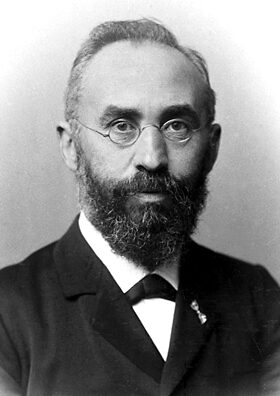
Abraham–Lorentz force
Abraham–Lorentz force is a recoil force on an accelerating charged particle caused by the particle emitting electromagnetic radiation.
All 3 facts, and where they come from
Facts
3 facts · 0 confirmed by two sources · 0 cited · 3 from one source
Where this comes from
Papalocal keeps its own record. It started from these sources; what each one said is kept here as it was copied, so a change on their side never changes this page by itself. Tap one to read its version.
What Wikidata says · copied November 17, 2026 · revision 2547448905
- Described as
- recoil force on an accelerating charged particle caused by the particle emitting electromagnetic radiation
- Other names
- Lorentz–Abraham force, Lorentz force
- What it is
- physical phenomenon
- Named after
- Max Abraham; Hendrik Lorentz
- Wikipedias with a page
- 11
Wikidata item Q253011 (wikidata.org/wiki/Q253011), public domain (CC0). Copied 2026-11-17.
What Wikipedia says · copied November 17, 2026 · revision 1385818993
In the physics of electromagnetism, the Abraham–Lorentz force (also known as the Lorentz–Abraham force) is the reaction force on an accelerating charged particle caused by the particle emitting electromagnetic radiation by self-interaction. It is also called the radiation reaction force, the radiation damping force, or the self-force. It is named after the physicists Max Abraham and Hendrik Lorentz.
The formula, although predating the theory of special relativity, was initially calculated for non-relativistic velocity approximations. It was extended to arbitrary velocities by Max Abraham and was shown to be physically consistent by George Adolphus Schott. The non-relativistic form is called Lorentz self-force while the relativistic version is called the Lorentz–Dirac force or collectively known as Abraham–Lorentz–Dirac force. The equations are in the domain of classical physics, not quantum physics, and therefore may not be valid at distances of roughly the Compton wavelength or below. There are, however, two analogs of the formula that are both fully quantum and relativistic: one is called the "Abraham–Lorentz–Dirac–Langevin equation", the other is the self-force on a moving mirror.
The force is proportional to the square of the object's charge, multiplied by the jerk that it is experiencing. (Jerk is the rate of change of acceleration.) The force points in the direction of the jerk. For example, in a cyclotron, where the jerk points opposite to the velocity, the radiation reaction is directed opposite to the velocity of the particle, providing a braking action. The Abraham–Lorentz force is the source of the radiation resistance of a radio antenna radiating radio waves.
There are pathological solutions of the Abraham–Lorentz–Dirac equation in which a particle accelerates in advance of the application of a force, so-called pre-acceleration solutions. Since this would represent an effect occurring before its cause (retrocausality), some theories have speculated that the equation allows signals to travel backward in time, thus challenging the physical principle of causality. One resolution of this problem was discussed by Arthur D. Yaghjian and was further discussed by Fritz Rohrlich and Rodrigo Medina. Furthermore, some authors argue that a radiation reaction force is unnecessary, introducing a corresponding stress-energy tensor that naturally conserves energy and momentum in Minkowski space and other suitable spacetimes.
From the Wikipedia article “Abraham–Lorentz force” (en.wikipedia.org/wiki/Abraham–Lorentz_force), by its contributors, under CC BY-SA 4.0 (creativecommons.org/licenses/by-sa/4.0/). Copied 2026-11-17; not changed.
Confirmed Two sources agree. Cited One source, and it names where it got it. One source One source, without a reference of its own. Sources disagree The sources disagree. We show the best-supported value and keep theirs below.