
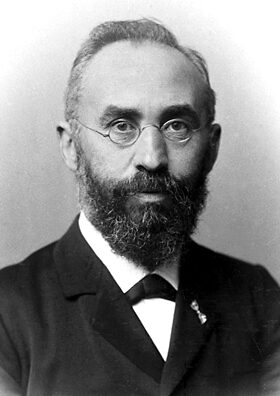
Hendrik Lorentz
Hendrik Lorentz was a Dutch physicist. Born July 18, 1853, in Arnhem. Died February 4, 1928, in Haarlem. Positions held include rector magnificus of Leiden University (1899–1900). Known for Lorentz covariance, Lorentz ether theory and Lorentz factor. Educated at Leiden University. Awards include Nobel Prize in Physics, Pour le Mérite for Sciences and Arts order and Copley Medal.
Facts
55 facts · 2 confirmed by two sources · 17 cited · 36 from one source
Where this comes from
Papalocal keeps its own record. It started from these sources; what each one said is kept here as it was copied, so a change on their side never changes this page by itself. Tap one to read its version.
What Wikidata says · copied November 16, 2026 · revision 2565544643
- Described as
- Dutch physicist (1853–1928)
- Other names
- H.Lorentz, Hendrik Antoon Lorentz, Lorentz, H. A. Lorentz, H.A. Lorentz, Hendrik A. Lorentz
- Born
- July 18, 1853 · 13 references
- Died
- February 4, 1928 · 14 references
- Born in
- Arnhem · 6 references
- Died in
- Haarlem · 5 references
- Buried in
- Algemene Begraafplaats Kleverlaan · 1 reference
- Name at birth
- Hendrik Antoon Lorentz
- Citizen of
- Kingdom of the Netherlands · 1 reference
- Occupation
- theoretical physicist; physicist · 2 references; mathematician · 1 reference; botanist; university teacher · 3 references; curator
- Positions held
- rector magnificus of Leiden University (1899–1900) · 1 reference
- Worked for
- Leiden University (1877–1923) · 1 reference; Teylers Museum (1912–1928) · 1 reference
- Education
- Leiden University (1870–1875) · 1 reference
- Member of
- Royal Society of London (1905–); Academy of Sciences of the USSR; Saint Petersburg Academy of Sciences; French Academy of Sciences; Royal Swedish Academy of Sciences; Royal Netherlands Academy of Arts and Sciences; American Academy of Arts and Sciences; Russian Academy of Sciences; Royal Prussian Academy of Sciences; Accademia Nazionale delle Scienze detta dei XL
- Known for
- Lorentz covariance; Lorentz ether theory; Lorentz factor; Lorentz force; Lorentz group; Lorentz oscillator; Lorentz transformation; length contraction; Lorentz–Lorenz equation; Abraham–Lorentz force
- Awards
- Nobel Prize in Physics (1902) · 2 references; Pour le Mérite for Sciences and Arts order (1908); Copley Medal (1918) · 1 reference; Rumford Medal (1908) · 1 reference; Franklin Medal (1917) · 1 reference; Foreign Member of the Royal Society (1905) · 1 reference; Commander of the Order of Orange-Nassau · 1 reference; Honorary doctor of Leiden University (1900) · 1 reference; Echegaray Medal (1925) · 1 reference; Knight of the Legion of Honour · 1 reference; Knight of the Order of the Netherlands Lion; doctor honoris causa from the University of Paris (1924) · 2 references; honorary member of the Physics Association (Frankfurt am Main, Germany) (1911)
- Field
- theoretical physics
- Spouse
- Aletta Lorentz-Kaiser
- Children
- Geertruida de Haas-Lorentz · 1 reference; Hannie Leemhorst-Lorentz; Rudolf Lorentz
- Wikipedias with a page
- 117
Wikidata item Q41688 (wikidata.org/wiki/Q41688), public domain (CC0). Copied November 16, 2026.
What Wikipedia says · copied November 16, 2026 · revision 1384110844
Hendrik Antoon Lorentz (18 July 1853 – 4 February 1928) was a Dutch theoretical physicist who shared the 1902 Nobel Prize in Physics with Pieter Zeeman for their discovery and theoretical explanation of the Zeeman effect. He derived the Lorentz transformation of the special theory of relativity, as well as the Lorentz force, which describes the force acting on a charged particle in an electromagnetic field. He was also responsible for the Lorentz oscillator model, a classical model used to describe the anomalous dispersion observed in dielectric materials when the driving frequency of the electric field was near the resonant frequency of the material, resulting in abnormal refractive indices.
Lorentz received many other honors and distinctions, including a term as Chairman of the International Committee on Intellectual Cooperation, the forerunner of UNESCO, from 1925 until his death in 1928.
- Born, in its opening lines
- July 18, 1853
- Died, in its opening lines
- February 4, 1928
From the Wikipedia article “Hendrik Lorentz” (en.wikipedia.org/wiki/Hendrik_Lorentz), by its contributors, under CC BY-SA 4.0 (creativecommons.org/licenses/by-sa/4.0/). Copied November 16, 2026; not changed.
Confirmed Two sources agree. Cited One source, and it names where it got it. One source One source, without a reference of its own. Sources disagree The sources disagree. We show the best-supported value and keep theirs below.
