Adagia
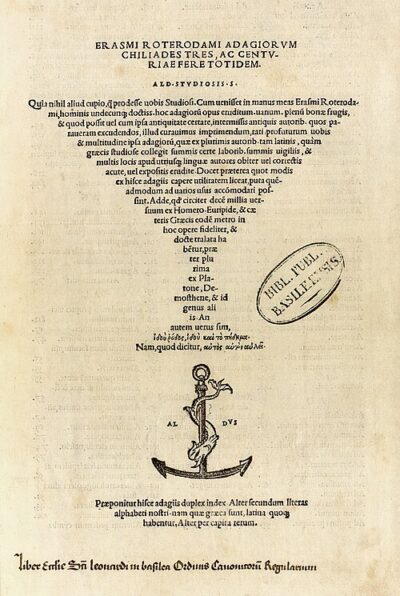
Adagia is a collection of Greek and Latin proverbs, compiled by Erasmus of Rotterdam. It came out in 1500.
- Published
- 1500
- Written by
- Erasmus
All 5 facts, and where they come from
Facts
5 facts · 0 confirmed by two sources · 0 cited · 5 from one source
Where this comes from
Papalocal keeps its own record. It started from these sources; what each one said is kept here as it was copied, so a change on their side never changes this page by itself. Tap one to read its version.
What Wikidata says · copied November 17, 2026 · revision 2550912987
- Described as
- collection of Greek and Latin proverbs, compiled by Erasmus of Rotterdam
- Other names
- Adages, Adagiorum Chiliades Tres, Adagiorum Collectanea, Collectanea Adagiorum, Collectiana Adagiorum
- What it is
- literary work
- Written by
- Erasmus · 1 reference
- Published
- 1500; 1508
- Language
- Latin · 1 reference; Neo-Latin · 1 reference
- Wikipedias with a page
- 14
Wikidata item Q346677 (wikidata.org/wiki/Q346677), public domain (CC0). Copied 2026-11-17.
What Wikipedia says · copied November 17, 2026 · revision 1384745191
Adagia (singular adagium) is the title of an annotated collection of Greek and Latin proverbs, compiled during the Renaissance by Dutch humanist Desiderius Erasmus Roterodamus. Erasmus' repository of proverbs is "one of the most monumental ... ever assembled" (Speroni, 1964, p. 1).
The first edition, titled Collectanea Adagiorum, was published in Paris in 1500, in a slim quarto of around eight hundred entries. By 1508, after his stay in Italy, Erasmus had expanded the collection (now called Adagiorum chiliades tres or "Three thousands of proverbs") to over 3,000 items, many accompanied by richly annotated commentaries, some of which were brief essays on political and moral topics. The work continued to expand right up to the author's death in 1536 (to a final total of 4,151 entries), confirming the fruit of Erasmus' vast reading in ancient literature.
From the Wikipedia article “Adagia” (en.wikipedia.org/wiki/Adagia), by its contributors, under CC BY-SA 4.0 (creativecommons.org/licenses/by-sa/4.0/). Copied 2026-11-17; not changed.
Confirmed Two sources agree. Cited One source, and it names where it got it. One source One source, without a reference of its own. Sources disagree The sources disagree. We show the best-supported value and keep theirs below.
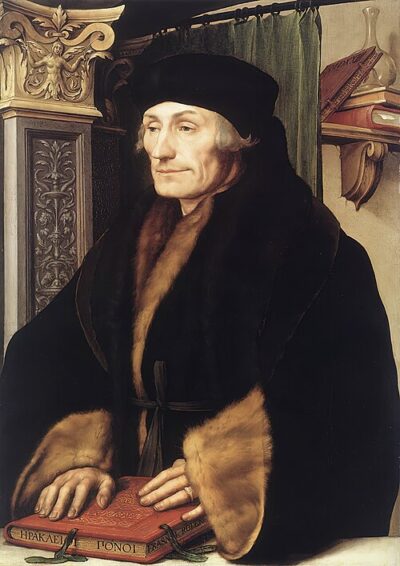
Picture: Desiderius Erasmus, via Wikimedia Commons · Public domain