
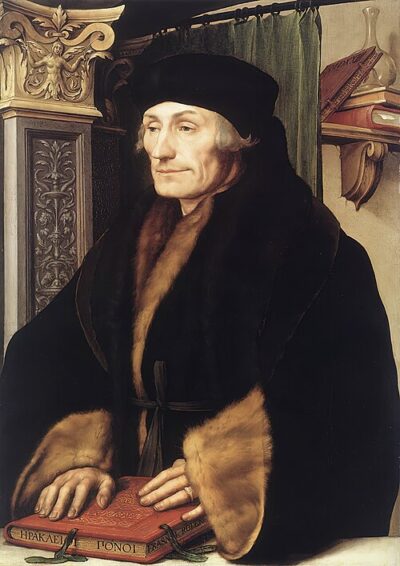
Erasmus
Erasmus was a Dutch Renaissance humanist, Catholic priest, and theologian. Born October 28, 1466, in Rotterdam. Died July 12, 1536, in Basel. Known for In Praise of Folly, A handbook on manners for children and The Education of a Christian Prince. Educated at University of Paris and Queens' College.
Facts
33 facts · 0 confirmed by two sources · 10 cited · 23 from one source
Where this comes from
Papalocal keeps its own record. It started from these sources; what each one said is kept here as it was copied, so a change on their side never changes this page by itself. Tap one to read its version.
What Wikidata says · copied November 16, 2026 · revision 2568733231
- Described as
- Dutch Renaissance humanist, Catholic priest, and theologian (1466-1536)
- Other names
- Erasmus of Rotterdam, Desiderius Erasmus of Rotterdam, Erasmus Rotterdam, Erasmus Von Rotterdam Erasmus, Erasmus von Rotterdam, Desiderius Erasmus Roterodamus, Gerrit Gerritszoon, Desiderius Erasmus von Rotterdam
- Born
- October 28, 1466 · 2 references
- Died
- July 12, 1536 · 3 references
- Born in
- Rotterdam · 3 references
- Died in
- Basel · 2 references
- Buried in
- Basel Minster
- Cause of death
- dysentery · 1 reference
- Citizen of
- Seventeen Provinces
- Occupation
- translator · 1 reference; philosopher · 1 reference; theologian · 4 references; essayist; Bible translator; writer · 3 references; latinist; Latin Catholic priest
- Worked for
- Old University of Leuven
- Education
- University of Paris (1495–); Queens' College; University of Cambridge; University of Turin · 1 reference; Collège de Montaigu · 1 reference; City Gymnasium
- Known for
- In Praise of Folly; A handbook on manners for children; The Education of a Christian Prince; Adagia; Familiar Colloquies; De capienda ex inimicis utilitate
- Field
- Christian philosophy; renaissance humanism
- Siblings
- Pieter Gerard · 1 reference
- Religion
- Catholic Church
- Lived in
- Erasmus House (1521)
- Wikipedias with a page
- 156
Wikidata item Q43499 (wikidata.org/wiki/Q43499), public domain (CC0). Copied November 16, 2026.
What Wikipedia says · copied November 16, 2026 · revision 1385568313
Desiderius Erasmus Roterodamus ( DEZ-i-DEER-ee-əs irr-AZ-məs; Dutch: [ˌdeːziˈdeːrijʏs eːˈrɑsmʏs]; 28 October c. 1466 – 12 July 1536), commonly known in English as Erasmus of Rotterdam or simply Erasmus, was a Dutch humanist, theologian, and philosopher. He was, through his writings and translations, one of the most influential scholars of the Northern Renaissance and a major figure of Western culture.
Erasmus was an important figure in Renaissance classical scholarship who wrote in a spontaneous, copious and correct but natural Latin style. As a Catholic priest developing humanist techniques for working on texts, he prepared pioneering new Latin and Greek scholarly editions of the New Testament and of the Church Fathers, with annotations and commentary that were immediately and vitally influential in both the Protestant Reformation and the Catholic Reformation. He also wrote On Free Will, The Praise of Folly, The Complaint of Peace, Handbook of a Christian Knight, On Civility in Children, Copia: Foundations of the Abundant Style and many other academic, popular and pedagogical works.
Erasmus lived against the backdrop of the growing European religious reformations and relocated regularly. He influenced a large circle of friends, scholars and correspondents including kings and popes. He developed a biblical humanistic theology in which he advocated the religious and civil necessity both of peaceable concord and of pastoral tolerance on matters of indifference. He remained a member of the Catholic Church all his life, remaining committed to reforming the church from within, but faced dangerous pushback from some university theologians. He promoted what he understood as the traditional doctrine of synergism, which some prominent reformers such as Martin Luther and John Calvin rejected in favour of the doctrine of monergism. His influential middle-road approach disappointed, and even angered, partisans in both camps.
From the Wikipedia article “Erasmus” (en.wikipedia.org/wiki/Erasmus), by its contributors, under CC BY-SA 4.0 (creativecommons.org/licenses/by-sa/4.0/). Copied November 16, 2026; not changed.
Confirmed Two sources agree. Cited One source, and it names where it got it. One source One source, without a reference of its own. Sources disagree The sources disagree. We show the best-supported value and keep theirs below.
